

Picture Comprehension for Class 4 English
Picture comprehension for Class 4 is an engaging activity that helps children observe images carefully, understand details, and answer questions based on what they see. It develops observation, reading, thinking, and communication skills in a fun and interactive way.
In picture comprehension exercises, students study a picture and answer questions related to the people, objects, actions, and events shown in it. These activities encourage children to think critically and express their ideas using complete sentences.
Table of Contents
- What is Picture Comprehension?
- Points to Follow While Doing Picture Comprehension
- Examples of Picture Comprehension with Questions and Answers
- Why is Picture Comprehension Important?
- Common Mistakes to Avoid
- Frequently Asked Questions on Picture Comprehension for Class 4

What is Picture Comprehension?
Picture comprehension is an activity where you look at the picture for details and then answer some simple questions about the picture. The simple questions are usually based on who, what, where, why, etc. The questions in picture comprehension exercises are usually simple and based on the classic 'WH' question words: 'Who', 'What', 'Where', 'When', 'Why', and 'How'. This structure helps children develop the habit of looking at a picture from multiple angles and thinking beyond what is immediately obvious.
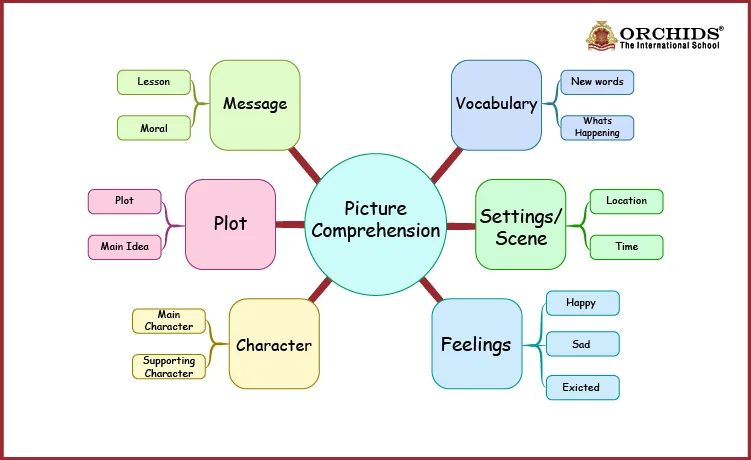
For Class 4 students, picture comprehension typically involves:
- Identifying the main characters or people in the picture
- Describing the setting or location
- Understanding the actions and events taking place
- Making simple inferences about the mood, time of day, or occasion
- Forming complete, grammatically correct sentences in response
Points to Follow While Doing Picture Comprehension
- Observe the picture carefully and try to get the main idea about it.
- Notice the setting or surroundings of the picture. Try to comprehend where the story took place.
- Try to look at the picture and notice who the main character is or how many characters are present in the picture.
- It is very important to observe and see what action is happening in the picture.
- Ask yourself questions about the picture and use simple sentences to describe what is present or happening in the picture.
- Avoid adding irrelevant details in your answer.
Examples of Picture Comprehension with Questions and Answers
Example 1:
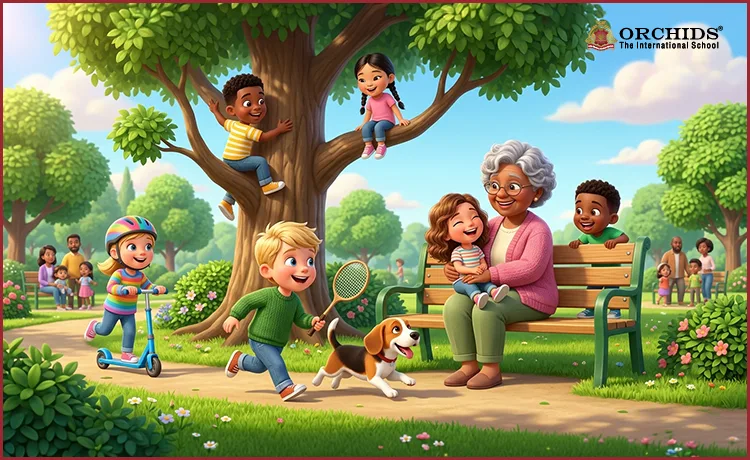
Some questions you might find in the picture comprehension are as follows:
- Where are the children playing?
Answer: The children are playing in the park. - How many children are playing?
Answer: Six children are playing. - How many are reading?
Answer: One child is reading a book with her grandmother. - What activities are happening in the picture?
Answer: The picture is of a park where an old lady is sitting with a girl, and both of them are reading a book. There is a boy behind the bench who is probably trying to hide. The two children are climbing up the tree. There is a girl who is riding her bike, and a boy with a pet is running behind her.
Example 2:
Carefully observe the picture and try to understand the context behind it.
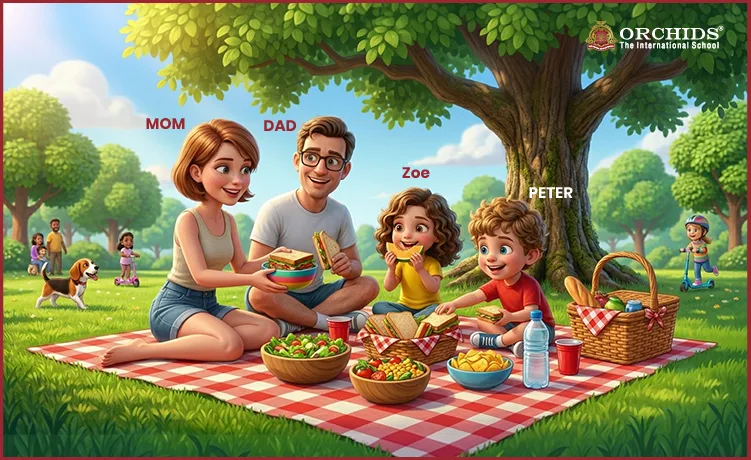
Questions:
- Who is in the picture?
- What are the children’s names?
- What time is it?
- What did they put on the ground?
- Do you think it is a holiday?
- What are they eating?
- Give a suitable title to the picture.
Answer:
- There is a family in the picture.
- The name of the girl is Zoe, and the boy is Peter.
- It is a pleasant morning.
- They had put a mat on the ground for food and refreshments.
- Yes, it can be a holiday.
- They are eating sandwiches, salad, and chips.
- A picnic day.
Why is Picture Comprehension Important?
- Learning to spot details from a picture can help you get ready for reading comprehension.
- Picture comprehension allows children to decipher the meaning of a picture, and they can use simple sentences to describe what is happening in the picture. It improves their observation and creative skill.
- It’s a great activity to start understanding beyond text.
- Picture comprehension is all about understanding comprehension and retaining information.
- It helps you to give an insight into what the author believes, visualise the context of the text and learn the specific vocabulary.
Common Mistakes to Avoid
- Vague answers: Saying "People are there" instead of "A grandmother and her granddaughter are sitting on a bench" loses marks. Be specific.
- Incomplete sentences: Always write full sentences, not fragments or single words.
- Adding irrelevant information: Stick to what the picture actually shows. Do not invent details that are not present.
- Ignoring part of the question: Read every question fully. Sometimes questions have two parts (e.g., "What are they doing and where are they?").
- Rushing through the picture: Spend adequate time observing before you write. A missed detail can mean a wrong answer.
- Repeating the question in the answer: Get straight to the point. Instead of "The answer to who is in the picture is that there is a family," simply write "There is a family in the picture."
Strong language skills open doors well beyond the classroom, shaping how confidently a child reads, writes and expresses ideas. If you want to know more about how Orchids The International School builds these skills through its English curriculum, get in touch with our admissions team.
Frequently Asked Questions on Picture Comprehension for Class 4
1. What is picture comprehension for Class 4?
Picture comprehension is an activity in which students observe a picture carefully and answer questions based on the details shown in the image. It helps improve observation, understanding, and communication skills.
2. What types of questions are asked in picture comprehension?
Picture comprehension questions are usually based on WH-question words: Who, What, Where, When, Why, and How. For example, who is in the picture? What are they doing? Where is the scene set? Some questions may also ask students to give a suitable title to the picture or describe the overall scene.
3. What are the common mistakes students make in picture comprehension?
Common mistakes include giving vague or one-word answers, writing incomplete sentences, adding irrelevant details not shown in the picture, rushing through observation, and missing parts of a question.
Related Links


Admissions Open for 2026-27
What type of concept pages would you prefer?
CBSE Schools In Popular Cities
- CBSE Schools in Bangalore
- CBSE Schools in Mumbai
- CBSE Schools in Pune
- CBSE Schools in Hyderabad
- CBSE Schools in Chennai
- CBSE Schools in Gurgaon
- CBSE Schools in Kolkata
- CBSE Schools in Indore
- CBSE Schools in Sonipat
- CBSE Schools in Delhi
- CBSE Schools in Rohtak
- CBSE Schools in Bhopal
- CBSE Schools in Aurangabad
- CBSE Schools in Jabalpur
- CBSE Schools in Jaipur
- CBSE Schools in Jodhpur
- CBSE Schools in Nagpur
- CBSE Schools in Ahmednagar
- CBSE School In Tumkur











Orchids The International School is one of India's leading chains of CBSE and ICSE schools, with 130+ schools across the country.