

Use of ‘A’, ‘An’ and ‘The’ for Class 3: Definition, Rules and Examples
Articles are an important part of English grammar that help students understand how nouns are identified and used in sentences. They make communication clearer by showing whether we are talking about something general or specific. In Class 3 English, learning a, an, and the helps students build strong sentence formation skills and improves reading and writing ability. These small words play a big role in making English meaningful and correct.
In this guide, you will learn definitions, types, rules, usage, exceptions, common mistakes, and practical examples of articles.
Table of Contents
- What are Articles in English Grammar for Class 3?
- Definition of Articles
- Types of Articles
- Common Mistakes with Articles
- Advanced Usage Rules of Articles
- Exceptions in Articles
- Importance of Articles in English Learning
- Frequently Asked Questions on the Use of ‘a, an, and the’ for Class 3

What are Articles in English Grammar for Class 3?
Articles are words used before nouns to show whether the noun is specific or general. They help readers understand whether we are talking about one particular thing or any random thing from a group.
English has three articles:
-
A
-
An
-
The
-
A / An → used for general or non-specific things
-
The → used for specific things
-
I saw a dog (any dog, not specific)
-
I saw the dog (a specific dog we already know)
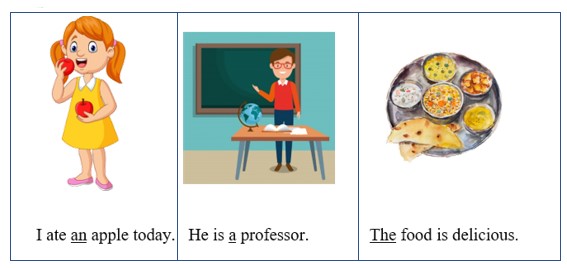
Definition of Articles
- Articles are words that are used before nouns.
- The three articles used in English are ‘a’, ‘an’, and ‘the’.
- They show whether a noun is singular or specific.
Example:
-
A boy is playing.
-
An apple is on the table.
-
The sun rises in the east.
The main function of articles is to tell whether we are referring to something general or something specific.
Types of Articles
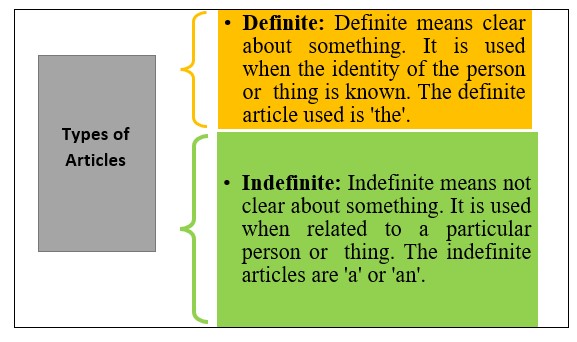
Usage of Indefinite Articles
- The indefinite article ("a" or "an") is used with singular countable noun that is specific or unknown.
- Would you buy me a pen from that shop? (‘a’ is used before a consonant)
- I want to buy an umbrella. (‘an’ is used before a vowel)
In the above example, it cannot be identified which pen or umbrella the speaker is talking about, it could be any type irrespective of color, brand or price, or quality. So an indefinite article ‘a’ or ‘an’ is used.
-
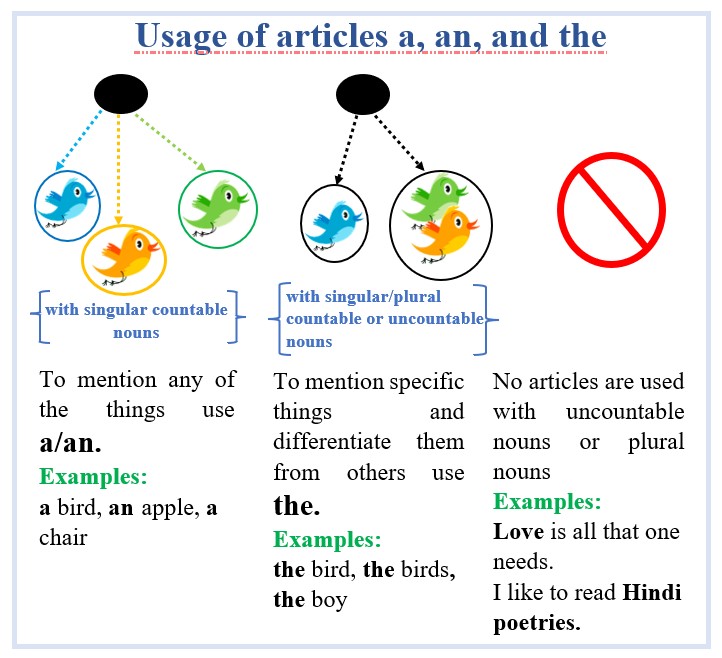
The article ‘a’ is used before singular nouns that start with a consonant sound. For instance, a boy, a table.
3. The article ‘an’ is used before singular nouns that start with a vowel sound. For instance, an apple, an umbrella.
4. The articles ‘a’ or ‘an’ is used when a singular countable noun is mentioned for the first time.
Usage of the Definite Article
-
The definite article ‘the’ is used when the reader knows what specific noun the speaker talks about.
-
It is used before a singular or plural noun.
-
The article is also used before the name of oceans and planets.
-
Common Mistakes with Articles
You often make errors while using articles because English does not always follow direct or simple rules. Articles depend on sound, context, and specificity, which makes them confusing at the beginner level. Understanding these mistakes helps improve both writing accuracy and spoken fluency.
Wrong article with professions-
I am a architect (Incorrect)
-
I am an architect (Correct)
The word “architect” begins with a vowel word or sound (/a/ sound), so the correct article is “an”, not “a”. In English, sound matters more than spelling.
-
She is busy woman (Incorrect)
-
She is a busy woman (Correct)
A singular countable noun (“woman”) must have an article or determiner. When describing someone with an adjective, we still need “a/an” before the adjective + noun combination.
-
I am going to library (Incorrect)
-
I am going to the library (Correct)
Public places like school, hospital, library, and market usually take “the” when we refer to a specific or known place. Without “the,” the sentence becomes grammatically incomplete in standard English usage.
-
She is best player (incorrect)
-
She is the best player (Correct)
Superlative adjectives like best, tallest, fastest show the highest degree of comparison, and English grammar requires the definite article “the” before them.
Advanced Usage Rules of Articles
Articles are not only grammar rules, they also depend on conceptual clarity: generalization, uniqueness, and classification.
No article with plural general nounsWhen we talk about things in general, no article is needed because we are not referring to a specific object.
-
I like apples (all apples in general, not specific ones)
-
Children need care and attention
Zero article is used when nouns represent a whole category or idea, not an individual item.
-
I live in India
-
We visited Paris
Proper nouns such as most countries and cities are already unique identifiers, so articles are unnecessary.
Certain geographical names always require “the” because they represent collective or descriptive entities rather than single names.
-
Mountain ranges → the Himalayas
-
Rivers → the Ganga
-
Island groups → the Bahamas
-
Countries with political structure → the United States, the United Kingdom
“The” is used when the name represents a system, group, or collective region, not a single unit.
Exceptions in Articles
English grammar includes exceptions because article usage depends on semantic meaning (what the noun represents) rather than fixed rules.
Geographical exceptions with “the”We use “the” when the noun refers to:
-
Mountain ranges → the Himalayas
-
Rivers → the Ganga / the Nile
-
Oceans and seas → the Pacific Ocean
These are treated as natural formations with identity or collective existence, not individual objects.
Unique universal objects-
the Sun
-
the Moon
-
the Earth
Reason:
These are considered unique celestial bodies, and English treats uniqueness as a reason to use “the”.
Importance of Articles in English Learning
Articles may look like small grammar words, but they play a structural role in sentence meaning and clarity. Without articles, sentences may become vague or grammatically incomplete.
Key linguistic importance:-
They define specific vs general meaning
-
They help in sentence accuracy and fluency
-
They improve spoken English naturalness
-
They build foundation for advanced grammar topics like determiners and noun phrases.
Strong language skills open doors well beyond the classroom, shaping how confidently a child reads, writes and expresses ideas. If you want to know more about how Orchids The International School builds these skills through its English curriculum, get in touch with our admissions team.
Frequently Asked Questions on the Use of ‘a, an, and the’ for Class 3
1. What are articles in English grammar for Class 3?
Articles are small words like a, an, and the used before nouns to show whether something is general or specific.
2. What is the difference between A, An, and The?
A and An are used for general nouns, while The is used for specific nouns that are already known.
3. When do we use A and An?
We use a before consonant sounds and an before vowel sounds, especially when mentioning something for the first time.
4. When should we use The in sentences?
We use the when talking about a specific person, place, or thing that is already known to the speaker and listener.
5. What are common mistakes in using articles?
Common mistakes include using the wrong article with professions, missing articles before singular nouns, and incorrect usage with superlative adjectives.
6. Why are articles important for students?
Articles help students form correct sentences, improve grammar, and communicate clearly in both speaking and writing.
Related Links


Admissions Open for 2026-27
What type of concept pages would you prefer?
CBSE Schools In Popular Cities
- CBSE Schools in Bangalore
- CBSE Schools in Mumbai
- CBSE Schools in Pune
- CBSE Schools in Hyderabad
- CBSE Schools in Chennai
- CBSE Schools in Gurgaon
- CBSE Schools in Kolkata
- CBSE Schools in Indore
- CBSE Schools in Sonipat
- CBSE Schools in Delhi
- CBSE Schools in Rohtak
- CBSE Schools in Bhopal
- CBSE Schools in Aurangabad
- CBSE Schools in Jabalpur
- CBSE Schools in Jaipur
- CBSE Schools in Jodhpur
- CBSE Schools in Nagpur
- CBSE Schools in Ahmednagar
- CBSE School In Tumkur











Orchids The International School is one of India's leading chains of CBSE and ICSE schools, with 110+ schools across the country.