

Usage of I, You, We, and They in English Grammar for Class 1
Pronouns are an important part of English grammar that help us avoid repeating nouns again and again. In Class 1 English, students begin learning simple pronouns like I, You, We, and They because they are commonly used in daily communication. These words make sentences shorter, clearer, and more natural to speak and write.
In this learning concept, you will und erstand how pronouns replace names, how they are used in different situations, and how they change based on whether we are talking about one person or many people. By the end of this lesson, you will be able to use pronouns confidently in real-life sentences and simple conversations.
Table of Contents
- What are Pronouns and Why Do We Use I, You, We, They?
- What is the Exception in Using ‘You’?
- Why are Pronouns Important for Class 1 English?
- How is the Pronoun ‘I’ Used in Sentences?
- How is the Pronoun ‘You’ Used in Sentences?
- How is the Pronoun ‘We’ Used in Sentences?
- How is the Pronoun ‘They’ Used in Sentences?
- Common Mistakes You Should Avoid
- Quick Revision Table
- Frequently Asked Questions on Use of I, You, We, and They

What are Pronouns and Why Do We Uses I, You, We, They?
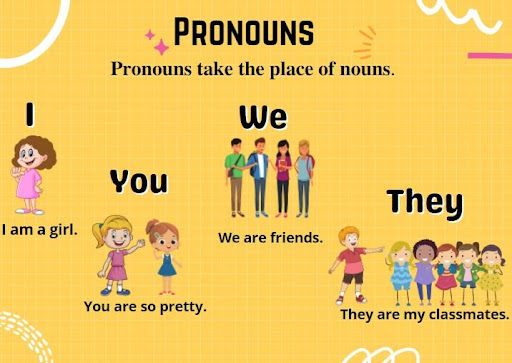
Pronouns are words that replace nouns in a sentence. Instead of repeating names like “Ravi,” “Sita,” or “the children,” we use pronouns to make sentences smooth and easy to understand.
In early English learning, I, You, We, and They are introduced because they are the most frequently used pronouns in daily speech.
Why pronouns are important:
-
They reduce repetition in sentences
-
They make speaking and writing faster
-
They help in forming natural conversations
-
They improve storytelling skills in children
For example:
Instead of saying “Ravi and I are going to Ravi’s school,” we say “We are going to school.”
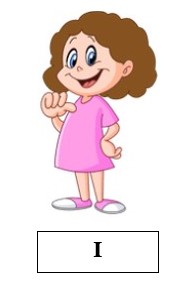
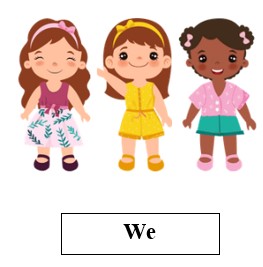
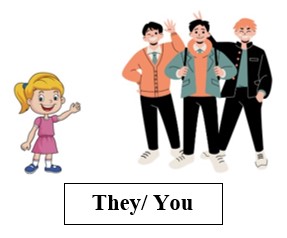
How is the Pronoun ‘I’ Used in Sentences?
- ‘I’ is a singular pronoun. We use ‘I’ to refer to what the speaker is doing or what the speaker talks about herself or himself in a sentence.
- When we talk about ourselves, we don’t take our names. Instead of that, we use ‘I’.
Example:

In this sentence, the speaker says that he is a cook. It means he is describing himself by using the word ‘I’.
How is the Pronoun ‘You’ Used in Sentences?
We use the pronoun ‘you’ when we speak directly to another person. In the example below, the speaker is giving a compliment directly to another person standing next to her. Instead of taking her name, she used the pronoun ‘you’.

How is the Pronoun ‘We’ Used in Sentences?
Pronouns that replace more than one noun are called plural pronouns. ‘We’ is a plural pronoun. ‘We’ is used to talk about a group of people that includes the speaker or the writer.
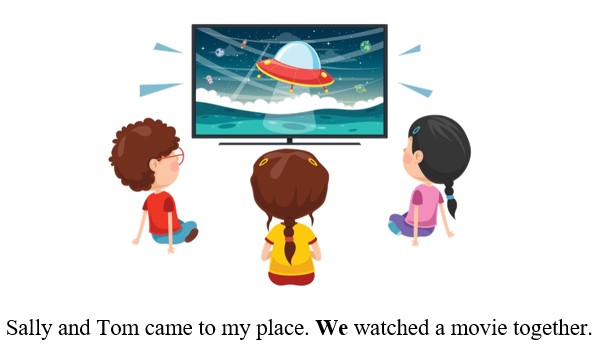
Here, the speaker is talking about herself and her friends Sally and Tom. Instead of repeating the proper nouns Sana and Tom, the speaker used ‘we’.
How is the Pronoun ‘They’ Used in Sentences?
We use the pronoun ‘they’ when we describe other persons. It replaces more than one noun. So, whenever the sentence is refering to more than one thing or person, we use ‘they’.
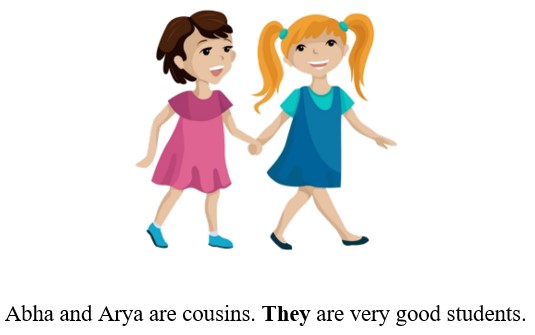
‘They’ replaced the two proper nouns ‘Abha’ and ‘Arya’.
What is the Exception in Using ‘You’?
The pronoun “you” is special because it can be used for both singular and plural forms.
It depends on how many people are being spoken to.
Examples:-
Ravi, you are late. (one person)
-
You all are invited to the party. (many people)
-
You are doing a great job. (general use)
“You” always stays the same in spelling even when used for one or many people.
Strong language skills open doors well beyond the classroom, shaping how confidently a child reads, writes and expresses ideas. If you want to know more about how Orchids The International School builds these skills through its English curriculum, get in touch with our admissions team.
Frequently Asked Questions on Use of I, You, We, and They
1. What are pronouns like I, You, We, and They?
Pronouns are words used instead of nouns (names). I, You, We, and They help us talk about people without repeating their names again and again.
2. When do we use “I” in a sentence?
We use “I” when we talk about ourselves.
Example:
I am going to school.
3. What is the correct use of “You”?
We use “You” when speaking directly to another person. It can be used for one person or many people.
Example:
You are my friend.
4. When do we use “We”?
We use “We” when talking about a group that includes the speaker.
Example:
We are playing together.
5. When is “They” used?
We use “They” when talking about more than one person or thing, but the speaker is not included.
Example:
They are reading books.
6. Can “You” be singular and plural?
Yes, “You” can refer to one person or many people depending on the situation.
Example:
You are late. / You all are welcome.
Related Links


Admissions Open for 2026-27
What type of concept pages would you prefer?
CBSE Schools In Popular Cities
- CBSE Schools in Bangalore
- CBSE Schools in Mumbai
- CBSE Schools in Pune
- CBSE Schools in Hyderabad
- CBSE Schools in Chennai
- CBSE Schools in Gurgaon
- CBSE Schools in Kolkata
- CBSE Schools in Indore
- CBSE Schools in Sonipat
- CBSE Schools in Delhi
- CBSE Schools in Rohtak
- CBSE Schools in Bhopal
- CBSE Schools in Aurangabad
- CBSE Schools in Jabalpur
- CBSE Schools in Jaipur
- CBSE Schools in Jodhpur
- CBSE Schools in Nagpur
- CBSE Schools in Ahmednagar
- CBSE School In Tumkur











Orchids The International School is one of India's leading chains of CBSE and ICSE schools, with 130+ schools across the country.