

Table of 161
The Table of 161 highlights how this number grows when multiplied with increasing whole numbers. Each new multiple shows a steady rise of 161, helping students recognise number patterns and strengthen multiplication skills. This table is useful for solving bigger calculations, bulk totals, and maths problems that require repeated groups. A Table of 161 PDF is available for easy downloading and consistent practice.
Table of 161 Chart
The Table of 161 chart shows the complete set of multiples formed by multiplying 161 with whole numbers. As students go through the chart, they can easily notice how each value increases by 161. It is useful for quick checks, classroom learning, and regular revision.
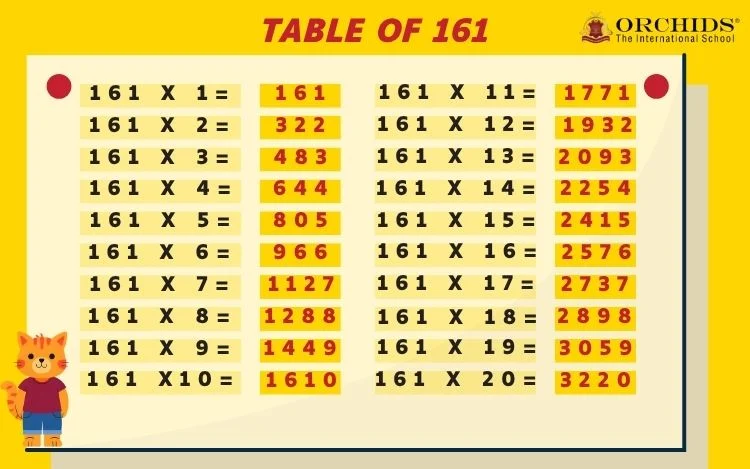

Multiplication Table of 161
The multiplication table of 161 shows how the number 161 forms larger results when multiplied by whole numbers. Each step in the table highlights how the value grows, helping learners understand the increasing totals produced by repeated multiplication with 161.
| Multiplicand | Operation | Multiplier | Result | |
| 161 | x | 1 | = | 161 |
| 161 | x | 2 | = | 322 |
| 161 | x | 3 | = | 483 |
| 161 | x | 4 | = | 644 |
| 161 | x | 5 | = | 805 |
| 161 | x | 6 | = | 966 |
| 161 | x | 7 | = | 1127 |
| 161 | x | 8 | = | 1288 |
| 161 | x | 9 | = | 1449 |
| 161 | x | 10 | = | 1610 |
| 161 | x | 11 | = | 1771 |
| 161 | x | 12 | = | 1932 |
| 161 | x | 13 | = | 2093 |
| 161 | x | 14 | = | 2254 |
| 161 | x | 15 | = | 2415 |
| 161 | x | 16 | = | 2576 |
| 161 | x | 17 | = | 2737 |
| 161 | x | 18 | = | 2898 |
| 161 | x | 19 | = | 3059 |
| 161 | x | 20 | = | 3220 |
Download the Table of 161 PDF to keep the full set of multiples handy for regular study and quick revision.
Know more about related topics:
Download PDF - Table of 161
How do you read the multiplication table of 161?
To read the table of 161, think of each result as the total formed when 161 is taken several times. Start with one group of 161, then two groups, then three, and continue. This helps you understand how the number expands through repeated grouping.
161 times 1 equals 161
161 times 2 equals 322
161 times 3 equals 483
161 times 4 equals 644
161 times 5 equals 805
161 times 6 equals 966
161 times 7 equals 1127
161 times 8 equals 1288
161 times 9 equals 1449
161 times 10 equals 1610
161 times 11 equals 1771
161 times 12 equals 1932
161 times 13 equals 2093
161 times 14 equals 2254
161 times 15 equals 2415
161 times 16 equals 2576
161 times 17 equals 2737
161 times 18 equals 2898
161 times 19 equals 3059
161 times 20 equals 3220
Table of 161 in Words
The Table of 161 in Words expresses every multiplication fact as a sentence, allowing learners to read each result clearly. This format supports a better understanding of how 161 grows with every step from 1 to 20.
One hundred sixty-one times one equals one hundred sixty-one
One hundred sixty-one times two equals three hundred twenty-two
One hundred sixty-one times three equals four hundred eighty-three
One hundred sixty-one times four equals six hundred forty-four
One hundred sixty-one times five equals eight hundred five
One hundred sixty-one times six equals nine hundred sixty-six
One hundred sixty-one times seven equals one thousand one hundred twenty-seven
One hundred sixty-one times eight equals one thousand two hundred eighty-eight
One hundred sixty-one times nine equals one thousand four hundred forty-nine
One hundred sixty-one times ten equals one thousand six hundred ten
One hundred sixty-one times eleven equals one thousand seven hundred seventy-one
One hundred sixty-one times twelve equals one thousand nine hundred thirty-two
One hundred sixty-one times thirteen equals two thousand ninety-three
One hundred sixty-one times fourteen equals two thousand two hundred fifty-four
One hundred sixty-one times fifteen equals two thousand four hundred fifteen
One hundred sixty-one times sixteen equals two thousand five hundred seventy-six
One hundred sixty-one times seventeen equals two thousand seven hundred thirty-seven
One hundred sixty-one times eighteen equals two thousand eight hundred ninety-eight
One hundred sixty-one times nineteen equals three thousand fifty-nine
One hundred sixty-one times twenty equals three thousand two hundred twenty
Table of 161 Using Repeated Addition
The Table of 161 grows by adding 161 step by step. Each new total comes from increasing the previous one by 161, showing how the number rises steadily. This method helps you follow the pattern of equal jumps throughout all its multiples.
|
Multiplication |
Repeated Addition |
Result |
|
161 × 1 |
161 |
161 |
|
161 × 2 |
161 + 161 |
322 |
|
161 × 3 |
161 + 161 + 161 |
483 |
|
161 × 4 |
161 + 161 + 161 + 161 |
644 |
|
161 × 5 |
161 + 161 + 161 + 161 + 161 |
805 |
|
161 × 6 |
161 + 161 + 161 + 161 + 161 + 161 |
966 |
|
161 × 7 |
161 + 161 + 161 + 161 + 161 + 161 + 161 |
1127 |
|
161 × 8 |
161 + 161 + 161 + 161 + 161 + 161 + 161 + 161 |
1288 |
|
161 × 9 |
161 + 161 + 161 + 161 + 161 + 161 + 161 + 161 + 161 |
1449 |
|
161 × 10 |
161 + 161 + 161 + 161 + 161 + 161 + 161 + 161 + 161 + 161 |
1610 |
Solved Problems on Table of 161
1. A printer prints 161 pages per hour. How many pages will it print in 12 hours?
Each hour, the printer prints 161 pages. Multiply the pages per hour by 12 to find the total.
161 × 12 = 1932
1932 pages
2. A shop sells 161 products per day. How many products will it sell in 9 days?
Each day, the shop sells 161 products. Multiply the daily sales by 9 to find the total.
161 × 9 = 1449
1449 products
3. A factory produces 161 units daily. How many units will it produce in 15 days?
Multiply the daily production by 15 to get the total units.
161 × 15 = 2415
2415 units
4. Each of 13 classrooms has 161 chairs. What is the total number of chairs?
Multiply the number of chairs per classroom by 13 to find the total.
161 × 13 = 2093
2093 chairs
5. A company hires 161 employees for each of 20 branches. How many employees are there in total?
Multiply the employees per branch by 20 to find the total employees.
161 × 20 = 3220
3220 employees
Learn More Multiplication Tables
Numbers make sense when they're taught right. To see how Orchids The International School turns Maths from intimidating to intuitive, reach out to our admissions team.
Frequently Asked Questions on Table of 161
1. What is the table of 161?
The table of 161 shows the results of multiplying 161 by natural numbers (1, 2, 3, …). It helps students understand how 161 increases step by step and is useful for solving multiplication problems.
2. What are the first five multiples of 161?
The first five multiples of 161 are: 161, 322, 483, 644, 805.
3. Are there any real-life applications for the table of 161?
Yes, it can be used to calculate the total number of pages printed, products produced, chairs in classrooms, or employees in multiple branches when each unit has 161 items.
4. How can the multiples of 161 be calculated quickly?
Multiply 161 by consecutive whole numbers to get the multiples. For example, 161 × 1 = 161, 161 × 2 = 322, 161 × 3 = 483, and so on.
5. Why is it helpful to memorize the table of 161?
Memorizing the table makes it easier to solve large multiplication problems, helps recognize number patterns, and allows faster calculations in daily arithmetic tasks.
Related Links


Admissions Open for 2026-27
What type of concept pages would you prefer?
CBSE Schools In Popular Cities
- CBSE Schools in Bangalore
- CBSE Schools in Mumbai
- CBSE Schools in Pune
- CBSE Schools in Hyderabad
- CBSE Schools in Chennai
- CBSE Schools in Gurgaon
- CBSE Schools in Kolkata
- CBSE Schools in Indore
- CBSE Schools in Sonipat
- CBSE Schools in Delhi
- CBSE Schools in Rohtak
- CBSE Schools in Bhopal
- CBSE Schools in Aurangabad
- CBSE Schools in Jabalpur
- CBSE Schools in Jaipur
- CBSE Schools in Jodhpur
- CBSE Schools in Nagpur
- CBSE Schools in Ahmednagar
- CBSE School In Tumkur











Orchids The International School is one of India's leading chains of CBSE and ICSE schools, with 110+ schools across the country.