

Table of 29
Table of 29 helps students master multiplication using repeated addition. Each multiple can be calculated by adding 29 repeatedly or multiplying directly. For example, 5 × 29 = 145, which is the same as 29 + 29 + 29 + 29 + 29. Practising the table from 1 to 20 helps learners recognise patterns, improve calculation speed, and gain confidence in solving maths problems. A PDF of the Table of 29 is available for download, making it easy to revise anytime.
Table of 29 chart
Table of 29 chart displays the 29 times table in a simple graphical format that helps students understand how each multiple is formed. As they move from 29 × 1 to 29 × 20, they can see how the value grows steadily by 29 each time. This chart is especially helpful for quick learning, revision, and building confidence in solving multiplication-based problems.
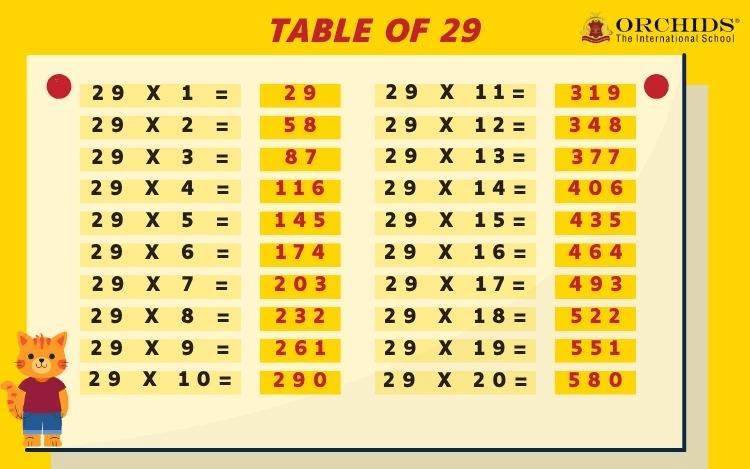

Multiplication Table of 29
Multiplication Table of 29 lists all the multiples formed when 29 is multiplied by natural numbers. It highlights how each step increases by 29, making it easier for students to see patterns and build strong mental maths skills. Regular practice of this table supports quick problem-solving and helps learners handle larger numbers more comfortably.
| Multiplicand | Operation | Multiplier | Result | |
| 29 | x | 1 | = | 29 |
| 29 | x | 2 | = | 58 |
| 29 | x | 3 | = | 87 |
| 29 | x | 4 | = | 116 |
| 29 | x | 5 | = | 145 |
| 29 | x | 6 | = | 174 |
| 29 | x | 7 | = | 203 |
| 29 | x | 8 | = | 232 |
| 29 | x | 9 | = | 261 |
| 29 | x | 10 | = | 290 |
| 29 | x | 11 | = | 319 |
| 29 | x | 12 | = | 348 |
| 29 | x | 13 | = | 377 |
| 29 | x | 14 | = | 406 |
| 29 | x | 15 | = | 435 |
| 29 | x | 16 | = | 464 |
| 29 | x | 17 | = | 493 |
| 29 | x | 18 | = | 522 |
| 29 | x | 19 | = | 551 |
| 29 | x | 20 | = | 580 |
Strengthen your multiplication skills with the 29 times table. Get the free Table of 29 PDF to revise the multiples whenever you need.
Know more about related topics:
Download PDF - Table of 29
How do you read the table of 29?
The 29 times table can be read by observing how every step jumps by 29. Begin with 29 × 1 = 29, then continue with 29 × 2 = 58, 29 × 3 = 87, etc. Saying the table aloud helps learners recognise the steady increase and strengthens their number sense, making it easier to use the multiples of 29 in maths exercises and real-life scenarios.
29 times 1 equals 29
29 times 2 equals 58
29 times 3 equals 87
29 times 4 equals 116
29 times 5 equals 145
29 times 6 equals 174
29 times 7 equals 203
29 times 8 equals 232
29 times 9 equals 261
29 times 10 equals 290
29 times 11 equals 319
29 times 12 equals 348
29 times 13 equals 377
29 times 14 equals 406
29 times 15 equals 435
29 times 16 equals 464
29 times 17 equals 493
29 times 18 equals 522
29 times 19 equals 551
29 times 20 equals 580
Table of 29 in words
The table of 29 lists the results of multiplying 29 by consecutive whole numbers. Since each product increases by 29, it helps learners understand the pattern of repeated addition. The chart makes learning the 29 times table simple and clear.
Twenty-nine times one equals twenty-nine
Twenty-nine times two equals fifty-eight
Twenty-nine times three equals eighty-seven
Twenty-nine times four equals one hundred sixteen
Twenty-nine times five equals one hundred forty-five
Twenty-nine times six equals one hundred seventy-four
Twenty-nine times seven equals two hundred three
Twenty-nine times eight equals two hundred thirty-two
Twenty-nine times nine equals two hundred sixty-one
Twenty-nine times ten equals two hundred ninety
Twenty-nine times eleven equals three hundred nineteen
Twenty-nine times twelve equals three hundred forty-eight
Twenty-nine times thirteen equals three hundred seventy-seven
Twenty-nine times fourteen equals four hundred six
Twenty-nine times fifteen equals four hundred thirty-five
Twenty-nine times sixteen equals four hundred sixty-four
Twenty-nine times seventeen equals four hundred ninety-three
Twenty-nine times eighteen equals five hundred twenty-two
Twenty-nine times nineteen equals five hundred fifty-one
Twenty-nine times twenty equals five hundred eighty
Table of 29 Using Repeated Addition
Repeated addition helps students understand how the table of 29 grows. By adding 29 step-by-step, learners can clearly see how each new multiple is formed, making the multiplication process more meaningful.
|
Multiplication |
Repeated Addition |
Result |
|
29 × 1 |
29 |
29 |
|
29 × 2 |
29 + 29 |
58 |
|
29 × 3 |
29 + 29 + 29 |
87 |
|
29 × 4 |
29 + 29 + 29 + 29 |
116 |
|
29 × 5 |
29 + 29 + 29 + 29 + 29 |
145 |
|
29 × 6 |
29 + 29 + 29 + 29 + 29 + 29 |
174 |
|
29 × 7 |
29 + 29 + 29 + 29 + 29 + 29 + 29 |
203 |
|
29 × 8 |
29 + 29 + 29 + 29 + 29 + 29 + 29 + 29 |
232 |
|
29 × 9 |
29 + 29 + 29 + 29 + 29 + 29 + 29 + 29 + 29 |
261 |
|
29 × 10 |
29 + 29 + 29 + 29 + 29 + 29 + 29 + 29 + 29 + 29 |
290 |
Solved Examples on Table of 29
1. Meena writes 3 pages daily. How many pages will she complete in 29 days?
Multiply the number of pages she writes each day (3) by the total days (29).
3 × 29 = 87
Meena will complete 87 pages in 29 days.
2. Brandon earns $18 per hour. How much money will he earn if he works for 29 hours?
Multiply his hourly wage (18) by the total hours worked (29).
18 × 29 = 522
Brandon will earn $522.
3. A team has 29 members. If there are 6 such teams, how many members are there in total?
Multiply the number of members in one team (29) by the number of teams (6).
29 × 6 = 174
There are 174 members in total.
4. A single cloth is sold at $29. What will be the cost of 4 items of clothing?
Multiply the price of one cloth (29) by the number of clothes (4).
29 × 4 = 116
The total cost of 4 items of clothing is $116.
Learn More Multiplication Tables
Numbers make sense when they're taught right. To see how Orchids The International School turns Maths from intimidating to intuitive, reach out to our admissions team.
Frequently Asked Questions on Table of 29
1. What is the table of 29?
The table of 29 is the multiplication table for the number 29. It shows the results obtained when 29 is multiplied by natural numbers like 1, 2, 3, and so on. Learning this table helps students calculate faster and solve maths problems confidently.
2. How is the table of 29 used in daily life?
The table of 29 is useful in real-life situations such as:
- Finding the total number of items when they are grouped in 29s
- Calculating the total cost when each item costs 29 units
- Planning quantities spread evenly across days or groups
- It helps in finding totals quickly without using repeated addition.
3. What are the first 10 multiples of 29?
The first ten multiples of 29 are:
29, 58, 87, 116, 145, 174, 203, 232, 261, and 290.
These multiples are obtained by multiplying 29 by numbers from 1 to 10.
4. Is there an easy way to learn the table of 29?
Yes, students can learn the table of 29 by first knowing the table of 30 and then subtracting the number once for each step. This method makes learning quicker and easier.
5. How does practising the table of 29 help in higher classes?
Practising the table of 29 strengthens number sense and prepares students to solve bigger multiplication, division, and word problems in higher grades.
Related Links


Admissions Open for 2026-27
What type of concept pages would you prefer?
CBSE Schools In Popular Cities
- CBSE Schools in Bangalore
- CBSE Schools in Mumbai
- CBSE Schools in Pune
- CBSE Schools in Hyderabad
- CBSE Schools in Chennai
- CBSE Schools in Gurgaon
- CBSE Schools in Kolkata
- CBSE Schools in Indore
- CBSE Schools in Sonipat
- CBSE Schools in Delhi
- CBSE Schools in Rohtak
- CBSE Schools in Bhopal
- CBSE Schools in Aurangabad
- CBSE Schools in Jabalpur
- CBSE Schools in Jaipur
- CBSE Schools in Jodhpur
- CBSE Schools in Nagpur
- CBSE Schools in Ahmednagar
- CBSE School In Tumkur











Orchids The International School is one of India's leading chains of CBSE and ICSE schools, with 110+ schools across the country.