

Types of Animals
Types of animals refer to the different groups into which animals are classified based on their characteristics, habitat, and behaviour. The animal kingdom is extremely diverse, with species that live on land, in water, and even in the air. Because animals vary widely in size, body structure, and feeding habits, scientists group them into categories to make studying them easier.
The purpose of this article is to explain the different types of animals in simple words, along with their characteristics and examples, so that learners can easily understand how animals are classified and why this classification is important.
Table of Contents
- What are Animals
- Types of Animals
- Wild Animals
- Domestic Animals
- Pet Animals
- Herbivores, Carnivores and Omnivore
- Frequently Asked Questions on Types of Animals
- New Words Related to Types of Animals
Before understanding the types of animals, it is important to know what animals are and how they live in nature.

What are Animals
Animals are living beings like us that are found in nature. They are found all over the world and need food, shelter, air, and water like other living beings to grow and survive.
Their size, eating habits, body colour, and body covering vary according to the place they are found in.
Examples:
-
Animals in colder regions have thick fur on their body, whereas those in hot areas do not.
-
Animals are classified on the basis of two factors based on where they live and their feeding habits.
Types of animals
Animals are living organisms that differ greatly in their size, structure, habitat, and way of life. But how are such a diverse group of organisms classified? Scientists group animals based on their common features, body structure, and the presence or absence of a backbone.
Each group includes different types of animals with unique features and adaptations that help them survive in various environments.
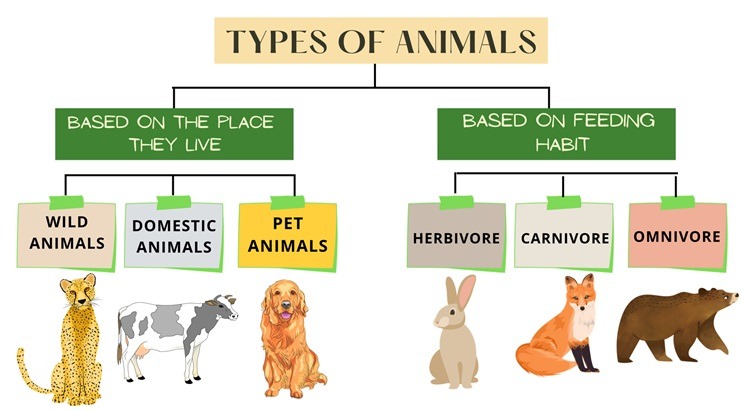
The major types of animals include:
1. Wild Animals
Some animals live freely in forests, mountains, and natural environments without depending on humans. These animals are known as wild animals.
Animals that live in natural habitats like forests, mountains, etc. are called wild animals.
-
These animals hunt for their food.
-
They are dangerous and fierce.
Examples: Lion, Bear, Jackal, Tiger, Leopard, etc.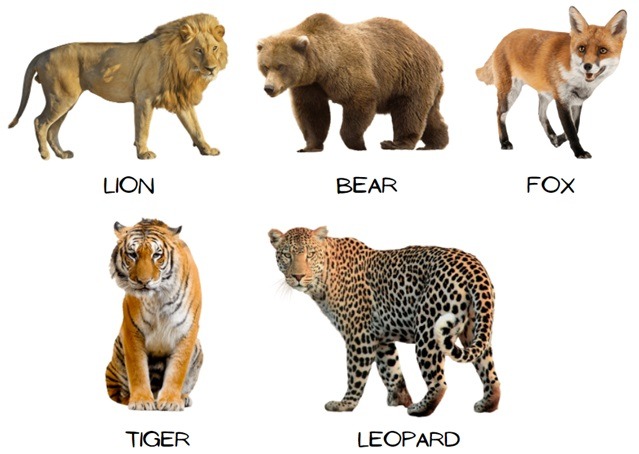
2. Domestic Animals
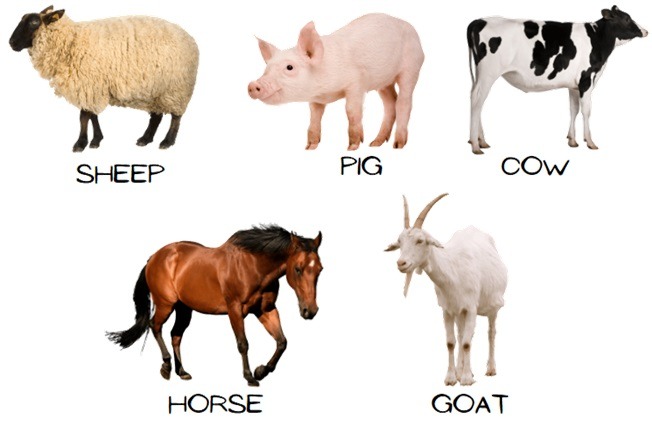
Unlike wild animals, some animals live with humans and depend on them for care and protection. These animals are called domestic animals.
Animals that depend on humans for food, shelter, and survival are called domestic animals.
-
These animals are calm in nature.
-
They are domesticated for animal products like wool, milk, meat, eggs, etc.
Humans also use domestic animals to carry loads. They do not hunt and are kept in farms, dairies, and stables.
Examples: Cow, Goat, Sheep, Horse, Camel, etc.
3. Pet Animals
Some animals are kept at home because they are friendly and provide companionship. These animals are called pets.
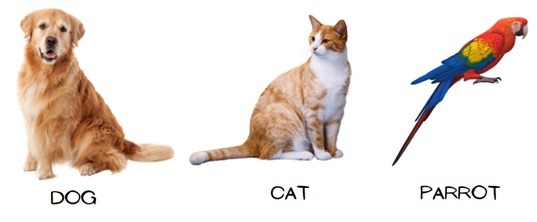
Animals that live with humans in their homes are called pet animals. They depend on humans for food and shelter and are kept for amusement and companionship.
Examples: Dog, Cat, Parrot, etc..
4. Herbivores, Carnivores and Omnivores
Animals can also be classified based on what they eat. This type of grouping helps us understand the feeding habits of different animals.
a. Herbivore
Animals that eat only plants and their parts are called herbivores. Examples: Goat, Cow, Rabbit, Horse, Giraffe, Rhinoceros, Gorilla, Panda, etc.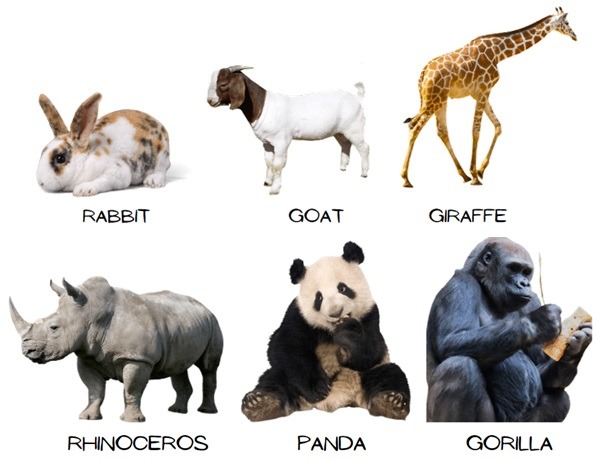
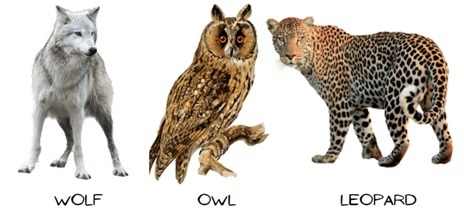
b. Carnivore
Some animals survive by eating the flesh of other animals. These animals are called carnivores.
The organisms that eat the flesh of other animals are called carnivores.
c. Omnivore
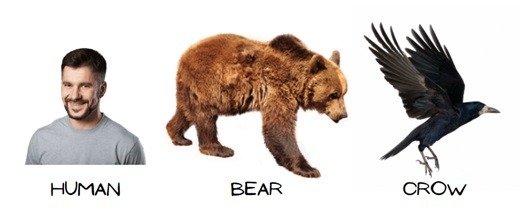
Certain animals eat both plants and animals for food. These animals are known as omnivores.
Animals that eat both plants and animals are called omnivores.
Examples: Bear, Humans, Crow, Jackal, etc.
d. Loving Animals
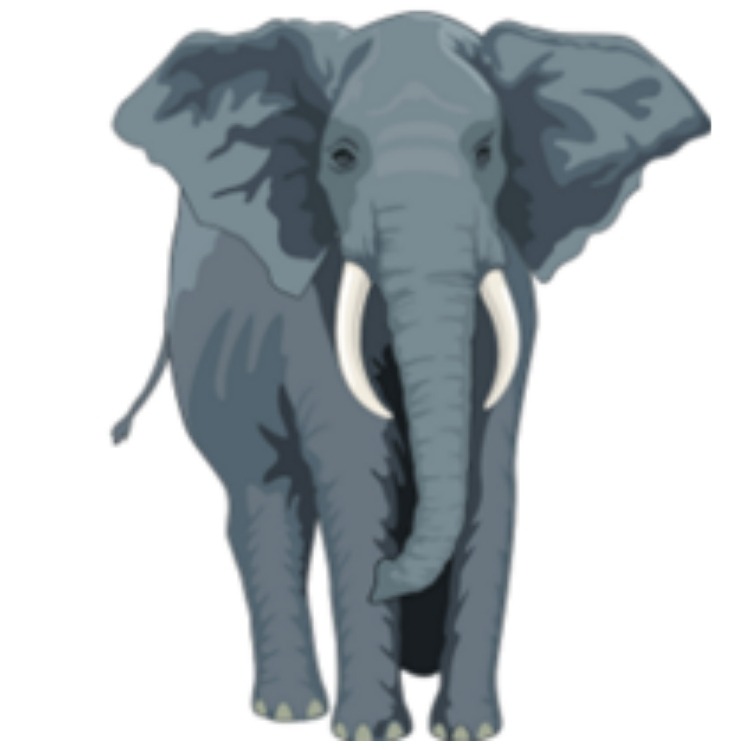
Animals are wonderful creatures of nature, and each type plays an important role in maintaining the balance of our environment.
We should always treat animals with care and kindness. Activities like hunting or poaching can harm wildlife and disturb nature.
All living beings deserve protection and respect, and animals should not be disturbed by human activities.
New words Related to Types of Animals
-
Poaching: The illegal hunting or killing of wild animals for products such as skin, horns, or meat.
-
Habitat: The natural place where an animal or plant lives and grows.
-
Predator: An animal that hunts and eats other animals for food.
-
Prey: An animal that is hunted and eaten by another animal.
-
Extinction: The complete disappearance of a species from Earth.
Till now, you have learned that types of animals are classified based on their habitat, food habits, and unique characteristics. These classifications help us understand how different animals live, survive, and contribute to the balance of nature.
Science isn't just a subject, it's the way of seeing the world. Curious how Orchids The International School teaches it that way? Talk to our admissions team.
Frequently Asked Questions on Types of Animals
1. What are the main types of animals?
The main types of animals are vertebrates and invertebrates. Vertebrates have a backbone and a well-developed internal skeleton, while invertebrates do not have a backbone and usually have softer bodies or an external covering.
2. What are vertebrate animals?
Vertebrates are animals that have a backbone and an internal skeleton. This group includes fish, amphibians, reptiles, birds, and mammals. These animals usually have more complex body systems and organs.
3. What are invertebrate animals?
Invertebrates are animals that do not have a backbone. They form the largest group of animals and include insects, worms, molluscs, crustaceans, and jellyfish. Many of them have an external skeleton or soft body.
4. Why are animals classified into different types?
Animals are classified into different types to organise and study the wide variety of living organisms. Classification helps scientists understand similarities, differences, and evolutionary relationships between animals.
5. Which type of animals is the most diverse?
Invertebrates are the most diverse type of animals. They make up more than 90% of all animal species and are found in almost every environment on Earth.
6. Can animals be classified in other ways?
Yes, animals can also be classified based on habitat (land, water, air), diet (herbivores, carnivores, omnivores), and reproduction methods. These classifications help in understanding animal lifestyles and behaviour.
7. What are some common examples of mammals?
Common examples of mammals include humans, dogs, elephants, whales, and bats. Mammals are warm-blooded animals that usually give birth to young ones and feed them with milk.


Admissions Open for 2026-27
What type of concept pages would you prefer?
CBSE Schools In Popular Cities
- CBSE Schools in Bangalore
- CBSE Schools in Mumbai
- CBSE Schools in Pune
- CBSE Schools in Hyderabad
- CBSE Schools in Chennai
- CBSE Schools in Gurgaon
- CBSE Schools in Kolkata
- CBSE Schools in Indore
- CBSE Schools in Sonipat
- CBSE Schools in Delhi
- CBSE Schools in Rohtak
- CBSE Schools in Bhopal
- CBSE Schools in Aurangabad
- CBSE Schools in Jabalpur
- CBSE Schools in Jaipur
- CBSE Schools in Jodhpur
- CBSE Schools in Nagpur
- CBSE Schools in Ahmednagar
- CBSE School In Tumkur











Orchids The International School is one of India's leading chains of CBSE and ICSE schools, with 110+ schools across the country.