

Greater Than and Less Than Symbols: Meaning, Tricks & Examples
Greater than and less than symbol are the most essential math skills taught at an early stage in school. The symbols assist in comparing two numbers, quantities, or values and which one is greater or lesser. Using them appropriately, students can readily identify numerical order and relationships. Mastering these mathematical symbols not only enhances basic numerical skills but also lays a solid foundation for subsequent topics such as algebra, data analysis, and logical reasoning.
Today, we will explore the greater than and less than symbols, their meanings, how to teach them, tricks to remember greater and less than, and practical greater than less than examples to make learning easier.
Quick Answer: The greater than and less than symbols are used to compare numbers and values.
| Symbol | Meaning | Example |
|---|---|---|
| > | Greater Than | 9 > 6 |
| < | Less Than | 4 < 7 |
| = | Equal To | 5 = 5 |
| ≥ | Greater Than or Equal To | x ≥ 5 |
| ≤ | Less Than or Equal To | y ≤ 10 |
Table of Contents
- What is the Greater Than and Less Than Symbol?
- Tricks to Remember Greater Than and Less Than
- Greater Than and Less Than Examples
- Applications of Greater Than and Less Than Symbols in Algebra
- Solved Examples
- Practice Questions on Greater Than and Less Than Symbols
- Free Downloadable Worksheet
- Conclusion
- FAQs on the Greater Than and Less Than Symbols

What is the Greater Than and Less Than Symbol?
In mathematics, the greater than and less than symbols are used to compare values or numbers. They help in distinguishing between larger and smaller numbers.
-
“>” is the greater than symbol.
-
“<” is the less-than symbol.
They are comparison operators, just like equals to (=). For example:
-
9 > 6 (Read as "9 is greater than 6")
-
4 < 7 (Read as "4 is less than 7")
These symbols are commonly introduced at the elementary level, and their application extends through advanced mathematical concepts like inequalities, algorithms, and coding.
Greater Than Symbol (>)
The greater than symbol is used when the number on the left is larger than the number on the right.
Example:
-
9 > 6 → 9 is greater than 6
-
100 > 10 → 100 is greater than 10
Less Than Symbol (<)
The less than symbol is used when the number on the left is smaller than the number on the right.
Example:
-
3 < 8 → 3 is less than 8
-
15 < 20 → 15 is less than 20
Equal To Symbol (=)
The equal to symbol is used when both quantities are exactly the same.
Example:
-
5 = 5 → 5 is equal to 5
-
12 + 3 = 15 → both sides are equal
This symbol works alongside the greater than and less than symbol to make logical comparisons in mathematics.
Know more about related topics:
Tricks to Remember Greater Than and Less Than
Teaching the greater than and less than symbols can be fun and engaging using simple tools and relatable visuals.
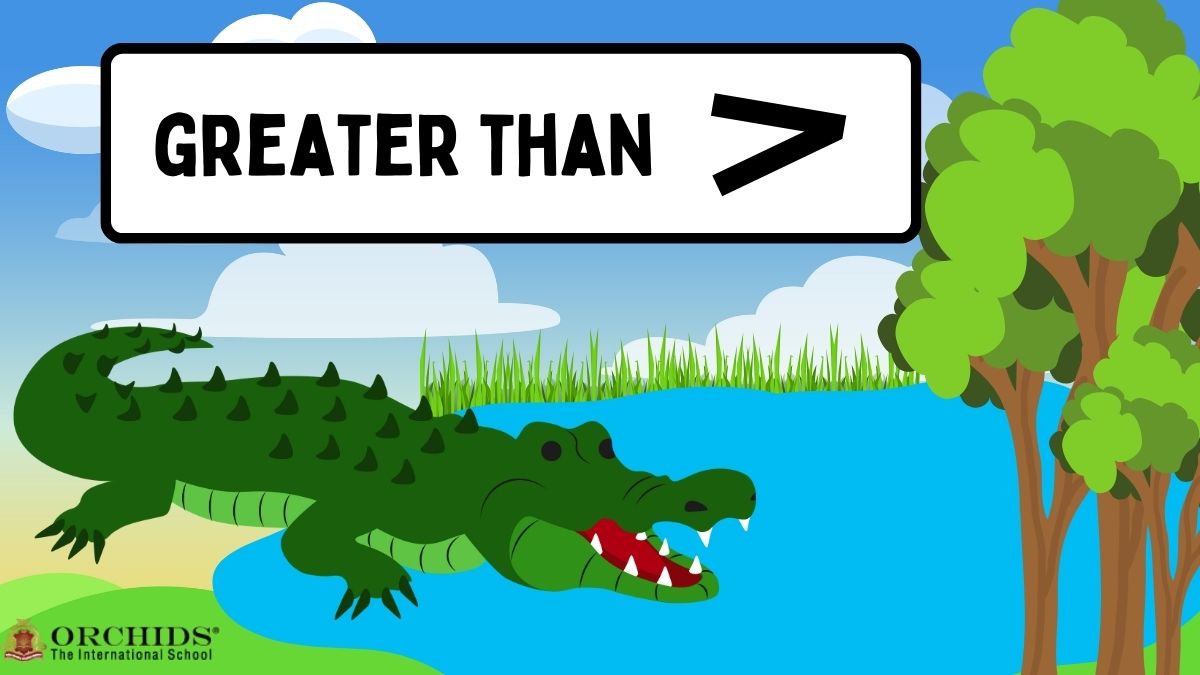
Alligator Mouth Trick
Think of the symbol as an alligator's mouth:
-
The alligator always eats the bigger number.
- So 7 > 4 means the alligator's mouth opens to the 7.
L for Less Than
-
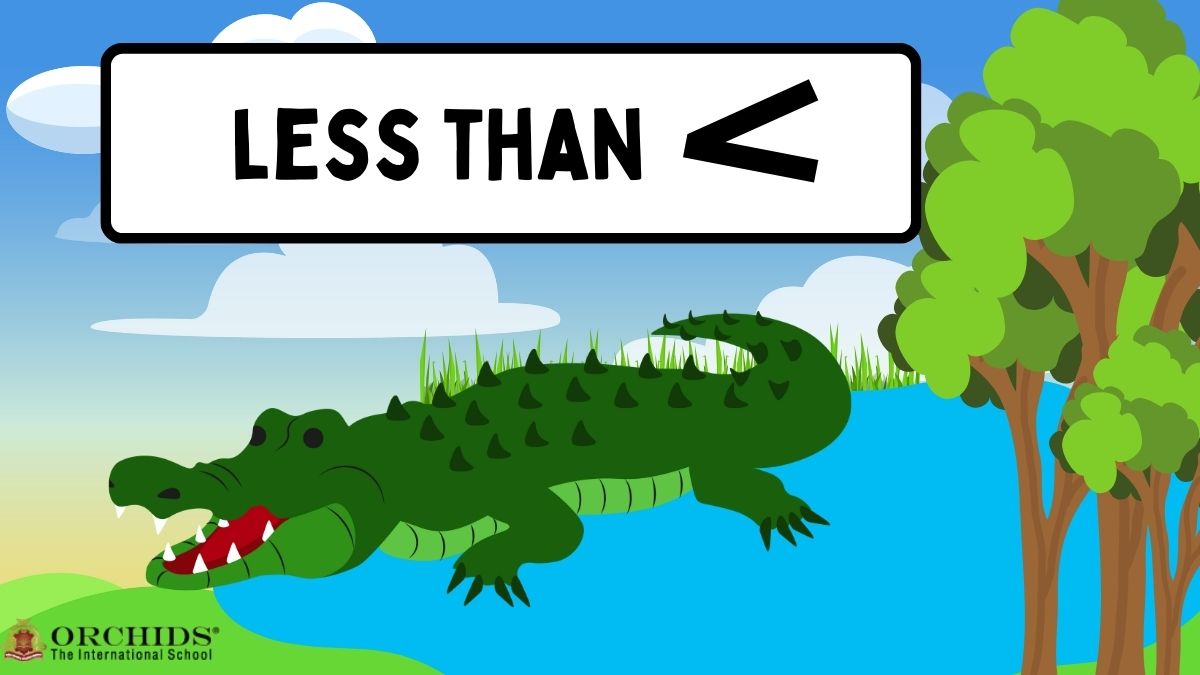
The less-than symbol (<) looks like a slanted "L".
-
So if you see "<", think L = less.
Visual Arrow
-
Less than (<) points to the left → smaller numbers
-
Greater than (>) points to the right → bigger numbers
Number Line Method:
-
Place numbers on a number line and show how the symbol points to the smaller number.
By using these tricks to remember greater and less than, students can easily differentiate the symbols.
Greater Than and Less Than Examples
Here are some useful greater than less than examples to show how these symbols work:
|
Example |
Comparison |
Symbol |
|
12 and 9 |
12 is greater than 9 |
12 > 9 |
|
3 and 10 |
3 is less than 10 |
3 < 10 |
|
7 and 7 |
Equal values |
7 = 7 |
|
15 and 8 |
15 is greater than 8 |
15 > 8 |
|
4 and 9 |
4 is less than 9 |
4 < 9 |
|
½ and ¾ |
½ is less than ¾ |
½ < ¾ |
|
2.5 and 2.3 |
2.5 is greater than 2.3 |
2.5 > 2.3 |
|
2³ and 2² |
8 is greater than 4 |
2³ > 2² |
|
-3 and -1 |
-3 is less than -1 |
-3 < -1 |
Applications of Greater Than and Less Than Symbols in Algebra
In algebra, the less than (<) and greater than (>) symbols are crucial. They are used in domain definition, graphing, inequalities, and mathematical modelling of real-world situations. The main applications are listed below:
1. Solving Inequalities
Inequalities are mathematical statements that use the greater than and less than symbols to compare expressions in algebra.
Example: x + 5 < 12
Subtract 5 from both sides: x < 7
This means any value of x that is less than 7 is a solution.
2. Graphing Inequalities on a Number Line
Inequalities are often shown on a number line to represent a range of values.
Example: x > 3
This means the graph starts just after 3 and continues to the right.
x ≤ -1
This means the graph includes -1 and continues to the left.
3. Real-Life Word Problems
Inequalities are used in algebra to model real-world situations such as budgets, speed limits, or minimum requirements.
Example: A person has at most ₹100 to spend.
Let x be the amount spent.
Then, x ≤ 100
This means the person can spend up to ₹100 but not more.
4. Systems of Inequalities
A system of inequalities involves solving two or more inequalities at once, often shown graphically.
Example: x + y ≤ 10
x ≥ 0
y ≥ 0
This system describes a region on a graph where all the conditions are satisfied.
5. Expressing Constraints or Limits
In algebraic problems involving maximum or minimum values, limits are established using the lesser than and greater than symbols.
Example:
A machine should run at less than 80 degrees Celsius.
This can be written as:
temperature < 80 °C
Solved Examples
Problem 1: Ravi scored 78 marks in Math, and Sita scored 85 marks. Who scored more? Use the appropriate symbol.
Solution: Compare 78 and 85
78 < 85
Sita scored more.
Answer: 78 < 85 (Sita scored greater marks)
Problem 2: A pencil costs ₹12, and a pen costs ₹18. Which is cheaper?
Solution: 12 < 18
A pencil is cheaper than a pen.
Answer: ₹12 < ₹18 (Pencil < Pen)
Problem 3: Rahul is 15 years old, and his brother is 12 years old. Who is older?
Solution: 15 > 12
Rahul is older than his brother.
Answer: 15 > 12 (Rahul > Brother)
Problem 4: A car travelled 120 km, and a bike travelled 85 km. Which vehicle went farther?
Solution: 120 > 85
The car travelled farther.
Answer: 120 > 85 (Car > Bike)
Problem 5: Today’s temperature is 32°C and yesterday’s was 35°C. Was today’s temperature greater or less?
Solution:
32 < 35
Today’s temperature is less than yesterday’s.
Answer: 32 < 35 (Today < Yesterday)
Practice Questions on Greater Than and Less Than Symbols
- Fill the correct symbol: 8 __ 5
- Fill the correct symbol: 12 __ 18
- Compare: 25 __ 25
- Compare: 100 __ 75
- Compare: 9 __ 14
- Compare: ⅓ __ ½
- Compare: -2 __ 3
- Compare: 2.7 __ 2.5
- Which number is greater: 45 or 54?
- Which number is smaller: 17 or 19?
Free Downloadable Worksheet on Greater Than and Less Than Symbols
Download free PDF worksheet on Greater Than and Less Than Symbols
Conclusion
The greater than (>) and less than (<) symbols are simple but powerful tools in mathematics. They help us compare numbers, solve inequalities, and make logical decisions. With practice using the alligator trick, number lines, and real-life examples, students can master these symbols quickly and apply them confidently across all areas of maths.
Frequently Asked Questions on Greater Than and Less Than Symbols
1. Which is greater and less: <, >?
Answers:
-
">" means greater than
-
"<" means less than
So:
5 > 3 means 5 is greater than 3
2 < 6 means 2 is less than 6
2. How to use <, >?
Answers: Use ">" when the number on the left is larger than the one on the right.
Use "<" when the number on the left is smaller than the one on the right.
Examples:
-
10 > 4 → 10 is greater than 4
-
3 < 8 → 3 is less than 8
Remember:
The open side of the symbol always faces the larger number.
3. How do you teach greater than and less than to kids?
Answer: The alligator trick, number lines, comparison games, and visual charts are common ways to teach greater than and less than symbols to children.
4. What is the alligator method for greater than and less than?
Answer: The open mouth of the alligator always faces the larger number because the alligator wants to eat the bigger amount.
5. What is the meaning of ≥ and ≤?
Answers:
-
"≥" means greater than or equal to
-
"≤" means less than or equal to
Examples:
-
x ≥ 5 → x can be 5 or more
-
y ≤ 10 → y can be 10 or less
6. How do you write greater than 5?
Answer: To show numbers greater than 5, we use the greater than symbol ( > ).
So, we write it as: x > 5
This means x can be 6, 7, 8, 9, 10, and so on.
7. How do I write greater than 7?
Answer:
To show numbers greater than 7, we again use the greater than symbol ( > ).
So, we write it as: x > 7
This means x can be 8, 9, 10, 11, and so on.
Master math concepts like the greater than and less than symbol with Orchids The International School!
Numbers make sense when they're taught right. To see how Orchids The International School turns Maths from intimidating to intuitive, reach out to our admissions team.
Related Links


Admissions Open for 2026-27
What type of concept pages would you prefer?
CBSE Schools In Popular Cities
- CBSE Schools in Bangalore
- CBSE Schools in Mumbai
- CBSE Schools in Pune
- CBSE Schools in Hyderabad
- CBSE Schools in Chennai
- CBSE Schools in Gurgaon
- CBSE Schools in Kolkata
- CBSE Schools in Indore
- CBSE Schools in Sonipat
- CBSE Schools in Delhi
- CBSE Schools in Rohtak
- CBSE Schools in Bhopal
- CBSE Schools in Aurangabad
- CBSE Schools in Jabalpur
- CBSE Schools in Jaipur
- CBSE Schools in Jodhpur
- CBSE Schools in Nagpur
- CBSE Schools in Ahmednagar
- CBSE School In Tumkur











Orchids The International School is one of India's leading chains of CBSE and ICSE schools, with 110+ schools across the country.