

Table of 166
The Table of 166 shows how the number 166 changes when multiplied by whole numbers in sequence. Each multiplication reveals a new value created by adding another set of 166. This table helps students understand how numbers grow in regular steps and supports them in working with larger calculations. A Table of 166 PDF is available for easy practice and revision.
Table of 166 Chart
The Table of 166 chart shows all multiples of 166 arranged in order. Each line illustrates how the number progresses when multiplied, making the chart useful for checking answers and understanding multiplication clearly.
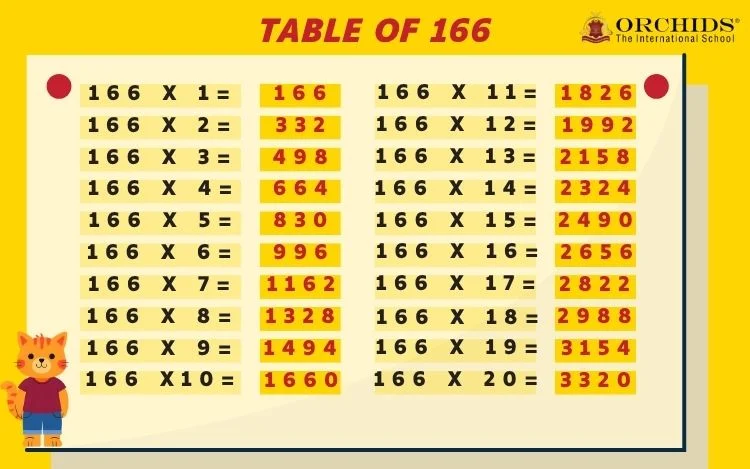

Multiplication Table of 166
The multiplication table of 166 shows how new totals are formed when 166 is multiplied by increasing numbers. Each multiplication creates a fresh value, helping learners recognise how repeated groups of 166 build larger results.
| Multiplicand | Operation | Multiplier | Result | |
| 166 | x | 1 | = | 166 |
| 166 | x | 2 | = | 332 |
| 166 | x | 3 | = | 498 |
| 166 | x | 4 | = | 664 |
| 166 | x | 5 | = | 830 |
| 166 | x | 6 | = | 996 |
| 166 | x | 7 | = | 1162 |
| 166 | x | 8 | = | 1328 |
| 166 | x | 9 | = | 1494 |
| 166 | x | 10 | = | 1660 |
| 166 | x | 11 | = | 1826 |
| 166 | x | 12 | = | 1992 |
| 166 | x | 13 | = | 2158 |
| 166 | x | 14 | = | 2324 |
| 166 | x | 15 | = | 2490 |
| 166 | x | 16 | = | 2656 |
| 166 | x | 17 | = | 2822 |
| 166 | x | 18 | = | 2988 |
| 166 | x | 19 | = | 3154 |
| 166 | x | 20 | = | 3320 |
Download the Table of 166 PDF to keep the entire chart handy for regular practice and quick reference anytime.
Know more about related topics:
Download PDF - Table of 166
How do you read the multiplication table of 166?
To read the table of 166, look at each line as forming another group of 166. Start from the first value and continue downward, noticing how every multiplication creates a new total based on repeated groups of 166.
166 times 1 equals 166
166 times 2 equals 332
166 times 3 equals 498
166 times 4 equals 664
166 times 5 equals 830
166 times 6 equals 996
166 times 7 equals 1162
166 times 8 equals 1328
166 times 9 equals 1494
166 times 10 equals 1660
166 times 11 equals 1826
166 times 12 equals 1992
166 times 13 equals 2158
166 times 14 equals 2324
166 times 15 equals 2490
166 times 16 equals 2656
166 times 17 equals 2822
166 times 18 equals 2988
166 times 19 equals 3154
166 times 20 equals 3320
Table of 160 in Words
The Table of 166 in Words describes every multiplication fact through simple sentences. This form helps readers follow how each total is formed when 166 is multiplied step by step.
One hundred sixty-six times one equals one hundred sixty-six
One hundred sixty-six times two equals three hundred thirty-two
One hundred sixty-six times three equals four hundred ninety-eight
One hundred sixty-six times four equals six hundred sixty-four
One hundred sixty-six times five equals eight hundred thirty
One hundred sixty-six times six equals nine hundred ninety-six
One hundred sixty-six times seven equals one thousand one hundred sixty-two
One hundred sixty-six times eight equals one thousand three hundred twenty-eight
One hundred sixty-six times nine equals one thousand four hundred ninety-four
One hundred sixty-six times ten equals one thousand six hundred sixty
One hundred sixty-six times eleven equals one thousand eight hundred twenty-six
One hundred sixty-six times twelve equals one thousand nine hundred ninety-two
One hundred sixty-six times thirteen equals two thousand one hundred fifty-eight
One hundred sixty-six times fourteen equals two thousand three hundred twenty-four
One hundred sixty-six times fifteen equals two thousand four hundred ninety
One hundred sixty-six times sixteen equals two thousand six hundred fifty-six
One hundred sixty-six times seventeen equals two thousand eight hundred twenty-two
One hundred sixty-six times eighteen equals two thousand nine hundred eighty-eight
One hundred sixty-six times nineteen equals three thousand one hundred fifty-four
One hundred sixty-six times twenty equals three thousand three hundred twenty
Table of 166 Using Repeated Addition
You can understand the table of 166 by viewing each result as the sum of repeated 166s. Start with 166, then keep adding 166 to see how the totals grow from one step to the next.
|
Multiplication |
Repeated Addition |
Result |
|
166 × 1 |
166 |
166 |
|
166 × 2 |
166 + 166 |
332 |
|
166 × 3 |
166 + 166 + 166 |
498 |
|
166 × 4 |
166 + 166 + 166 + 166 |
664 |
|
166 × 5 |
166 + 166 + 166 + 166 + 166 |
830 |
|
166 × 6 |
166 + 166 + 166 + 166 + 166 + 166 |
996 |
|
166 × 7 |
166 + 166 + 166 + 166 + 166 + 166 + 166 |
1162 |
|
166 × 8 |
166 + 166 + 166 + 166 + 166 + 166 + 166 + 166 |
1328 |
|
166 × 9 |
166 + 166 + 166 + 166 + 166 + 166 + 166 + 166 + 166 |
1494 |
|
166 × 10 |
166 + 166 + 166 + 166 + 166 + 166 + 166 + 166 + 166 + 166 |
1660 |
Solved Examples on Table of 166
1. A factory packs 166 bottles in one carton. How many bottles are packed in 8 cartons?
Multiply the bottles per carton by the number of cartons:
166 × 8 = 1328 bottles
So, 8 cartons hold 1328 bottles.
2. A school prints 166 worksheets every day. How many worksheets are printed in 12 days?
Total worksheets = 166 × 12 = 1992 worksheets
Therefore, the 1992 worksheets were printed in 12 days.
3. A shopkeeper receives 166 chocolates in each box. How many chocolates are there in 15 boxes?
Multiply to find the total:
166 × 15 = 2490 chocolates
So, 15 boxes contain 2490 chocolates.
4. A transport company loads 166 bags into each truck. How many bags are carried by 9 trucks?
Total bags = 166 × 9 = 1494 bags
Hence, the trucks carry 1494 bags altogether.
5. A library adds 166 new books every month. How many books will be added in 20 months?
166 × 20 = 3320 books
So, in 20 months, the library adds 3320 new books.
Learn More Multiplication Tables
Numbers make sense when they're taught right. To see how Orchids The International School turns Maths from intimidating to intuitive, reach out to our admissions team.
Frequently Asked Questions on Table of 166
1. What is the table of 166?
The table of 166 lists the results you get when multiplying 166 by whole numbers. It helps you see how the value of 166 grows when multiplied step by step.
2. What are the first ten multiples of 166?
The first ten multiples of 166 are: 166, 332, 498, 664, 830, 996, 1162, 1328, 1494, and 1660.
3. How do you read the table of 166?
You read the table of 166 by following each multiplication line one after another. Begin with 166 × 1, then move to 166 × 2, and continue to understand how the totals increase.
4. How can the table of 166 help in quick calculations?
Knowing the table of 166 allows you to solve multiplication and division problems faster, especially in situations where large numbers are involved.
5. Is there any pattern in the table of 166?
Yes, each new multiple is obtained by adding 166 to the previous one. This consistent jump helps you recognise and remember the sequence more easily.
Related Links


Admissions Open for 2026-27
What type of concept pages would you prefer?
CBSE Schools In Popular Cities
- CBSE Schools in Bangalore
- CBSE Schools in Mumbai
- CBSE Schools in Pune
- CBSE Schools in Hyderabad
- CBSE Schools in Chennai
- CBSE Schools in Gurgaon
- CBSE Schools in Kolkata
- CBSE Schools in Indore
- CBSE Schools in Sonipat
- CBSE Schools in Delhi
- CBSE Schools in Rohtak
- CBSE Schools in Bhopal
- CBSE Schools in Aurangabad
- CBSE Schools in Jabalpur
- CBSE Schools in Jaipur
- CBSE Schools in Jodhpur
- CBSE Schools in Nagpur
- CBSE Schools in Ahmednagar
- CBSE School In Tumkur











Orchids The International School is one of India's leading chains of CBSE and ICSE schools, with 110+ schools across the country.