

Table of 28
Table of 28 allows learners to see the connection between multiplication and repeated addition. Each step demonstrates how 28 is added repeatedly to reach the next multiple, making complex calculations more understandable. Students can use this table to boost speed in solving maths questions and prepare for exams efficiently. A free PDF of the Table of 28 is also available for study purposes.
Table of 28 chart
Table of 28 chart presents the multiples of 28 in a clear, organised layout, helping students quickly track how the number increases with every step. By viewing the chart from 28 × 1 to 28 × 20, learners can easily observe number patterns and practise multiplication more effectively. The visual format also makes revision faster and supports better memorisation of the table.
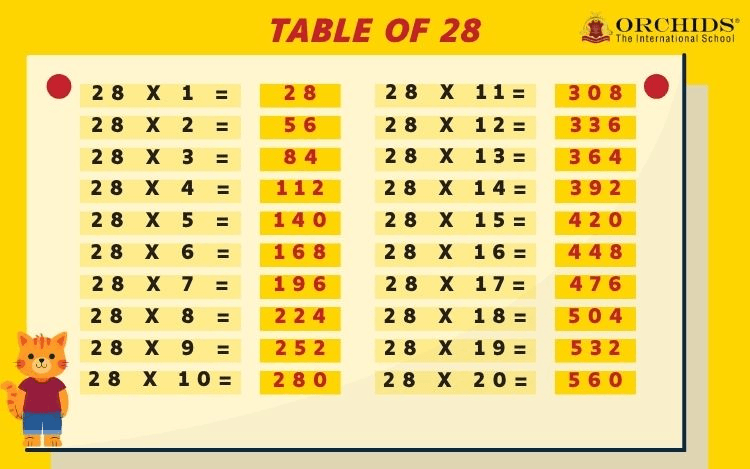

Multiplication Table of 28
The multiplication Table of 28 shows how the number 28 grows when multiplied by different whole numbers. It helps students understand multiplication as repeated addition, such as 28 × 3 = 84, which is the same as adding 28 three times. By practising the table from 1 to 20, learners improve their calculation speed and gain confidence while solving maths questions in class and in daily life.
| Multiplicand | Operation | Multiplier | Result | |
| 28 | x | 1 | = | 28 |
| 28 | x | 2 | = | 56 |
| 28 | x | 3 | = | 84 |
| 28 | x | 4 | = | 112 |
| 28 | x | 5 | = | 140 |
| 28 | x | 6 | = | 168 |
| 28 | x | 7 | = | 196 |
| 28 | x | 8 | = | 224 |
| 28 | x | 9 | = | 252 |
| 28 | x | 10 | = | 280 |
| 28 | x | 11 | = | 308 |
| 28 | x | 12 | = | 336 |
| 28 | x | 13 | = | 364 |
| 28 | x | 14 | = | 392 |
| 28 | x | 15 | = | 420 |
| 28 | x | 16 | = | 448 |
| 28 | x | 17 | = | 476 |
| 28 | x | 18 | = | 504 |
| 28 | x | 19 | = | 532 |
| 28 | x | 20 | = | 560 |
Make practising the 28 times table easier! Download the free Table of 28 PDF and use it anytime for quick revision and better memorisation.
Know more about related topics:
Download PDF - Table of 28
How do you read the multiplication table of 28?
To read the 28 times table, follow each line to see how the number 28 increases when multiplied by whole numbers from 1 to 20. Start with 28 times 1 is 28, then move to 28 times 2 is 56, and so on. Reading the multiples in order helps students understand the pattern of adding 28 repeatedly and improves their speed in solving multiplication-based problems.
28 times 1 equals 28
28 times 2 equals 56
28 times 3 equals 84
28 times 4 equals 112
28 times 5 equals 140
28 times 6 equals 168
28 times 7 equals 196
28 times 8 equals 224
28 times 9 equals 252
28 times 10 equals 280
28 times 11 equals 308
28 times 12 equals 336
28 times 13 equals 364
28 times 14 equals 392
28 times 15 equals 420
28 times 16 equals 448
28 times 17 equals 476
28 times 18 equals 504
28 times 19 equals 532
28 times 20 equals 560
Table of 28 in words
The table of 28 shows the multiples you get when you multiply 28 by natural numbers. Each step increases by 28, helping students understand repeated addition. This table makes learning and memorising the 28 times table easier.
Twenty-eight times one equals twenty-eight
Twenty-eight times two equals fifty-six
Twenty-eight times three equals eighty-four
Twenty-eight times four equals one hundred twelve
Twenty-eight times five equals one hundred forty
Twenty-eight times six equals one hundred sixty-eight
Twenty-eight times seven equals one hundred ninety-six
Twenty-eight times eight equals two hundred twenty-four
Twenty-eight times nine equals two hundred fifty-two
Twenty-eight times ten equals two hundred eighty
Twenty-eight times eleven equals three hundred eight
Twenty-eight times twelve equals three hundred thirty-six
Twenty-eight times thirteen equals three hundred sixty-four
Twenty-eight times fourteen equals three hundred ninety-two
Twenty-eight times fifteen equals four hundred twenty
Twenty-eight times sixteen equals four hundred forty-eight
Twenty-eight times seventeen equals four hundred seventy-six
Twenty-eight times eighteen equals five hundred four
Twenty-eight times nineteen equals five hundred thirty-two
Twenty-eight times twenty equals five hundred sixty
Table of 28 Using Repeated Addition
Learning the table of 28 becomes easier when students see how each multiple is built by adding 28 again and again. This method shows the pattern behind multiplication and helps strengthen basic number concepts.
|
Multiplication |
Repeated Addition |
Result |
|
28 × 1 |
28 |
28 |
|
28 × 2 |
28 + 28 |
56 |
|
28 × 3 |
28 + 28 + 28 |
84 |
|
28 × 4 |
28 + 28 + 28 + 28 |
112 |
|
28 × 5 |
28 + 28 + 28 + 28 + 28 |
140 |
|
28 × 6 |
28 + 28 + 28 + 28 + 28 + 28 |
168 |
|
28 × 7 |
28 + 28 + 28 + 28 + 28 + 28 + 28 |
196 |
|
28 × 8 |
28 + 28 + 28 + 28 + 28 + 28 + 28 + 28 |
224 |
|
28 × 9 |
28 + 28 + 28 + 28 + 28 + 28 + 28 + 28 + 28 |
252 |
|
28 × 10 |
28 + 28 + 28 + 28 + 28 + 28 + 28 + 28 + 28 + 28 |
280 |
Solved Examples on Table of 28
1. Find the total number of marbles in 4 packs if each pack contains 28 marbles.
To find the total, multiply the number of packs (4) by the number of marbles in each pack (28).
28 × 4 = 112
There are 112 marbles in total.
2. Calculate the number of juice cans a woman buys in 28 days if she buys 3 each day.
Multiply the number of juice cans bought each day (3) by the total number of days (28).
3 × 28 = 84
She buys 84 juice cans in 28 days.
3. Determine the earnings of Roger if he works for 28 hours at $20 per hour.
Multiply his hourly wage (20) by the total hours worked (28).
20 × 28 = 560
Answer: Roger earns $560.
4. If there are 28 desks in one classroom, how many desks are there in 7 classrooms?
Multiply the number of desks in one classroom (28) by the number of classrooms (7).
28 × 7 = 196
There are 196 desks in total.
Learn More Multiplication Tables
Numbers make sense when they're taught right. To see how Orchids The International School turns Maths from intimidating to intuitive, reach out to our admissions team.
Frequently Asked Questions on Table of 28
1. What is the multiplication table of 28?
The table of 28 is a list of multiples of 28. Each multiple is obtained by multiplying 28 by natural numbers like 1, 2, 3, and so on. It helps students learn multiplication and solve math problems quickly.
2. What are the first 10 multiples of 28?
The first ten multiples of 28 are:
28, 56, 84, 112, 140, 168, 196, 224, 252, and 280.
These are found by multiplying 28 by 1, 2, 3, … up to 10.
3. How can I read the table of 28?
The table of 28 is read by saying each multiplication sentence aloud, along with its answer. For example:
28 × 1 = 28 (Twenty-eight ones are twenty-eight)
28 × 2 = 56 (Twenty-eight twos are fifty-six)
28 × 3 = 84 (Twenty-eight threes are eighty-four)
Reading the table aloud helps students remember the multiples more easily.
4. How is the table of 28 useful in daily life?
The table of 28 is useful when counting items in equal groups, calculating total quantities, or solving real-life word problems related to numbers and grouping.
5. What is the best way to practise the table of 28?
The best way to practise the table of 28 is by writing it daily, reading it aloud, and solving small multiplication sums using 28.
Related Links


Admissions Open for 2026-27
What type of concept pages would you prefer?
CBSE Schools In Popular Cities
- CBSE Schools in Bangalore
- CBSE Schools in Mumbai
- CBSE Schools in Pune
- CBSE Schools in Hyderabad
- CBSE Schools in Chennai
- CBSE Schools in Gurgaon
- CBSE Schools in Kolkata
- CBSE Schools in Indore
- CBSE Schools in Sonipat
- CBSE Schools in Delhi
- CBSE Schools in Rohtak
- CBSE Schools in Bhopal
- CBSE Schools in Aurangabad
- CBSE Schools in Jabalpur
- CBSE Schools in Jaipur
- CBSE Schools in Jodhpur
- CBSE Schools in Nagpur
- CBSE Schools in Ahmednagar
- CBSE School In Tumkur











Orchids The International School is one of India's leading chains of CBSE and ICSE schools, with 110+ schools across the country.