

Table of 13
Table of 13 is useful for strengthening multiplication skills, especially as numbers get larger. It helps learners improve mental math, recognize number patterns, and solve real-world problems such as area, calculation, and measurement. Students can also download a printable PDF of the Table of 13 for practice and revision.
Table of 13 Chart
A table of 13 chart displays multiplication facts clearly from 13×1 to 13×20, making it easier for learners to understand and memorize bigger numbers. With the help of this chart, students can revise quickly and build accuracy through repeated practice.
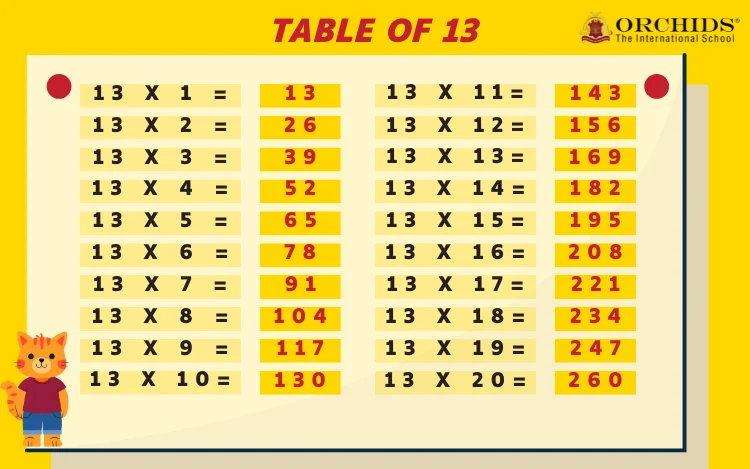

Multiplication Table of 13
The table of 13 shows how multiplying 13 by natural numbers creates increasing values in steps of 13. This consistency helps children understand multiplication as repeated addition and boosts confidence in solving larger math calculations.
| Multiplicand | Operation | Multiplier | Result | |
| 13 | x | 1 | = | 13 |
| 13 | x | 2 | = | 26 |
| 13 | x | 3 | = | 39 |
| 13 | x | 4 | = | 52 |
| 13 | x | 5 | = | 65 |
| 13 | x | 6 | = | 78 |
| 13 | x | 7 | = | 91 |
| 13 | x | 8 | = | 104 |
| 13 | x | 9 | = | 117 |
| 13 | x | 10 | = | 130 |
| 13 | x | 11 | = | 143 |
| 13 | x | 12 | = | 156 |
| 13 | x | 13 | = | 169 |
| 13 | x | 14 | = | 182 |
| 13 | x | 15 | = | 195 |
| 13 | x | 16 | = | 208 |
| 13 | x | 17 | = | 221 |
| 13 | x | 18 | = | 234 |
| 13 | x | 19 | = | 247 |
| 13 | x | 20 | = | 260 |
Know more about related topics:
Download PDF -Table of 13
How to read the multiplication table of 13?
To read the multiplication table of 13, say each fact aloud while recognizing that every new result adds 13 more than the previous one.
13 times 1 equals 13
13 times 2 equals 26
13 times 3 equals 39
13 times 4 equals 52
13 times 5 equals 65
13 times 6 equals 78
13 times 7 equals 91
13 times 8 equals 104
13 times 9 equals 117
13 times 10 equals 130
13 times 11 equals 143
13 times 12 equals 156
13 times 13 equals 169
13 times 14 equals 182
13 times 15 equals 195
13 times 16 equals 208
13 times 17 equals 221
13 times 18 equals 234
13 times 19 equals 247
13 times 20 equals 260
Table of 13 in Words:
This format helps build verbal understanding and improves fluency:
Thirteen times one equals thirteen
Thirteen times two equals twenty-six
Thirteen times three equals thirty-nine
Thirteen times four equals fifty-two
Thirteen times five equals sixty-five
Thirteen times six equals seventy-eight
Thirteen times seven equals ninety-one
Thirteen times eight equals one hundred four
Thirteen times nine equals one hundred seventeen
Thirteen times ten equals one hundred thirty
Thirteen times eleven equals one hundred forty-three
Thirteen times twelve equals one hundred fifty-six
Thirteen times thirteen equals one hundred sixty-nine
Thirteen times fourteen equals one hundred eighty-two
Thirteen times fifteen equals one hundred ninety-five
Thirteen times sixteen equals two hundred eight
Thirteen times seventeen equals two hundred twenty-one
Thirteen times eighteen equals two hundred thirty-four
Thirteen times nineteen equals two hundred forty-seven
Thirteen times twenty equals two hundred sixty
Table of 13 Using the Repeated Addition Method
This helps students see multiplication as repeated equal addition:
|
Multiplication |
Repeated Addition |
Answer |
|
13 × 1 |
13 |
13 |
|
13 × 2 |
13 + 13 |
26 |
|
13 × 3 |
13 + 13 + 13 |
39 |
|
13 × 4 |
13 + 13 + 13 + 13 |
52 |
|
13 × 5 |
13 + 13 + 13 + 13 + 13 |
65 |
|
13 × 6 |
13 + 13 + 13 + 13 + 13 + 13 |
78 |
|
13 × 7 |
13 + 13 + 13 + 13 + 13 + 13 + 13 |
91 |
|
13 × 8 |
13 + 13 + 13 + 13 + 13 + 13 + 13 + 13 |
104 |
|
13 × 9 |
13 + 13 + 13 + 13 + 13 + 13 + 13 + 13 + 13 |
117 |
|
13 × 10 |
13 + 13 + 13 + 13 + 13 + 13 + 13 + 13 + 13 + 13 |
130 |
Solved Examples on Table of 13
Example 1: Find 13 times 7 plus 9.
Solution:
-
13 × 7 = 91
-
91 + 9 = 100
-
So, the final answer is 100.
Example 2: What is the 10th multiple of 13?
Solution:
-
13 × 10 = 130
-
So, the 10th multiple is 130.
Example 3: Subtract 25 from 13 × 11.
Solution:
-
13 × 11 = 143
-
143 − 25 = 118
-
So, the answer is 118.
Example 4: Multiply 13 by the difference of 9 and 4.
Solution:
-
9 − 4 = 5
-
13 × 5 = 65
-
So, the result is 65.
Example 5: Find 13 times 9 minus 15.
Solution:
-
13 × 9 = 117
-
117 − 15 = 102
-
So, the final answer is 102.
Learn More Multiplication Tables
Numbers make sense when they're taught right. To see how Orchids The International School turns Maths from intimidating to intuitive, reach out to our admissions team.
Frequently Asked Questions on Table of 13
1. Is every value in the table of 13 odd or even?
Not always. Because 13 is odd, multiplying it by an odd number gives an odd product, while multiplying it by an even number gives an even product.
2. Are multiples of 13 also multiples of prime numbers?
Yes. Since 13 is a prime number, every multiple of 13 is a product of 13 and another whole number.
3. Is there a quick method to multiply by 13?
Yes. One common method is:
-
Multiply the number by 10, then add three times the same number.
-
Example: 13 × 6 = (10 × 6) + (3 × 6) = 60 + 18 = 78.
4. What is the 15th multiple of 13?
The 15th multiple is 13 × 15 = 195
5. Why should students learn the table of 13?
Learning the table of 13 helps improve speed in solving multiplication, division, fractions, algebra, and real-life calculations such as budgeting and measurement.
Related Links


Admissions Open for 2026-27
What type of concept pages would you prefer?
CBSE Schools In Popular Cities
- CBSE Schools in Bangalore
- CBSE Schools in Mumbai
- CBSE Schools in Pune
- CBSE Schools in Hyderabad
- CBSE Schools in Chennai
- CBSE Schools in Gurgaon
- CBSE Schools in Kolkata
- CBSE Schools in Indore
- CBSE Schools in Sonipat
- CBSE Schools in Delhi
- CBSE Schools in Rohtak
- CBSE Schools in Bhopal
- CBSE Schools in Aurangabad
- CBSE Schools in Jabalpur
- CBSE Schools in Jaipur
- CBSE Schools in Jodhpur
- CBSE Schools in Nagpur
- CBSE Schools in Ahmednagar
- CBSE School In Tumkur











Orchids The International School is one of India's leading chains of CBSE and ICSE schools, with 110+ schools across the country.