

Biology
Biology is the science that studies living organisms, their structure, function, growth, evolution, and interactions with the environment. It is a field that constantly changes as discoveries reveal more about life in all its forms. Sometimes, a scientific discovery not only answers old questions but also raises new ones. In simple terms, biology explains everyday processes such as why we need oxygen, how plants make food, why people fall sick, and how animals survive in different habitats.
This article breaks down key ideas, discoveries related to biology its branches and how biology shapes one's future to help you understand how life works at every level.
History and Evolution of Biology
The term “biology” was first used in the modern sense in the late 18th century by scientists such as Michael Christoph Hanow and Lamarck. To understand how the subject has developed since then, let’s take a look at its journey over time.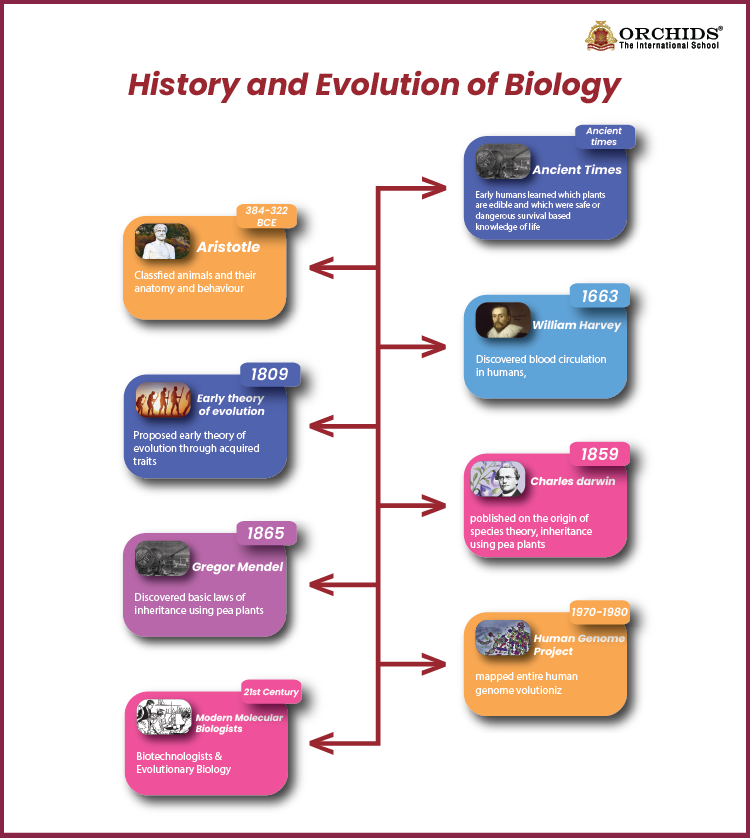
It is not limited to textbooks but is deeply connected to daily life, from how our body works to the food we eat. Life exists across Earth, from frozen regions to dry deserts, and scientists have identified over 8.7 million species so far.
As technology advances, our understanding of life continues to change, especially after the discovery of viruses, which challenged traditional ideas of what it means to be alive.
Major Branches of Biology
And have you ever wondered how we study life in so many ways, from examining cells under a microscope to learning about entire ecosystems?
That’s where biology comes in. It is a vast subject, but it becomes easier to understand when we divide it into key areas.
Here are some important branches of biology:
|
Division |
What It Studies |
Applications |
|
Anatomy |
Structure of organisms, organs, and tissues |
Human skeleton, organ studies |
|
Biotechnology |
Using living systems for technology and products |
Genetic engineering, vaccines, biofuels |
|
Botany |
Plants, their growth, and reproduction |
Agriculture, medicinal plants, and plant conservation |
|
Ecology |
Relationships between organisms and their environment |
Ecosystem studies, conservation, and climate research |
|
Genetics |
Inheritance, DNA, and traits |
Gene therapy, breeding, studying hereditary diseases |
|
Immunology |
Immune system and defense mechanisms |
Vaccines, disease prevention |
|
Microbiology |
Microorganisms like bacteria, viruses, and fungi |
Antibiotics, studying pathogens |
|
Physiology |
Functions of living organisms and systems |
Human body functions, animal physiology |
|
Zoology |
Animals, their behaviour, and classification |
Wildlife conservation, studying animal behaviour |
How Biology Shapes Our Career?
Biology is not just a school subject; it opens doors to a wide range of exciting career paths. A strong foundation in biology can lead you into fields such as:
-
Medicine and healthcare (doctors, nurses, lab technicians, pharmacists)
-
Biotechnology and genetic research
-
Environmental science and conservation
-
Agriculture and food technology
-
Microbiology and immunology
-
Teaching and academic research
This collection also includes 2000+ articles on topics like human biology, genetics, plants, animals, microorganisms, and ecology. By exploring these resources, you can gain a deeper understanding of how life works and how living organisms are connected to the world around us.
Biology helps us understand life, from cells to ecosystems. By learning its branches and concepts, we can better understand health, nature, and the environment. As science grows, biology will continue to play a key role in improving lives and protecting our planet.
Frequently Asked Questions on Biology
1. What is biology in simple words?
Biology is the science that studies living organisms, including their structure, growth, functions, and how they interact with their environment.
2. What are the main branches of biology?
The major branches of biology are botany, which deals with plants, zoology, which focuses on animals, and microbiology, which studies microscopic living organisms.
3. Why is biology important?
Biology helps us understand how life works, how diseases occur, and how the environment supports living organisms, making it useful in medicine, farming, and conservation.
4. What do you learn in biology?
In biology, you learn about cells, tissues, organs, life processes, genetics, evolution, ecosystems, and how living organisms survive and reproduce.
5. What is the difference between biology and zoology?
Biology includes the study of all living organisms, while zoology is a branch of biology that focuses only on animals.
6. Who studies Biology?
A biologist studies living organisms by observing, experimenting, and analysing how life functions at different levels of organisation.
7. How is biology useful in daily life?
Biology improves healthcare, food production, hygiene, and environmental safety by helping us understand life processes and disease prevention.
8. Is biology a good career option?
Biology offers careers in medicine, biotechnology, research, environmental science, and pharmaceuticals, making it a vast and growing field.
CBSE Schools In Popular Cities
- CBSE Schools in Bangalore
- CBSE Schools in Mumbai
- CBSE Schools in Pune
- CBSE Schools in Hyderabad
- CBSE Schools in Chennai
- CBSE Schools in Gurgaon
- CBSE Schools in Kolkata
- CBSE Schools in Indore
- CBSE Schools in Sonipat
- CBSE Schools in Delhi
- CBSE Schools in Rohtak
- CBSE Schools in Bhopal
- CBSE Schools in Aurangabad
- CBSE Schools in Jabalpur
- CBSE Schools in Jaipur
- CBSE Schools in Jodhpur
- CBSE Schools in Nagpur
- CBSE Schools in Ahmednagar
- CBSE School In Tumkur











Orchids The International School is one of India's leading chains of CBSE and ICSE schools, with 130+ schools across the country.