

Structure of tongue: Detailed Anatomy and Its Functions in the Body
The structure of tongue is more complex than it appears, yet many people don’t realise how crucial it is for daily life. Its muscular layers, glands, nerves, and taste receptors all work together to enable essential functions like eating, tasting, speaking, and swallowing.
This article explains the structure of tongue, its main parts and detailed anatomy and the functions of taste buds and papillae, helping you learn how this remarkable organ works.
Table of Contents
- All About the Human Tongue
- Detailed Structure of tongue
- Functions of the Tongue
- Frequently Asked Questions on the Structure of Tongue

All About the Human Tongue
The tongue is a muscular structure located on the floor of the mouth and forms part of the front wall of the throat, known as the oropharynx. It is supplied with a rich network of blood vessels and nerves, which allow it to work with precision and sensitivity.
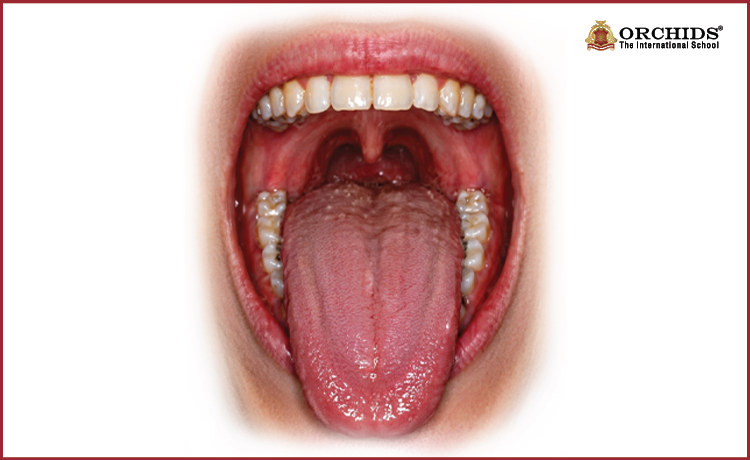
The tongue also contains taste buds, small sensory organs that allow us to taste food.
Fact: An adult human tongue has almost 10,000 taste buds, while children have even more.
As people grow older, some taste buds stop functioning, which is why taste sensations gradually become weaker with a
Seeing a well-labelled diagram makes it easier to visualise the position of the papillae, taste buds, and major sections of the tongue.
Now there’s an obvious question: how is the tongue actually structured?
Detailed Structure of tongue
At first glance, the tongue may appear to be a simple muscle inside the mouth. However, just like the eye, it is built layer by layer and equipped with special parts of the tongue that allow it to taste, move, speak, and swallow.
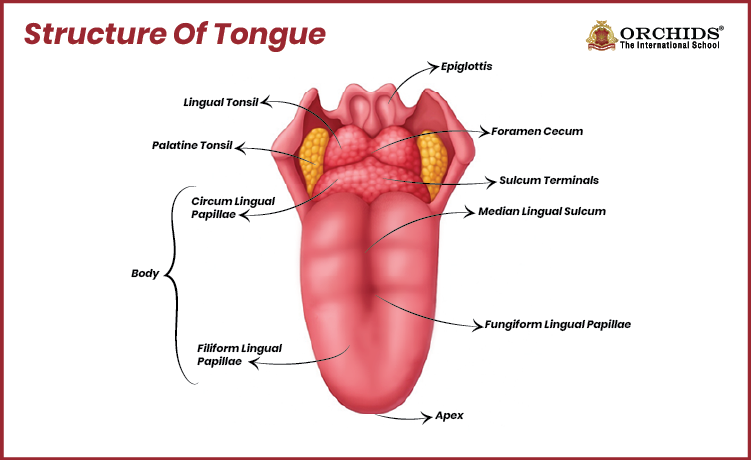
To understand this clearly, imagine the tongue not as one solid piece but as a system made of tissues, muscles, glands, nerves, and surface structures that work together.
When we study the structure of the tongue, the easiest way to learn is to explore it from the outer surface to the inner layers and then move into how it is controlled.
Now, let us walk through this diagram of tongue in the same order in which it is built.
To begin, go through what the tongue is made of on the outside and inside.
- The outer covering of the tongue is called epithelium. This is the surface layer that protects the tongue and contains the tiny structures responsible for taste. It is here that papillae and taste buds are located.
- Just beneath this surface lie the muscles. These are voluntary muscles, which means you can control them. This is why you can roll your tongue, change its shape while speaking, or move food while chewing.
- Within the tongue are small glands that release fluids. These secretions keep the tongue moist and make swallowing easier.
Now, let us understand how the tongue is divided physically.
- The front part is called the tip or apex. This is the most flexible section and is especially active during speaking and tasting.
- The middle region is known as the body of the tongue. Its upper surface feels rough because it is covered with tiny projections, while its lower surface is smooth.
- The back portion is the base or root of the tongue. This part forms the front wall of the throat and is attached to the floor of the mouth, the mandible, and the hyoid bone.
Next, the tongue is also divided by development into two functional regions.
- The front two-thirds form the anterior or oral part, which is mainly involved in tasting.
- The back one-third forms the posterior or pharyngeal part, which plays a major role in swallowing.
These two portions are separated by a visible V-shaped line known as the terminal sulcus.
At the centre of this line lies a tiny pit called the foramen cecum, which marks the spot where the thyroid gland first develops during early growth.
Now, let us move on to what makes the tongue rough and sensitive to taste.
- The tongue surface contains hundreds of small projections called papillae. They give the tongue its textured surface and support the taste buds.
Interestingly!! There are four types of papillae on the tongue:
- Filiform papillae are thin and pointed and help in gripping food but do not detect taste.
- Fungiform papillae are rounded structures mostly found near the front and sides and contain taste buds.
- Circumvallate papillae are large papillae arranged in a V-shape near the back of the tongue and are packed with taste buds.
- Foliate papillae are found on the sides of the tongue near the terminal sulcus.
And taste buds are not limited to the tongue. They are also found in the palate, throat, epiglottis, and even in the upper part of the oesophagus.
- Now, let us understand why the tongue can move so freely. The tongue is made of voluntary skeletal muscles consisting of cross-striated fibres.
This unique structure explains how the tongue performs precise movements like speaking, swallowing, and adjusting food during chewing.
Next, let us see how the tongue stays clean and protected. The tongue contains salivary glands that release fluids and keep the surface healthy.
Mucous glands produce mucus, serous glands release watery fluid, and lingual tonsils at the back of the tongue serve as immune protectors against infection.
Finally, none of these actions would work without nerve control. The tongue is supplied by important nerves. The glossopharyngeal nerve carries taste sensation, the chorda tympani from the facial nerve carries taste from the front region, and the trigeminal nerve controls touch, pain, and temperature sensations.
So, the structure of the tongue is not random at all. Every layer, nerve, and surface feature is carefully designed to work together.
Just like the diagram of an eye explains vision, the diagram of the tongue explains how we taste, speak, and swallow.
Next, let’s look at the functions of the tongue and how each part works in everyday life.
Functions of the Tongue
The tongue is an amazing organ that does much more than it looks like at first glance. It plays a vital role in several daily functions that are essential for eating, speaking, and sensing the world around us.
Here are a few functions of the tongue:
- It helps in chewing by moving and mixing food with saliva, breaking it down into smaller pieces that are easier to swallow.
- The tongue also pushes the food toward the throat, ensuring smooth swallowing and safe passage into the oesophagus.
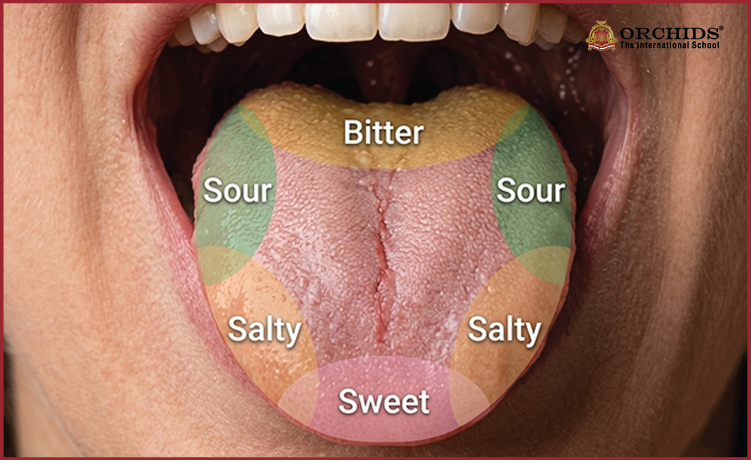
- It contains thousands of taste buds that send signals to the brain, allowing you to enjoy and differentiate flavours.
- The tongue is equally important for speech as it shapes sounds and helps in clear articulation, enabling effective communication.
- And it helps in mastication by moving food around the mouth and mixing it with saliva for easier chewing.
- It supports deglutition by pushing food toward the throat and aiding in safe swallowing.
- The tongue is also responsible for taste as it contains thousands of taste buds that send flavour signals to the brain.
In addition, it plays a major role in speech by shaping sounds and helping in clear pronunciation.
Lastly, the tongue helps in secretion by releasing mucus and serous fluid that keep the mouth moist and make swallowing easier.
In this article, we discussed how the structure of the tongue, a simple-looking organ, performs complex tasks. And we also learnt through a diagram of the tongue, how the muscles allow movement, papillae support taste, nerves carry signals, and glands ensure moisture. From chewing and speaking to sensing flavours, the tongue plays a crucial role in everyday life.
Frequently Asked Questions on the Structure of Tongue
1. What are the three main parts of the tongue?
The tongue is divided into three parts called the tip (apex), body, and base, each playing a different role in speaking, tasting, and swallowing.
2. What is the epiglottis and why is it important?
The epiglottis is a leaf-shaped flap of cartilage that closes over the windpipe during swallowing, preventing food and water from entering the lungs.
3. What are taste buds, and where are they found?
Taste buds are tiny sensory organs that detect flavours and send taste signals to the brain, and they are mainly found on the papillae of the tongue.
4. Why do people lose taste sensitivity as they grow older?
As people age, many taste buds gradually stop working, which leads to reduced ability to sense certain flavours.
5. How many taste buds does a human tongue have?
An adult tongue has around 10,000 taste buds, while children have even more, which explains their sharper taste sensitivity.
6. What type of muscles are present in the tongue?
The tongue contains voluntary skeletal muscles, which allow precise movements required for speaking, chewing, and swallowing.
7. Which nerves control taste and sensation in the tongue?
Taste is controlled by the glossopharyngeal nerve and facial nerve, while touch, pain, and temperature are transmitted by the trigeminal nerve.
8. What are the main functions of the tongue?
The tongue helps in tasting food, chewing, swallowing, speaking clearly, and keeping the mouth moist through glandular secretions.
Science isn't just a subject, it's the way of seeing the world. Curious how Orchids The International School teaches it that way? Talk to our admissions team.
Admissions Open for 2026-27
What type of concept pages would you prefer?
CBSE Schools In Popular Cities
- CBSE Schools in Bangalore
- CBSE Schools in Mumbai
- CBSE Schools in Pune
- CBSE Schools in Hyderabad
- CBSE Schools in Chennai
- CBSE Schools in Gurgaon
- CBSE Schools in Kolkata
- CBSE Schools in Indore
- CBSE Schools in Sonipat
- CBSE Schools in Delhi
- CBSE Schools in Rohtak
- CBSE Schools in Bhopal
- CBSE Schools in Aurangabad
- CBSE Schools in Jabalpur
- CBSE Schools in Jaipur
- CBSE Schools in Jodhpur
- CBSE Schools in Nagpur
- CBSE Schools in Ahmednagar
- CBSE School In Tumkur











Orchids The International School is one of India's leading chains of CBSE and ICSE schools, with 110+ schools across the country.