

Physics
Physics is the science that studies how matter and energy interact and affect each other over time and space. It is a field that keeps changing as we discover new things.
Sometimes, when a discovery is made, not only does the answer change, but the question itself can change, too. That’s why many people define basic physics by what it used to be rather than what it is now and what it will become.
Physics shows us patterns in nature and gives us tools to use those patterns in practical ways.
To see how far it has come, let’s take a quick look back at the journey of physics through history.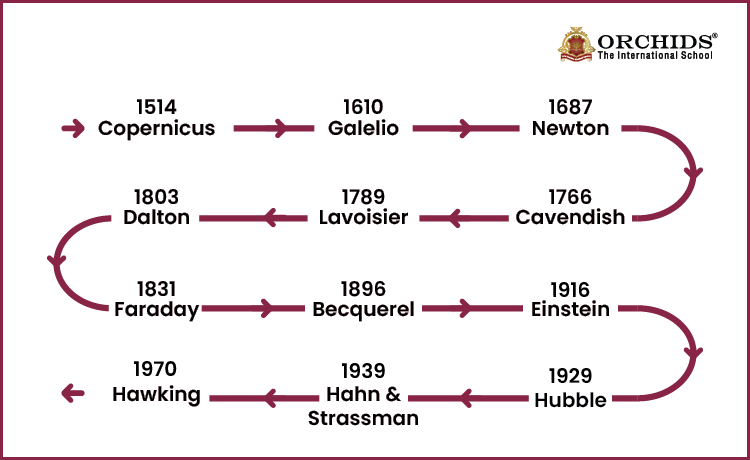
Step by step, physics grew as humans asked questions, tested ideas, and looked for patterns. Each discovery built on the one before it, making physics not just a subject, but a continuous journey of understanding.
If you love physics or are a student wanting to learn more, there are lots of resources to explore. This article explains basic physics in simple words, covering ideas, theories, discoveries, and experiments.
Main Branches of Physics
Have you ever thought about how one subject can explain so many different things, from why a ball bounces to how light bends through a glass, or even how stars shine? Physics does all of this, but it becomes easier to understand when we divide it into parts.
That’s where branches of physics come in. Each branch looks at one side of nature, and together, they cover almost everything around us.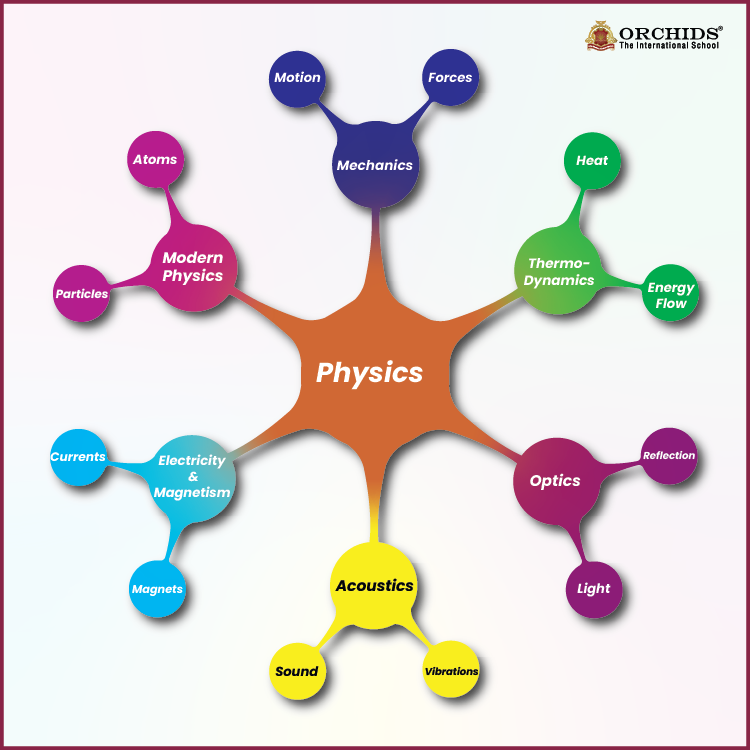
Let’s take a look at the 6 main branches of physics and what they study:
|
Branch |
What it Studies |
Examples |
|
Mechanics |
Motion, forces, energy |
Cars moving, balls rolling, swings |
|
Thermodynamics |
Heat and energy flow |
Boiling water, engines, refrigerators |
|
Optics |
Light, reflection, refraction |
Lenses, mirrors, rainbows |
|
Acoustics |
Sound and vibrations |
Music, speakers, echoes |
|
Electricity & Magnetism |
Electric charges, currents, and magnets |
Bulbs, motors, circuits |
|
Modern Physics |
Atoms, particles, relativity |
Nuclear energy, particle physics, space science |
Important Laws of Physics
Physics is guided by rules that never change. These laws of Physics explain how objects move, how energy flows, and how forces act in the world around us.
But how do we actually see these laws at work? Let’s explore some key ones.
|
Law |
What it Explains |
Example |
|
Newton’s Laws of Motion |
How objects move |
A rolling ball, a car coming to a stop |
|
Law of Conservation of Energy |
Energy cannot be created or destroyed |
A swinging pendulum, a battery powering a light |
|
Law of Gravitation |
Objects pull on each other |
Earth and Moon, an apple falling from a tree |
|
Laws of Thermodynamics |
How heat and energy move |
Boiling water, engine operation |
|
Ohm’s Law |
Relationship between voltage, current, and resistance |
Electric circuits, powering a bulb |
|
Hooke’s Law |
How springs stretch or compress under force |
Stretching a spring, bouncing on a trampoline |
These laws are like nature’s rulebook. By knowing them, we can predict outcomes and understand why things happen the way they do.
Common Formulas to Learn in Physics
The list of physics formulas is the tool that helps us apply these laws to real situations. They make physics practical and allow us to calculate exactly what will happen.
Here is the quick checklist of physics formulas:
|
Concept |
Formula |
What it Means |
|
Speed |
v = d ÷ t |
Distance divided by time |
|
Acceleration |
a = (vf - vi) ÷ t |
Change in speed over time |
|
Force |
F = m × a |
Mass times acceleration |
|
Work |
W = F × d |
Force applied over a distance |
|
Kinetic Energy |
KE = ½ m × v² |
Energy of a moving object |
|
Potential Energy |
PE = m × g × h |
Energy stored due to height |
Check out the other important list of Physics formulas here.
With these formulas, we can understand everything from why a ball rolls down a slope to how rockets lift off into space. Physics becomes not just a theory, but a practical guide to the world around us.
This collection has 1900+ articles on topics like particle physics, astrophysics, motion, energy, and more. By going through these resources, you can get a better understanding of the laws that shape the universe.
Frequently Asked Questions on Physics
1. What exactly is Physics?
Physics is the science that explains how matter, energy, forces, and motion interact in our world.
2. Why is physics important in daily life?
It helps us understand nature, operate technology, improve healthcare, and make sense of everyday activities.
3. How is physics divided into branches?
Physics has branches like Mechanics, Thermodynamics, Optics, Acoustics, Electricity & Magnetism, and Modern Physics, each focusing on different aspects of nature.
4. What are the main concepts I should know in physics?
Key concepts include Force, Energy, Work, Power, Mass, Gravity, Motion, and Waves. These explain how things move and interact.
5. What are some basic laws of physics?
Important laws are Newton’s Laws of Motion, Conservation of Energy, Gravitation, Thermodynamics, Ohm’s Law, and Hooke’s Law.
6. Why do we use formulas in physics?
Formulas let us calculate and understand speed, force, energy, and work, so we can predict real-world results accurately.
CBSE Schools In Popular Cities
- CBSE Schools in Bangalore
- CBSE Schools in Mumbai
- CBSE Schools in Pune
- CBSE Schools in Hyderabad
- CBSE Schools in Chennai
- CBSE Schools in Gurgaon
- CBSE Schools in Kolkata
- CBSE Schools in Indore
- CBSE Schools in Sonipat
- CBSE Schools in Delhi
- CBSE Schools in Rohtak
- CBSE Schools in Bhopal
- CBSE Schools in Aurangabad
- CBSE Schools in Jabalpur
- CBSE Schools in Jaipur
- CBSE Schools in Jodhpur
- CBSE Schools in Nagpur
- CBSE Schools in Ahmednagar
- CBSE School In Tumkur











Orchids The International School is one of India's leading chains of CBSE and ICSE schools, with 130+ schools across the country.