

Types of Forces
Types of forces are all around us, even if we don’t always notice them. They are the pushes and pulls that make a ball roll, a swing move, or a rocket lift off into space. In very simple language, a force is any interaction that can change the motion of an object.
This article is a complete guide to learn what force is, the different types of forces, see real-life examples, and learn how these invisible pushes and pulls are used in daily life.
Table of Contents

What is Force?
Force can simply be defined as, “Force is nothing but a push or pull that can change the motion of an object.”
Have you ever pushed open a door or pulled your school bag closer? In both cases, you are applying a force!
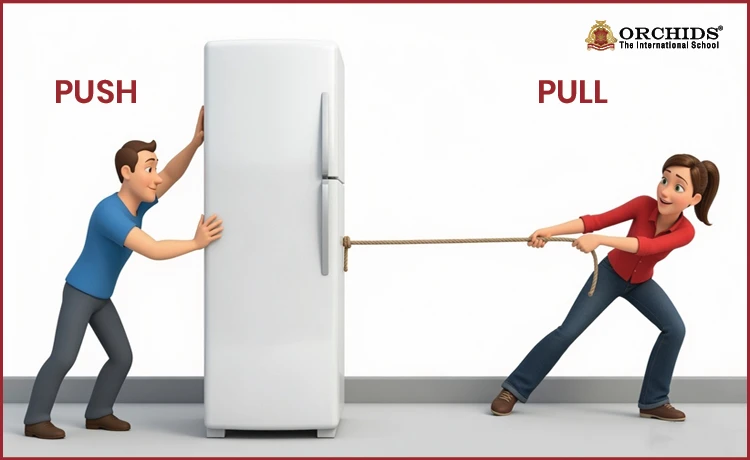
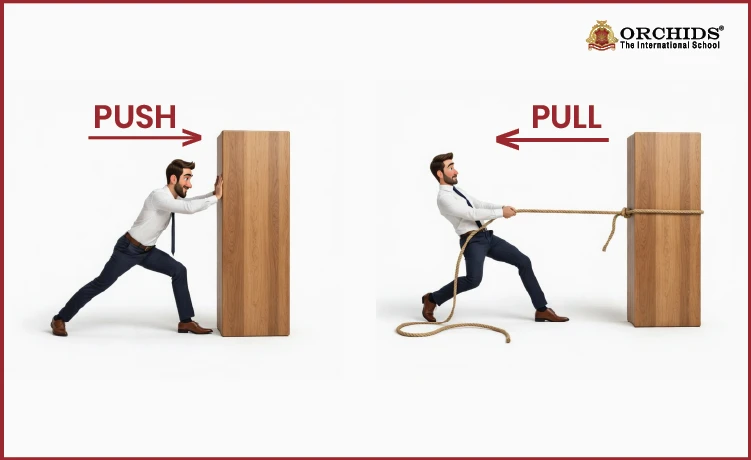
In the image above we can see that,
- The man pushing the refrigerator is applying a push force.
- The woman pulling the refrigerator with a rope is applying a pull force.
So here, both actions are examples of force, because they involve applying a push or pull to an object. If the applied force is strong enough, the refrigerator will move from its position.
In simple terms,
|
“Whenever two objects interact, they exert a push or pull on each other, and that interaction is called force.” |
Mathematically, force is expressed as
From the above, it can be concluded that,
- The stronger you push or pull, the faster an object accelerates.
- The heavier an object is, the more force you need to move it.
So, force is one of the most basic yet important concepts in physics. Force helps us understand how and why objects move in the world around us.
Read More: Force
Understanding force is the first step toward learning how things behave.
But did you know there are many kinds of forces acting around us all the time? Let’s discuss the different types of forces.
Types of Forces
Forces are mainly divided into two categories,
- Contact Forces
- Non-Contact Forces
- Balanced Force
- Unbalanced Force
Let’s understand them one by one
Contact Force
Contact forces are the forces that act only when two objects physically touch.
Everyday actions like pushing a trolley, dragging a chair, or kicking a ball involve contact forces.
Here are the different types of Contact Force:
(i) Frictional Force is a force that opposes motion between two surfaces. For example, it’s the reason your shoes grip the ground when you walk, preventing you from slipping.
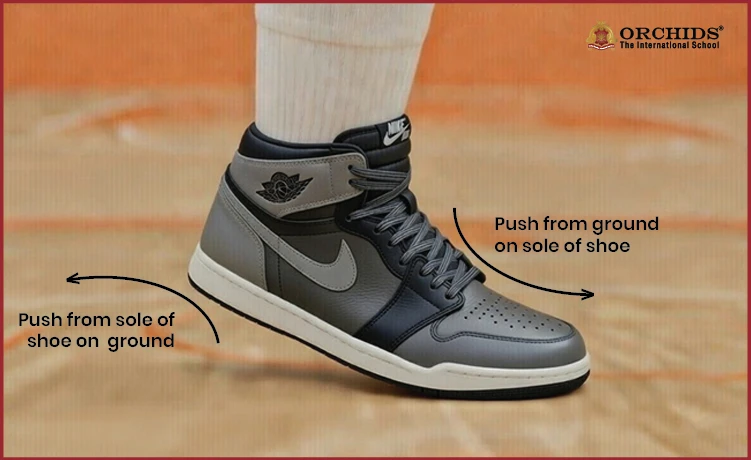
Similarly, a car slows down when the brakes are applied because friction acts on the tyres. Athletes also rely on friction, so players wear spikes for a better grip, and gloves help batsmen hold the cricket bat firmly
(ii) Another type is Muscular Force, which is produced by the contraction of our muscles. You use it when lifting weights while exercising, pushing a swing, or pulling a rope in a tug-of-war.
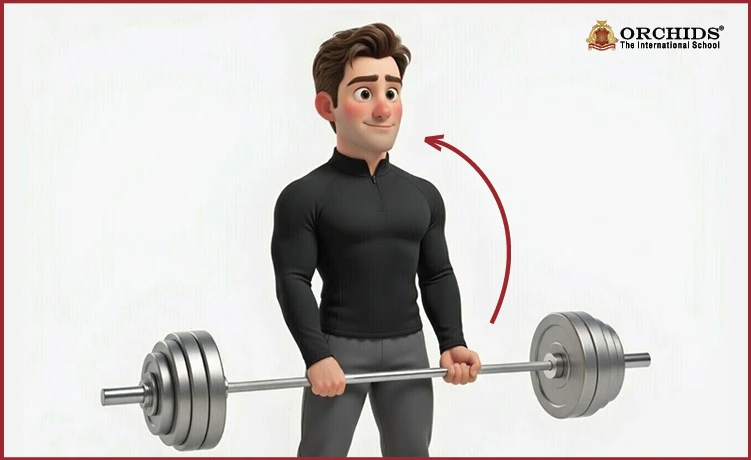
You may wonder after knowing that everyday activities like running, climbing, and bending also rely on muscular force to get things done.
(iii) Another important force is the Normal Force, which acts upward whenever an object rests on a surface. For example, a book lying on a table does not fall because the table pushes it upward, balancing the pull of gravity.
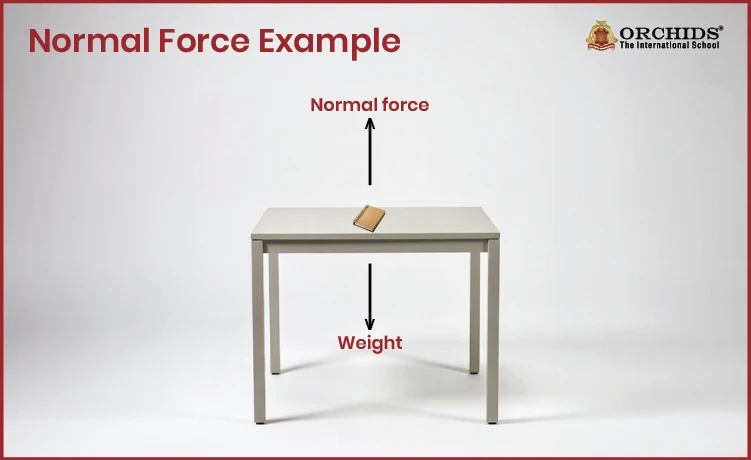
(iv) Next is Applied Force, which is any push or pull exerted by a person or another object. You experience it when pushing a cupboard, pulling a drawer, or hitting a ball with a bat.
(v)Tension Force occurs in a string, rope, wire, or cable when it is stretched. For instance, a mountaineer hanging by a rope feels the tension in the rope supporting their weight.

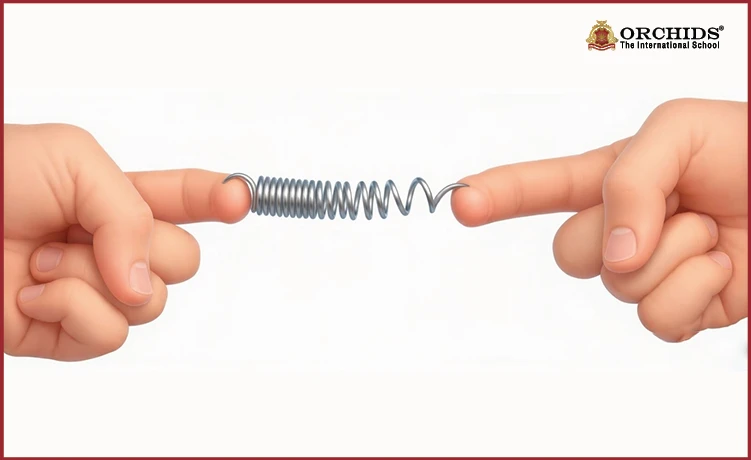
(vi) Then there’s Spring Force, which is stored in a compressed or stretched spring. A simple example is a spring toy that jumps back when you press and release it due to this force.
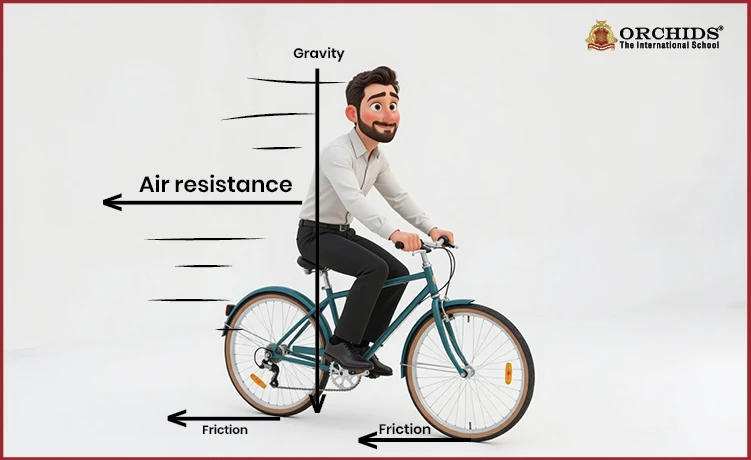
(vii) Lastly, Air Resistance is a friction-like force that acts on objects moving through the air. This is why riding a bicycle against a strong wind feels more difficult, as the air resists your motion.
Non-Contact Force
Non-contact forces act on objects without any physical touch. You may not see them, but they shape everything in the universe, from falling apples to orbiting planets.
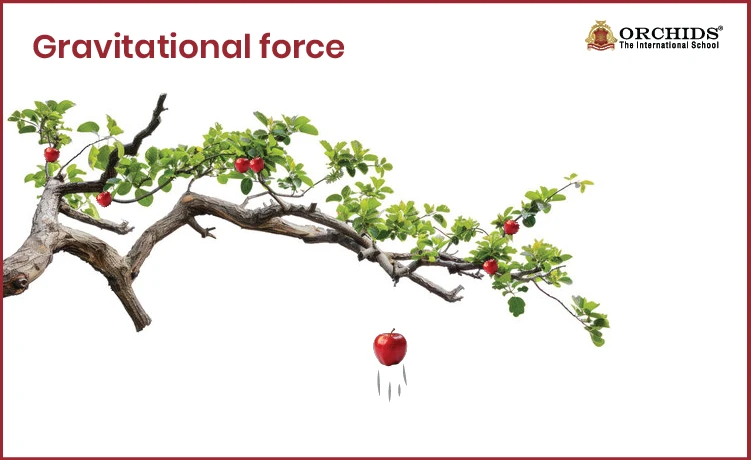
(i) One well-known non-contact force is the Gravitational Force, which acts between any two masses. That's why things fall downward: a ball thrown up comes back down, water flows downward, and fruits fall from trees.
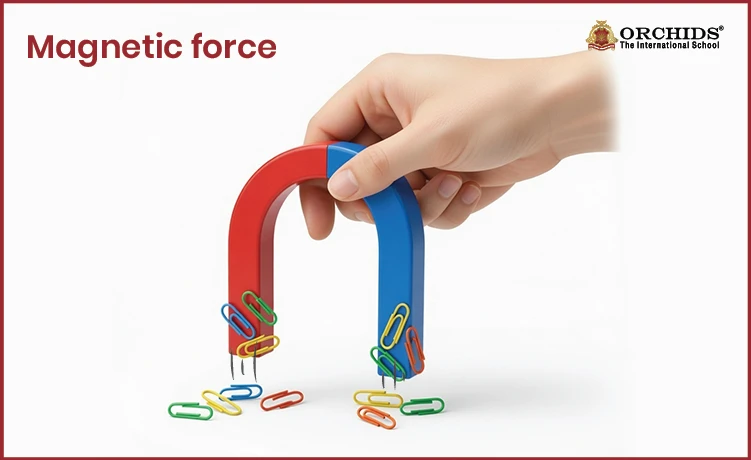
(ii) Another type is the Magnetic Force, which acts between moving charged particles or magnets. For example, magnets attract iron objects, such as paper clips and fridge magnets.
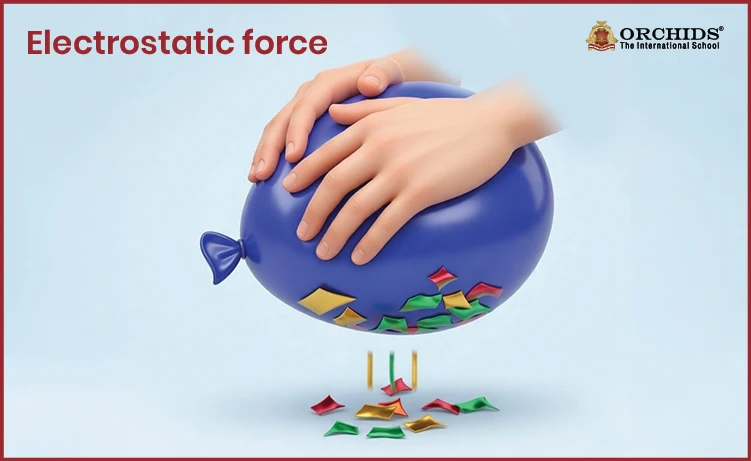
(iii) Electrostatic Force occurs between electrically charged objects. You see it when tiny pieces of paper stick to a comb after combing your hair, when a balloon rubbed on your hair sticks to the wall, or on a much larger scale, during lightning storms.
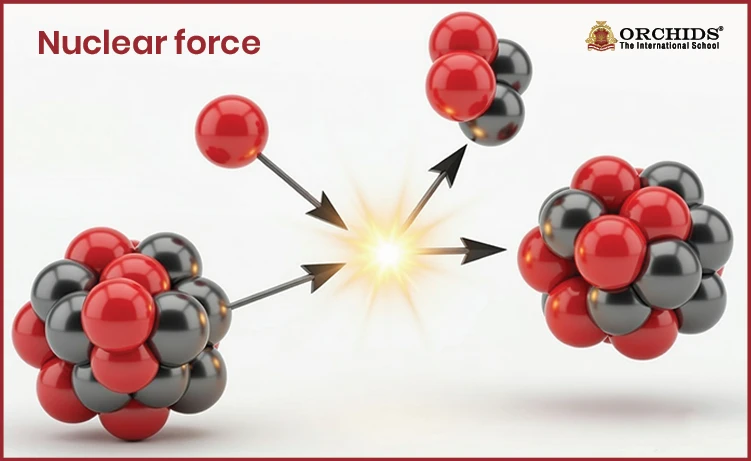
(iv) Finally, there is the Nuclear Force, the strongest force known, which holds protons and neutrons together inside an atom’s nucleus. Without this force, atoms and everything made of atoms!
Balanced force
When forces on an object are equal and opposite, it stays at rest or moves at a constant speed.
The interesting fact about balanced forces is that when forces are balanced, an object's motion does not change; it will either remain at rest or continue moving at a constant velocity.
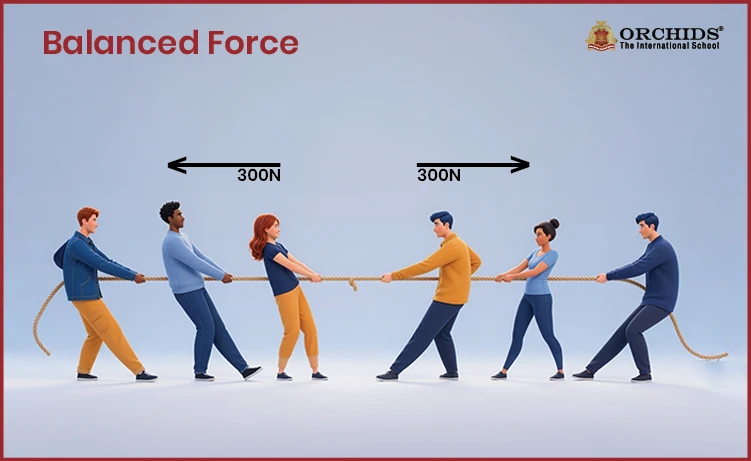
For example, a book resting on a table or two equally matched teams in a game of tug-of-war.
Unbalanced Force
When forces are unequal, they change the object’s motion, speeding it up, slowing it down, or changing its direction.
This net force causes an object at rest to start moving, or a moving object to change its speed or direction. The best example is a tug-of-war match. If one team pulls harder than the other, the forces on the rope are no longer equal.
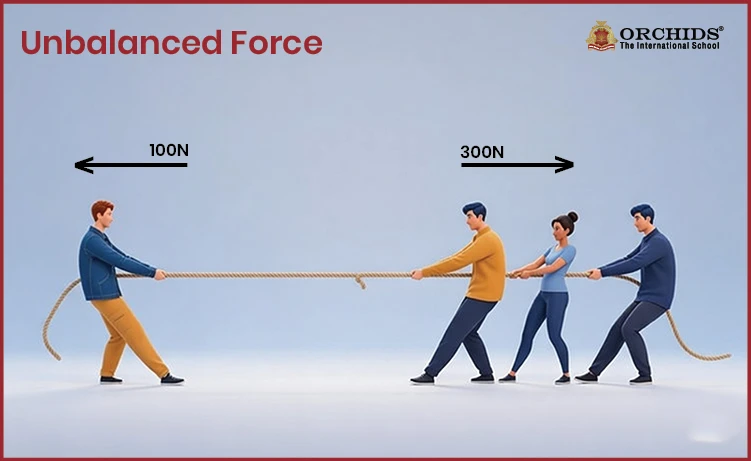
The stronger team creates a net force, causing the rope (and sometimes the other team!) to move in their direction.
Read More: Effects of Force: How Force Changes Objects
So far, we learned, from the pushing that starts a ball rolling to the invisible pull of gravity keeping planets in orbit, force plays an important role. Understanding the different types of forces in physics, both contact and non-contact, helps us make sense of how objects move and interact in daily life.
By observing and applying these forces, we can not only explain natural phenomena but also design machines, sports equipment, vehicles, and technology that make life easier and more efficient
Frequently Asked Questions on Types of forces
1. What is the meaning of force in physics?
In physics, force is any push or pull that can change the motion of an object. It can make things start moving, stop, or change direction.
2. What are the different types of forces in physics?
Different types of forces in physics describe how objects interact with each other, like pushing, pulling, or gravitational attraction. Understanding them helps explain everyday phenomena, from falling apples to moving cars.
3. Can you give some examples of types of force with examples?
Types of force with examples include friction when sliding a book, tension in a rope during tug-of-war, and gravity pulling objects toward Earth. These examples make physics easy to relate to daily life.
4. What is meant by types of contact force?
Types of contact force are forces that occur when two objects physically touch, like pushing a door or pulling a cart. They differ from forces acting at a distance, such as gravity or magnetism.
5. How do different types of forces in physics affect motion?
Different types of forces in physics can speed up, slow down, or change the direction of objects. For instance, friction slows down a rolling ball while a push accelerates it.
6. What are some common types of force with examples at home?
Types of force with examples at home include lifting a bucket (applied force), rubbing hands together (friction), and a magnet attracting keys (magnetic force). These show physics in everyday life.
7. Can you explain the types of contact force in simple terms?
Types of contact force include pushing, pulling, tension, and friction, all of which happen when objects touch. For example, sliding a chair across the floor involves friction, a common contact force.
8. Why is it important to learn different types of forces in physics?
Learning different types of forces in physics helps us understand how everything moves and interacts. It’s the foundation for designing machines, vehicles, and even understanding nature.
Science isn't just a subject, it's the way of seeing the world. Curious how Orchids The International School teaches it that way? Talk to our admissions team.
Admissions Open for 2026-27
What type of concept pages would you prefer?
CBSE Schools In Popular Cities
- CBSE Schools in Bangalore
- CBSE Schools in Mumbai
- CBSE Schools in Pune
- CBSE Schools in Hyderabad
- CBSE Schools in Chennai
- CBSE Schools in Gurgaon
- CBSE Schools in Kolkata
- CBSE Schools in Indore
- CBSE Schools in Sonipat
- CBSE Schools in Delhi
- CBSE Schools in Rohtak
- CBSE Schools in Bhopal
- CBSE Schools in Aurangabad
- CBSE Schools in Jabalpur
- CBSE Schools in Jaipur
- CBSE Schools in Jodhpur
- CBSE Schools in Nagpur
- CBSE Schools in Ahmednagar
- CBSE School In Tumkur











Orchids The International School is one of India's leading chains of CBSE and ICSE schools, with 110+ schools across the country.