

Conservative Force
Conservative Force plays a key role in understanding how energy behaves in physics. It refers to forces that depend only on where an object starts and where it ends, not on the path taken between those points. These forces help mechanical energy stay conserved, making them predictable and reversible in nature.
This article is a perfect guide to understanding what conservative forces are, how they behave, and how they differ from non-conservative forces in detail.
Table of Contents
- What is a Conservative Force?
- Important Properties of Conservative Force
- Non-Conservative Force & Its Properties
- Frequently Asked Questions on Conservative Force

What is a Conservative Force?
A Conservative Force is a force where the work done does not depend on the path traveled.
Then, on what property does it depend?
Conservative force is dependent upon the initial and final points of the path covered. It only cares about where you start and where you end.
If an object moves in a closed loop and returns to its starting point, the total work done by a conservative force becomes zero. This is because the beginning and ending points are the same. Conservative forces always follow the law of conservation of energy.
We already know that there are so many natural forces, such as the magnetic force, the electrostatic force, and the gravitational force. You will be amazed after knowing that all these forces are examples of conservative forces.
Let's try to understand this concept with an example.
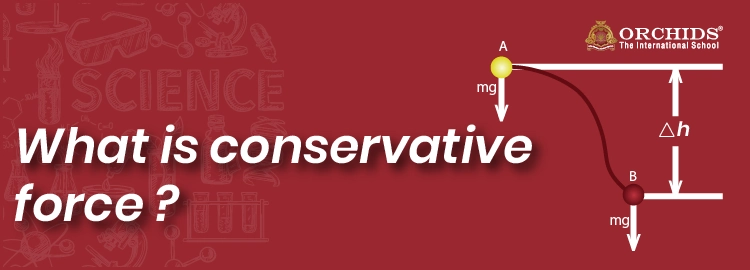
Consider a small object that is moving from point A to point B. Here, gravity pulls it downward with a force equal to mg (where m is mass and g is acceleration due to gravity).
-01.webp "Object under gravity Conservative-Force.")
Now, the object may not move in a straight line. It might take a curved or zig-zag path because of other forces acting on it. That curvy pink line in the above picture shows this arbitrary path.
But you will be amazed after knowing that gravity doesn't care about the arbitrary path at all that is travelled by the object.
Gravity only cares about how much the object moved up or down, that is, the vertical displacement, which is denoted by Δh.
So even if the object takes the longest, twistiest path, gravity will always do the same amount of work as long as:
-
The starting point A
-
The ending point B
have the same height difference.
Here we can easily calculate the work done by gravity using a mathematical expression,
Here,=difference between the final position (B) and the initial position (A)
g = acceleration due to gravity
m = mass of the particle
From the above expression, it can be concluded that the total work done by gravity only depends on the starting and ending points, not on the path taken.
That is the reason why gravitational force is called a conservative force.
Next, let's discuss the major properties of a conservative force.
Important Properties of Conservative Force
A force is called conservative if it follows these key properties:
-
The work done by the force depends only on the starting point and ending point, not on the path taken.
-
If an object returns to its starting point (a closed loop), the total work done by a conservative force is zero.
-
The work done by a conservative force can be completely recovered if the motion is reversed.
Now, let's discuss what a non-conservative force?
Non-Conservative Force & Its Properties
A non-conservative force is a force where the work done depends on the path taken by an object, not just its starting and ending points.
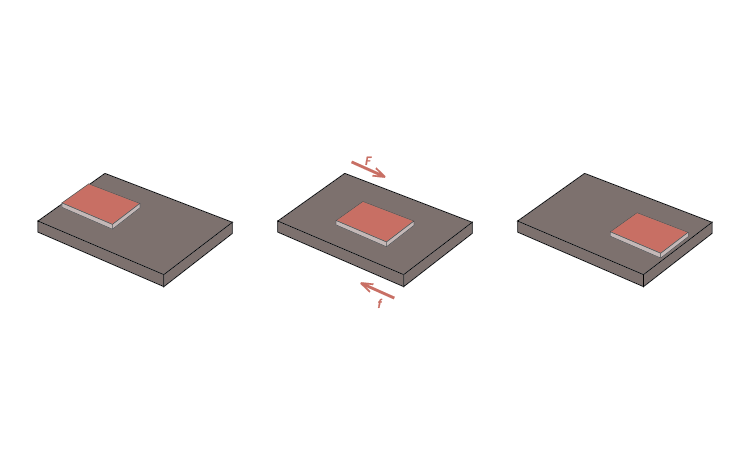
To understand this in a better way, consider a simple example. Friction is a classic non-conservative force. When you slide a book across a table, friction turns some of the mechanical energy of the book into heat. This energy cannot be fully recovered, which makes the process irreversible.
Non-conservative forces cause changes in mechanical energy, which is the total of kinetic energy (energy of motion) and potential energy (stored energy). So, whenever a non-conservative force does work, it either adds or removes energy from the system.
Now, let's discuss the properties of Non-Conservative Forces,
Non-conservative forces have opposite properties compared to conservative forces:
-
The work done depends on the path taken, not just the start and end points.
-
Work in a closed path is not zero means that if the object returns to its starting point, the total work done is not zero.
-
The energy transformed by a non-conservative force cannot be fully recovered.
Till now, we have learned that conservative forces are special because they only care about where an object starts and where it ends; that is, not the path in between. That is the reason why forces like gravity, magnetic force, and electrostatic force can store and return energy perfectly. On the other hand, non-conservative forces like friction depend on the path and always waste some energy as heat.
Frequently Asked Questions on Conservative Force
1. What is conservative force?
A conservative force is a force where the work done depends only on the starting and ending points. It helps energy stay stored and easily reversible, like gravity or spring force.
2. What is non-conservative force?
A non-conservative force is a force where work depends on the path taken. It usually causes energy loss, such as friction, slowing things down.
3. What are some conservative force examples?
Some common conservative force examples include gravitational force, electrostatic force, and spring force. These forces store energy that can be fully recovered.
4. What do conservative forces depend on?
Conservative forces depend only on the initial and final position of an object. They do not depend on the path followed.
5. Is air resistance a conservative force?
No, air resistance is a non-conservative force because it slows objects down and causes continuous energy loss.
6. Is gravitational force a conservative force?
Yes, gravitational force is indeed a conservative force. It allows mechanical energy to stay conserved since the work done is independent of the path.
7. Is friction a conservative force?
Friction is a non-conservative force because it converts energy into heat, which cannot be recovered.
Science isn't just a subject, it's the way of seeing the world. Curious how Orchids The International School teaches it that way? Talk to our admissions team.
Admissions Open for 2026-27
What type of concept pages would you prefer?
CBSE Schools In Popular Cities
- CBSE Schools in Bangalore
- CBSE Schools in Mumbai
- CBSE Schools in Pune
- CBSE Schools in Hyderabad
- CBSE Schools in Chennai
- CBSE Schools in Gurgaon
- CBSE Schools in Kolkata
- CBSE Schools in Indore
- CBSE Schools in Sonipat
- CBSE Schools in Delhi
- CBSE Schools in Rohtak
- CBSE Schools in Bhopal
- CBSE Schools in Aurangabad
- CBSE Schools in Jabalpur
- CBSE Schools in Jaipur
- CBSE Schools in Jodhpur
- CBSE Schools in Nagpur
- CBSE Schools in Ahmednagar
- CBSE School In Tumkur











Orchids The International School is one of India's leading chains of CBSE and ICSE schools, with 110+ schools across the country.