

Chemistry
Where CuriosityClicks
Chemistry is not just a classroom subject; Not everybody is aware of how it’s the hidden force shaping our daily lives. The curious thing about chemistry is that it is from the moment we breathe in oxygen to the technology that powers our devices; chemistry helps us understand how matter actually behaves, transforms, and interacts. In short, the things around us may look simple, but there is a huge chemistry playing behind!
This article breaks down chemistry, explaining its branches and demonstrating its connections to other sciences with real-life examples.
What is Chemistry?
Chemistry is the branch of science; unlike physics and biology, it is mainly the study of matter, anything that has mass and takes up space. It investigates the composition of substances, their behaviour, and the changes they undergo.
Do you know? How did the evolution of chemistry take place?
Chemistry began with ancient humans observing natural processes like metal reactions and fermentation, progressed through alchemy, and evolved into modern science with pioneers like Boyle and Lavoisier. 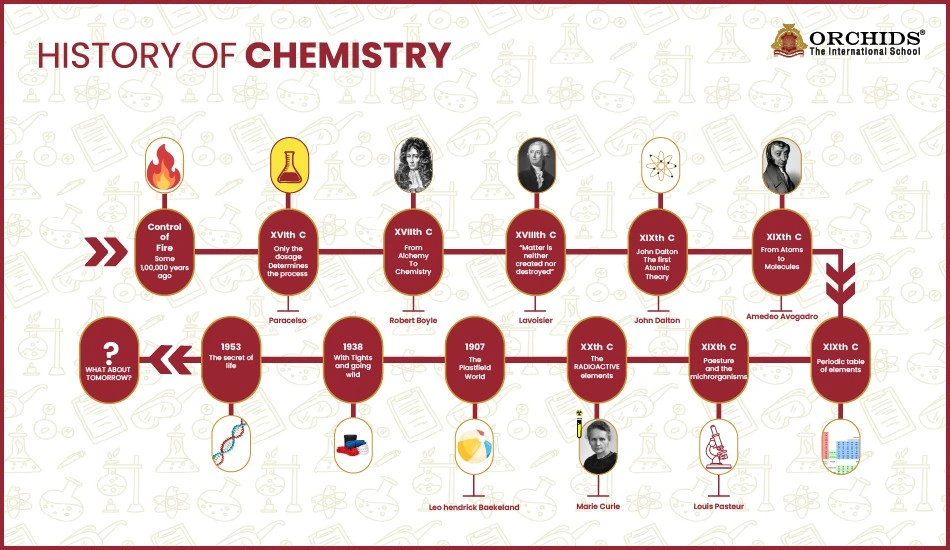
When it comes to chemistry, the heart is atoms and molecules, the tiny building blocks of everything around us. But Chemistry doesn’t just look at what things are made of; it also explores energy: how heat, light, or electricity can trigger chemical reactions or be released during them.
For example:
- Rusting of iron shows how metals react with oxygen and moisture.
- Medicines work because chemical compounds interact with our bodies in specific ways.
- Batteries store and release energy through controlled chemical reactions.
Interestingly!! The development of atomic theory, the periodic table, and specialised branches such as organic and inorganic chemistry shaped it into a central science, driving advances in medicine, industry, materials, and technology.
How are Chemistry and Other Branches of Science Related?
Science is a systematic way to study and understand the universe.
The fact! Chemistry is often called thecentral science because it bridges physics (how the universe works at a fundamental level) and biology (the study of living organisms). For example:
- Biochemistry applies chemical principles to understand processes like digestion, respiration, and DNA replication.
- Environmental science uses chemistry to track pollutants, study climate change, and develop clean energy solutions.
- Materials science relies on chemistry to create stronger alloys, flexible plastics, or new battery materials.
This interconnectedness makes chemistry crucial for solving global challenges such as renewable energy, healthcare innovation, and sustainable agriculture.
The illustration below shows how these relationships between the science branches, which are major ones, with chemistry being at the centre, look like!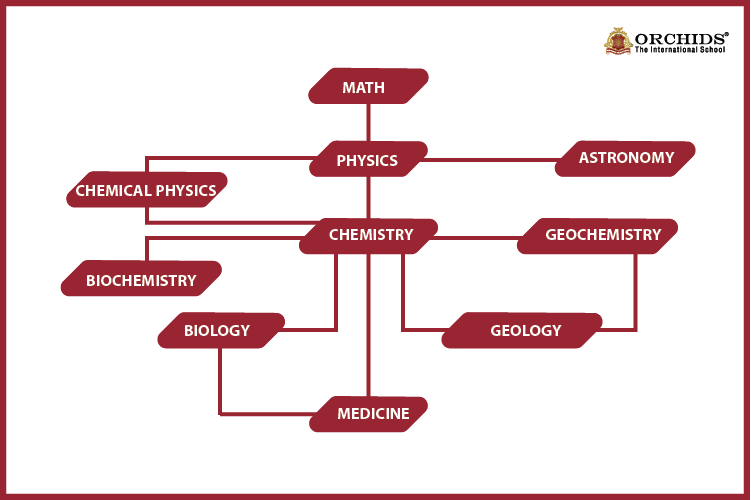
Because the universe is vast, science is divided into several categories, each focusing on different aspects of nature:
|
Category |
What It Covers |
|
Formal Sciences |
Deals with abstract systems like mathematics, statistics, and logic. These form the language and tools that other sciences, including chemistry, use to model and predict phenomena. |
|
Natural Sciences |
Investigates natural phenomena using observation and experimentation. Chemistry, physics, and biology are central here. For instance, physics provides the laws of energy and motion, while chemistry uses them to explain molecular interactions. |
|
Social Sciences |
Focuses on human behaviour and societies. Disciplines like psychology, economics, and sociology sometimes use chemical knowledge, such as in studying how drugs affect the brain or how environmental chemistry influences public health. |
Next, let's discuss the branches of Chemistry :
Branches of Chemistry
To better understand the vast scope of this science, it is divided into several branches, each focusing on specific aspects of substances and their interactions.
The main branches of Chemistry include:
- Organic Chemistry
- Inorganic Chemistry
- Physical Chemistry
- Analytical Chemistry
- Biochemistry
Below is the short description of how this branch is categorised:
|
Branch |
Description |
|
Organic Chemistry |
Studies carbon-based compounds. Fuels, plastics, perfumes, and life-saving drugs all depend on organic chemistry. |
|
Inorganic Chemistry |
Focuses on metals, minerals, and non-carbon compounds. It’s essential for materials science, catalysis, and pigments. |
|
Physical Chemistry |
Combines chemistry and physics to study energy changes, molecular structures, and reaction rates. It explains why reactions speed up with heat or slow down with cold. |
|
Analytical Chemistry |
Identifies and measures the components of substances. Used in forensics, food safety, and drug testing. |
|
Biochemistry |
Explores the chemical processes within living organisms, like how enzymes break down food or how DNA replicates. |
Apart from that, it also has some specialised areas:
- Environmental Chemistryincludes the Study of pollution, water quality, and sustainable technologies.
- Medicinal Chemistry is about designing and improving pharmaceuticals.
- Polymer Chemistry develops plastics, fibres, and advanced materials.
- Nuclear Chemistry examines radioactive substances and energy production.
- Materials Chemistryinnovates stronger metals, flexible electronics, and biodegradable materials.
- Industrial Chemistry applies chemical knowledge for large-scale manufacturing of products like fertilisers, dyes, fuels, and consumer goods.
- Theoretical Chemistry uses mathematics and computer models to predict molecular behaviour and explain chemical phenomena.
- Agricultural Chemistry focuses on fertilisers, pesticides, soil chemistry, and crop protection to improve agricultural productivity.
- Nuclear Chemistry examines radioactive substances, nuclear reactions, and energy production, contributing to power generation and medical imaging.
Examples of Chemistry in Daily Life
- Cooking and Baking involve heating food, which changes its chemical structure. Ever noticed? caramelising sugar or baking bread.
- The photosynthesis process is where Plants convert sunlight, water, and carbon dioxide into food and oxygen, sustaining life on Earth. It involves a major chemical process.
- Household Cleaners aremostly available in everyone's home, which are actually acids and bases in cleaning agents that remove stains and disinfect surfaces.
- Medicines and Vaccinesare an important part of human life, right? This is where the chemistry creates life-saving drugs and vaccines, from antibiotics to cancer treatments.
- The Sunscreens and Cosmetics, which areformulated using compounds that absorb or reflect harmful UV rays, are also made through certain chemical processes.
- Even Water Purification involvesChlorine and other chemicals to keep our drinking water safe.
Apart from the above examples, chemistry is everywhere in our daily life, and it is mostly related to chemical processes if we analyse everything so carefully.
Chemistry is the science that helps us understand what everything around us is made of and how different substances behave, react, and transform. From the air we breathe to the medicines we take, from the food we eat to the materials used in buildings and technology, chemistry is deeply connected to everyday life.
Chemistry Concepts
The Orchids International School Learning offers a rich collection of FREE study materials across chemistry to help students excel. Our well-structured resources are organised under clear topics and categories, making it easy for learners to find exactly what they need.
Frequently Asked Questions on Chemistry
1. What is chemistry?
Chemistry is the study of substances, their properties, and how they change or react with each other. It helps us understand the world at a molecular level.
2. What is chemistry definition?
The definition of chemistry is the branch of science that explores matter, its composition, and the transformations it undergoes during chemical reactions.
3. Who is the father of chemistry?
Antoine Lavoisier is called the father of chemistry for establishing modern chemical naming and laws that shaped the science.
4. What is organic chemistry?
Organic chemistry is the study of carbon-containing compounds and how they form the basis of life and countless useful materials.
5. What is inorganic chemistry?
Inorganic chemistry focuses on compounds that are not primarily carbon-based, including metals, minerals, and salts.
6. What is green chemistry?
Green chemistry is the approach of designing chemical processes and products that reduce or eliminate harmful substances for a safer, sustainable future.
7. Why is chemistry important?
Chemistry is important because it explains the makeup of everything around us and drives innovations in medicine, energy, and technology.
8. What are the branches of chemistry?
The branches of chemistry include organic, inorganic, physical, analytical, and biochemistry, each studying different aspects of matter and its changes.
9. How is chemistry used in daily life?
Chemistry is part of our daily lives, from cooking and cleaning to developing medicines and eco-friendly materials.
CBSE Schools In Popular Cities
- CBSE Schools in Bangalore
- CBSE Schools in Mumbai
- CBSE Schools in Pune
- CBSE Schools in Hyderabad
- CBSE Schools in Chennai
- CBSE Schools in Gurgaon
- CBSE Schools in Kolkata
- CBSE Schools in Indore
- CBSE Schools in Sonipat
- CBSE Schools in Delhi
- CBSE Schools in Rohtak
- CBSE Schools in Bhopal
- CBSE Schools in Aurangabad
- CBSE Schools in Jabalpur
- CBSE Schools in Jaipur
- CBSE Schools in Jodhpur
- CBSE Schools in Nagpur
- CBSE Schools in Ahmednagar
- CBSE School In Tumkur











Orchids The International School is one of India's leading chains of CBSE and ICSE schools, with 110+ schools across the country.