

Carbonate Ores: Formation, Properties and Industrial Significance
Carbonate ores are minerals that contain metals bonded with carbonate compounds. These ores are an important source of metals like zinc and copper.
This article provides complete information on carbonate ores, types used and more about the chemistry of it for a better understanding.
Table of Contents

What are Carbonate Ores?
Carbonate ores are naturally occurring minerals that contain carbonates (CO₃²⁻) bonded with metals. These ores are important sources of metals like copper, calcium, magnesium, zinc, and iron. Let’s break down each of them in a simple way.
Types of Carbonate Ores
Copper Carbonate Ore: Malachite
We would have to agree that malachite is an aesthetically pleasing mineral with its green characteristics, and of course, it contains copper. Malachite is a copper carbonate hydroxide, which is a mouthful for a mineral, especially considering that malachite's chemical formula is Cu₂CO₃(OH)₂.
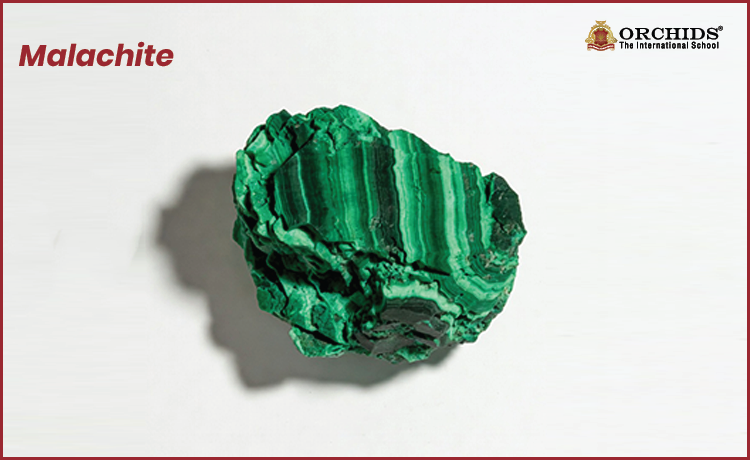
- Appearance: Vivid green; opaque and beautiful band pattern.
- Structure: Malachite forms in the monoclinic crystal system. Copper ions (Cu²⁺) link up with hydroxide (OH⁻) and carbonate (CO₃²⁻) ions in a special arrangement.
- Formation: It usually forms from the weathering and oxidation of copper sulfide ores.
- Commonly found: Azurite, calcite, and goethite.
But the interesting question is, how is copper extracted?
- Malachite is heated (smelting), breaking it down into copper oxide.
- Then, using carbon (like charcoal), copper oxide is reduced to pure copper metal.
Interesting use: Used decoratively, like in the famous Malachite Room in Russia’s Hermitage Museum.
Carbonate Ore of Calcium: Calcite
Calcite is one of the most common calcium carbonate minerals with the chemical formula CaCO₃.
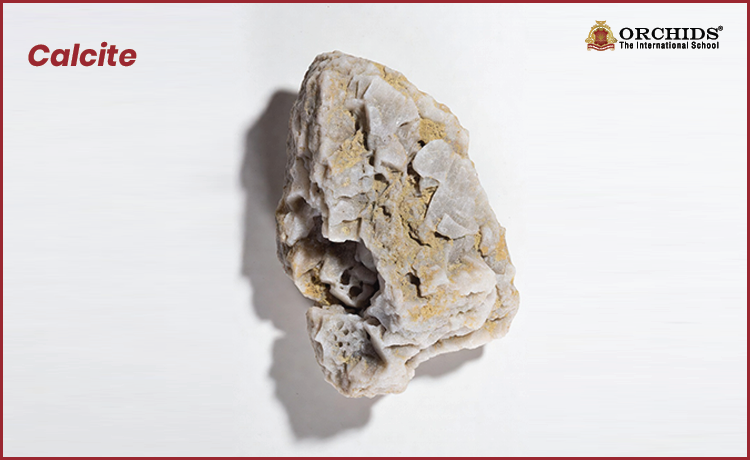
- Appearance: Clear to white, can also glow (phosphorescence or fluorescence).
- Reaction with acid: It fizzes when exposed to acid, producing calcium ions, water, and carbon dioxide:
- CaCO₃ (s) + 2H⁺ (aq) → Ca²⁺ (aq) + H₂O (l) + CO₂ (g)
- Natural source: Found in sedimentary rocks like limestone, which is formed from marine shells.
- Other uses: Helpful in soil improvement, concrete repair, and even Viking navigation (Iceland spar).
Carbonate Ore of Magnesium: Magnesite
Magnesite is the main carbonate ore of magnesium, with the formula MgCO₃, with a variety of uses.
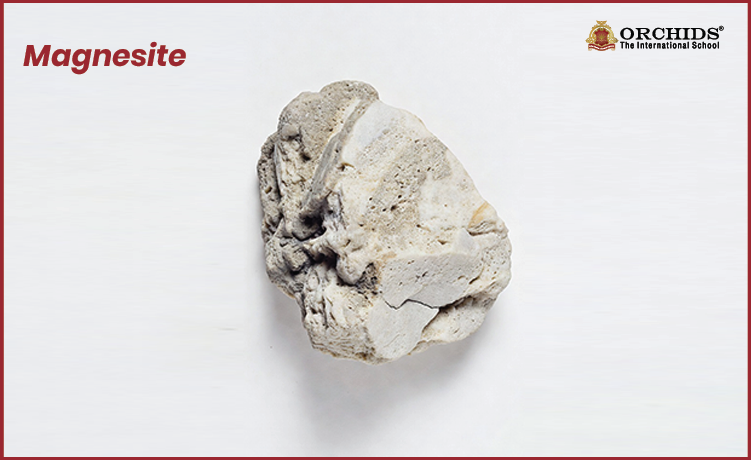
- Appearance: white with a trigonal crystal structure.
- Solubility: It doesn't dissolve well in water but reacts with acids.
- Formation: It can form from the carbonation of serpentine rock (like lizardite):
- 2 Mg₃Si₂O₅(OH)₄ + 3 CO₂ → Mg₃Si₄O₁₀(OH)₂ + 3 MgCO₃ + 3 H₂O
- Uses: Polished into beads for jewellery; often dyed to mimic turquoise.
Carbonate Ore of Zinc: Smithsonite
Smithsonite, or zinc carbonate, has the formula ZnCO₃ and is also known as zinc spar or turkey fat.
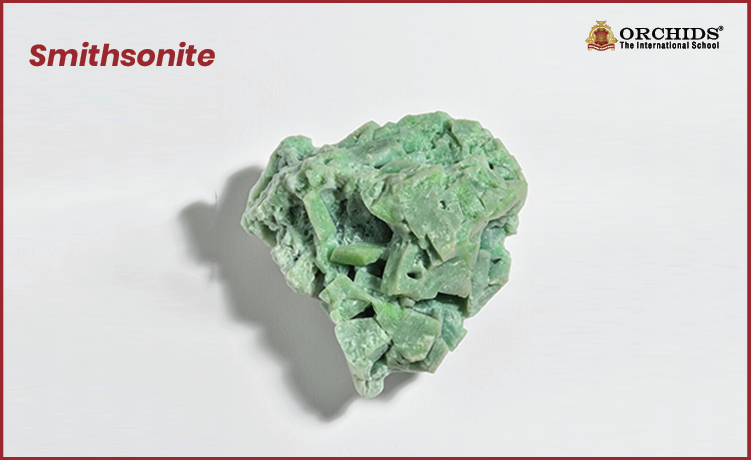
- Appearance: Comes in many colours, usually found in rounded, smooth formations.
- Formation: Forms in areas where zinc ores weather or oxidise.
- Uses: Siderite is a source of zinc that is used primarily for galvanising metals, in batteries, and in healthcare products.
Carbonate Ore of Iron Siderite
Siderite is an iron carbonate mineral with the formula FeCO₃, which has many different uses.
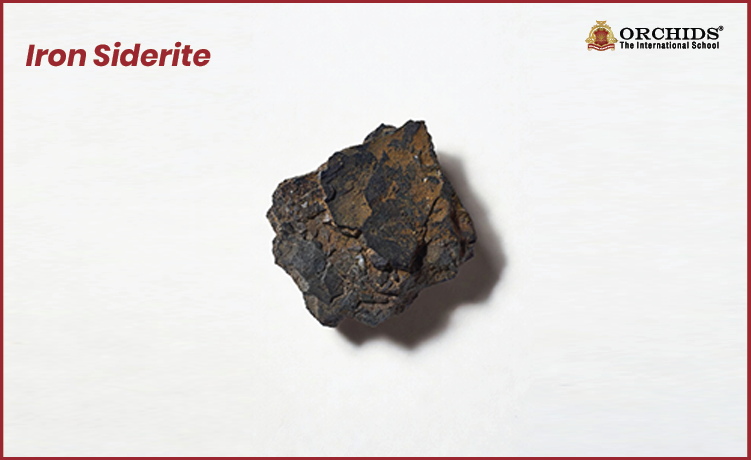
- Appearance: Ranges from yellow to dark brown or black, often found in rhombohedral crystals.
- Fun Fact: Did you know that siderite is a type of iron meteorite?
- Value: It’s actually tougher to smelt than iron oxide ores like hematite.
Below are Pointers to keep in Mind while learning Carbonate Ores
- Rocks having metals mixed with carbonate (CO₃²⁻) are known as carbonate ores.
- Malachite (copper), calcite (calcium), magnesite (magnesium), smithsonite (zinc), and siderite (iron) are examples.
- When they react with acid, they typically bubble, which is carbon dioxide escaping.
- These ores are found in sedimentary rocks and are frequently formed by weathering and other natural processes.
- These ores are frequently roasted and treated with carbon to extract the metal.
Learn More: Calcium Carbonate and Ammonium bicarbonate
As we have learned, their common rock appearance, carbonate ores are rich in essential metals that we utilise daily, such as the calcium in cement and the copper in wires. And everything makes more sense the more you investigate. This is how Carbonate ores are beneficial to our lives.
Frequently Asked Questions on Carbonate Ore
1. What are carbonate ores mostly of?
Carbonate ores are mainly made up of metal carbonates like calcium, copper, or zinc bonded with carbon and oxygen. These minerals are found naturally in the earth’s crust.
2. How are carbonate ores extracted?
They are usually extracted through a process called calcination, where the ore is heated to break it down and release carbon dioxide.
3. Are carbonate ores roasted?
No, carbonate ores are not roasted; instead, they undergo calcination because roasting is mainly for sulphide ores.
4. Are carbonate ores strongly heated?
Yes, they are strongly heated in the absence of air during calcination to convert the carbonate into metal oxide.
5. How are carbonate ores concentrated?
Carbonate ores are concentrated by physical methods like froth flotation or gravity separation to remove impurities before further processing.
Science isn't just a subject, it's the way of seeing the world. Curious how Orchids The International School teaches it that way? Talk to our admissions team.
Admissions Open for 2026-27
What type of concept pages would you prefer?
CBSE Schools In Popular Cities
- CBSE Schools in Bangalore
- CBSE Schools in Mumbai
- CBSE Schools in Pune
- CBSE Schools in Hyderabad
- CBSE Schools in Chennai
- CBSE Schools in Gurgaon
- CBSE Schools in Kolkata
- CBSE Schools in Indore
- CBSE Schools in Sonipat
- CBSE Schools in Delhi
- CBSE Schools in Rohtak
- CBSE Schools in Bhopal
- CBSE Schools in Aurangabad
- CBSE Schools in Jabalpur
- CBSE Schools in Jaipur
- CBSE Schools in Jodhpur
- CBSE Schools in Nagpur
- CBSE Schools in Ahmednagar
- CBSE School In Tumkur











Orchids The International School is one of India's leading chains of CBSE and ICSE schools, with 110+ schools across the country.