

Ammonium bicarbonate
Ammonium bicarbonate is a well-known compound that quietly supports both chemical production plants and home kitchens. It is a significant ingredient in a number of fast-baking applications, agricultural applications, and industrial applications.
This article will discuss the production of ammonium bicarbonate, its general chemical behaviour, its applications, and the best practices for handling it safely.
Table of Contents
- What is Ammonium Bicarbonate and its Structure
- Production of Ammonium Bicarbonate
- Features of Ammonium Bicarbonate
- Reactions of Ammonium Bicarbonate
- Uses of Ammonium Bicarbonate
- Health Hazards of Ammonium Bicarbonate
- Tricks to Learn About Ammonium Bicarbonate
- Frequently Asked Questions on Ammonium bicarbonate

What is Ammonium Bicarbonate and its Structure
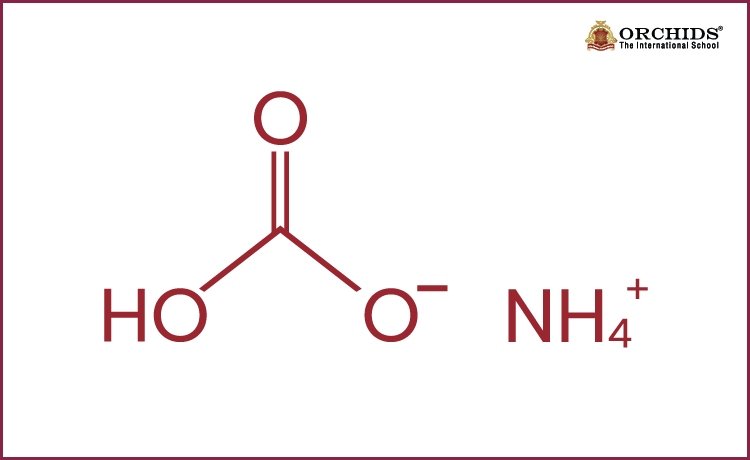
Ammonium bicarbonate is a salt that is inorganic and made from two common ions that have bonded:
-
Ammonium ion
-
Bicarbonate ion
The product has ionic bonding and is a white crystalline compound. The positive charge of the ammonium ion neutralises the negative charge of the bicarbonate ion, and this compound is generally stable.
.webp "Ammonium Bicarbonate")
The bonding within the molecule is heat-unstable; moderate heating will dissociate it to a gaseous state. However, this heat-unstable background molecular structure will have some applications in chemical and food uses.
Production of Ammonium Bicarbonate
Ammonium bicarbonate is mostly produced by the reaction of ammonia (NH₃) and carbon dioxide (CO₂) in water (H₂O). The reaction occurs at low temperature, which is done under controlled, industrial conditions.
➔Chemical Reaction:
➔This reaction also generates heat, so it’s exothermic. Ammonium bicarbonate also would have a fast decomposition rate at room temperature.
Therefore, storage is of utmost importance to avoid losing material through decomposition; a proper seal is recommended if possible.
Features of Ammonium Bicarbonate
|
Property |
Detail |
|
Chemical Formula |
|
|
Molar Mass |
79.06 g/mol |
|
Appearance |
White crystalline powder |
|
Odour |
Slight ammonia-like odour |
|
Solubility |
Soluble in water, insoluble in alcohol |
|
Stability |
Decomposes on heating |
|
Melting Point |
Descends between 36°C to 60°C |
Reactions of Ammonium Bicarbonate
- Thermal Decomposition
Heating ammonium bicarbonate decomposes into three gases:
This process is responsible for the rising of baked foods, as the ejected gases form air bubbles in the dough.
- Reaction with Acids
Ammonium bicarbonate reacts with acids to yield carbon dioxide gas:
- Reaction with Bases
Upon treatment with strong bases such as sodium hydroxide (NaOH), it liberates ammonia:
➔
Uses of Ammonium Bicarbonate
Ammonium bicarbonate is important because of its ability to release gases under mild conditions. It is used in a variety of ways:
-
Laboratory: Used as a reagent in analytical chemistry and in the preparation of some buffer systems.
-
Cleaning products; When its fizzing characteristic is used in some compounds for industrial cleaning products, it is especially valuable when de-scaling or deodorising products.
-
Pharmaceutical: Used as part of some medication preparations, either as a carbonate donor or due to gas-emitting properties.
Health Hazards of Ammonium Bicarbonate
Though quite safe in controlled, small quantities (particularly in foods), ammonium bicarbonate should be treated with care when used in large quantities.
-
Irritation of the nose and throat from breathing in dust.
-
Causes slight irritation or redness.
-
In small quantities (in baked foods), it is safe. But eating it raw or in excess can induce nausea or abdominal upset.
Safety Tips
-
Never expose to open fires or heat
-
Keep it in tightly closed containers in cool, dry areas
Tricks to Learn About Ammonium Bicarbonate
-
Name combo trick;Ammonium (NH₄⁺) + Bicarbonate (HCO₃⁻) = NH₄HCO₃, a simple salt combo.
-
Structure memory; It’s just positive meets negative ionic bond in a white powder form.
-
Fun fact recall: Common in the kitchen but useful in labs-small salt, big impact.
We have learned that ammonium bicarbonate might look like just another white powder; however, its role in day-to-day life and industrial chemistry is surprisingly diverse. Part of knowing its value can be related to how it is made, how it acts, and where it is used.
Frequently Asked Questions on Ammonium bicarbonate
1. What is the importance of ammonium bicarbonate?
It’s useful in baking, cleaning, and science labs because it easily gives off gases. That makes it great for puffing up dough or removing grime.
2. What happens to ammonium bicarbonate when heated?
It breaks apart into gas when heated, like bubbles forming in dough. This is why it’s used in baking and some fizzing cleaners.
3. How long does ammonium bicarbonate last?
It lasts a long time if kept sealed in a cool, dry place. But it slowly breaks down if left out in the open.
4. Is ammonium bicarbonate acidic or basic?
It’s mildly basic, so it can cancel out acids. That’s why it’s helpful in some chemical reactions and cleaners.
5. Why is ammonium bicarbonate preferred in cooking over other compounds?
Because ammonium bicarbonate releases gases quickly without leaving any residue, it's great for crisp textures in cookies and crackers.
6. What is the mw ammonium acetate, and why is it important in labs?
The mw ammonium acetate is 77.08 g per mol, and it's often used as a buffer in chemistry labs due to its stable nature in reactions.
Science isn't just a subject, it's the way of seeing the world. Curious how Orchids The International School teaches it that way? Talk to our admissions team.
Admissions Open for 2026-27
What type of concept pages would you prefer?
CBSE Schools In Popular Cities
- CBSE Schools in Bangalore
- CBSE Schools in Mumbai
- CBSE Schools in Pune
- CBSE Schools in Hyderabad
- CBSE Schools in Chennai
- CBSE Schools in Gurgaon
- CBSE Schools in Kolkata
- CBSE Schools in Indore
- CBSE Schools in Sonipat
- CBSE Schools in Delhi
- CBSE Schools in Rohtak
- CBSE Schools in Bhopal
- CBSE Schools in Aurangabad
- CBSE Schools in Jabalpur
- CBSE Schools in Jaipur
- CBSE Schools in Jodhpur
- CBSE Schools in Nagpur
- CBSE Schools in Ahmednagar
- CBSE School In Tumkur











Orchids The International School is one of India's leading chains of CBSE and ICSE schools, with 110+ schools across the country.