

Allylic Carbon
Allylic Carbon: In organic chemistry, understanding how carbon atoms behave in different positions is essential to mastering reactions. Do you know about one special position is the allylic carbon, a carbon atom directly next to a carbon–carbon double bond.
This article aims to help students clearly visualise and differentiate allylic and vinylic carbons, understand why allylic carbocations are stable, and connect these concepts with real-world examples.
Table of Contents
- What is an Allylic Carbon?
- Allylic Carbocation and Its Stability
- Vinylic vs. Allylic Carbon
- Applications and Importance of Allylic Compounds
- Frequently Asked Questions on Allylic Carbon

What is Allylic Carbon?
An allylic carbon is a carbon atom that is directly attached to a carbon–carbon double bond (C=C).
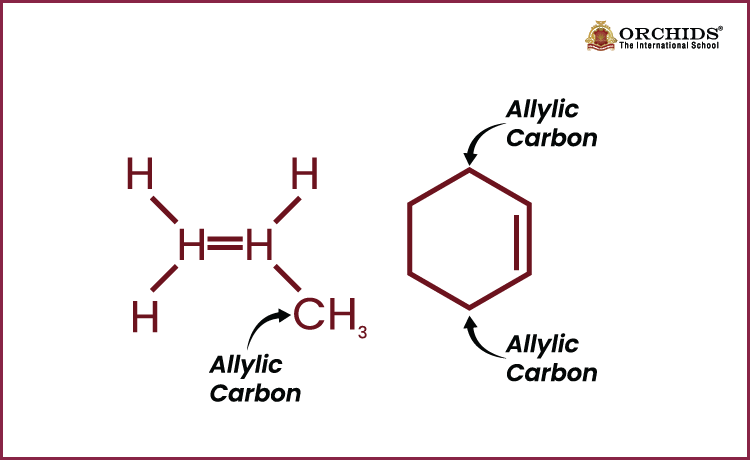
In other words, it’s not part of the double bond itself, but it sits right next to it.
This position gives the allylic carbon some unique reactivity and stability in chemical reactions.
The general formula or structure for an allylic group is:
In this group:
- The double bond (C=C) gives rise to special resonance effects.
- The CH₂ group next to the double bond is called the allylic position.
- The carbon at this position is the allylic carbon.
Let’s look at a few simple examples of Allylic Carbons:
- Propene (CH₃–CH=CH₂)
→ The carbon in CH₃– is the allylic carbon. - Cyclohexene
→ The carbon atoms directly next to the double bond (C=C) are allylic carbons. - Allyl chloride (CH₂=CH–CH₂Cl)
→ The carbon bonded to chlorine (CH₂Cl) is an allylic carbon.
These examples demonstrate that allylic carbons are always one step away from a double bond, rather than being part of it.
Due to this arrangement, electrons can easily shift between bonds, giving allylic compounds their distinctive chemical reactivity.
But what about the Hybridisation of the Allylic Carbon?
In the allylic group:
The allylic carbon, however, is sp³ hybridised because it is connected through a single sigma (σ) bond to the double-bonded carbon.
The fact that Hydrocarbons are organic compounds made only of carbon and hydrogen. Depending on how many carbon atoms are attached to a given carbon atom, they can be classified as:
- Primary carbon (1°) is attached to one other carbon.
- Secondary carbon (2°) is attached to two other carbons.
- Tertiary carbon (3°) is attached to three other carbons.
For example, in ethane (CH₃–CH₃), both carbon atoms are primary because each is attached to only one other carbon.
This classification helps us understand how stable or reactive certain positions in a molecule can be, which becomes very important when we study carbocations.
This difference in hybridisation contributes to the stability and reactivity of the allylic position.
Allylic Carbocation and Its Stability
When a carbon atom carries a positive charge (C⁺), it forms a carbocation.
What happens is that in an allylic system, if this positive charge is on the allylic carbon, the result is an allylic carbocation.
The structure can be represented as:
When it comes to its stability, the allylic carbocation is highly stable because the positive charge is delocalised (spread out) through resonance.
Electrons from the double bond move to share the charge across multiple carbons:
This delocalisation makes the carbocation less reactive and more stable compared to normal carbocations.
Let's learn about the Stability Order of Carbocations :
In general, carbocation stability follows this trend:
But when resonance is possible, allylic carbocations become even more stable due to charge spreading.
So, the revised order, including resonance effect, is:
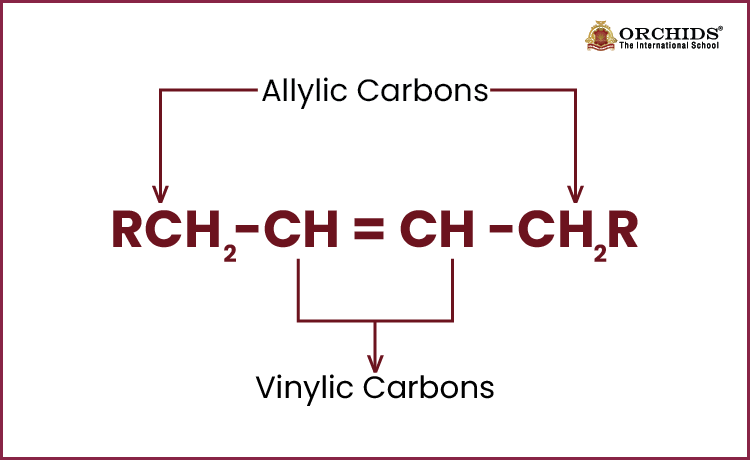
Have you heard about vinylic carbon? It’s easy to confuse vinylic and allylic carbons, but they are different in structure and reactivity.
Vinylic vs. Allylic Carbon
| Type of Carbon | Position in the Molecule | General Formula | Hybridisation | Example |
| Vinylic Carbon | Carbon atom involved directly in a double bond (C=C) | R–CH=CH₂ | sp² | Ethene (CH₂=CH₂) |
| Allylic Carbon | Carbon atom adjacent to a C=C bond | R–CH₂–CH=CH₂ | sp³ | Propene (CH₃–CH=CH₂) |
So, in propene (CH₃–CH=CH₂):
- The CH₂=CH– part contains vinylic carbons.
- The CH₃– carbon next to it is the allylic carbon.
Below is the illustration of Allylic and Vinylic carbon!
Applications and Importance of Allylic Compounds
Allylic compounds play a crucial role in both nature and industry. Because of the special stability and reactivity of the allylic position, these compounds often serve as key building blocks in organic synthesis and biochemical processes.
They are used in the preparation of Natural rubber, Terpenes (fragrant compounds in plants), Pharmaceutical intermediates, Polymers and synthetic rubbers
Till now, we have learned that the allylic position may look simple, but it’s one of the most interesting and important parts of organic chemistry. Because of its proximity to a double bond and ability to stabilise charges through resonance, the allylic carbon often plays a starring role in chemical reactions from basic substitution to complex polymer formation. Isn't it a great contribution?
Frequently Asked Questions on Allylic Carbon
1. What is the significance of allylic carbons?
Allylic carbons play a vital role in organic reactions because their position next to a double bond allows for easy formation of stable intermediates. They help explain reactivity in many chemical processes.
2. Why is allylic more stable?
The allylic position is more stable due to resonance; the delocalisation of electrons spreads the charge, reducing instability. This makes allylic radicals and carbocations less reactive.
3. What is the effect of allylic strain?
Allylic strain occurs when atoms around an allylic system are too close, causing crowding or steric hindrance. It can influence molecular shape, stability, and reaction pathways.
4. What is the hybridisation of allylic carbon?
An allylic carbon is sp³ hybridised because it is directly attached to an sp² carbon of the double bond. This unique setup allows for electron interaction and resonance effects.
5. What are the applications of allylic compounds?
Allylic compounds are widely used in making polymers, perfumes, and pharmaceuticals. Their reactive allylic sites make them ideal for oxidation and substitution reactions in industry.
6. What is allylic oxidation?
Allylic oxidation is a reaction that adds oxygen to the allylic position of a molecule. It’s commonly used to produce alcohols, ketones, or aldehydes from alkenes in organic synthesis.
7. What is Allylic Carbon?
An allylic carbon is the carbon atom directly attached to a carbon–carbon double bond (C=C).
It is not part of the double bond but lies next to it, influencing the molecule’s reactivity and stability.
Science isn't just a subject, it's the way of seeing the world. Curious how Orchids The International School teaches it that way? Talk to our admissions team.
Admissions Open for 2026-27
What type of concept pages would you prefer?
CBSE Schools In Popular Cities
- CBSE Schools in Bangalore
- CBSE Schools in Mumbai
- CBSE Schools in Pune
- CBSE Schools in Hyderabad
- CBSE Schools in Chennai
- CBSE Schools in Gurgaon
- CBSE Schools in Kolkata
- CBSE Schools in Indore
- CBSE Schools in Sonipat
- CBSE Schools in Delhi
- CBSE Schools in Rohtak
- CBSE Schools in Bhopal
- CBSE Schools in Aurangabad
- CBSE Schools in Jabalpur
- CBSE Schools in Jaipur
- CBSE Schools in Jodhpur
- CBSE Schools in Nagpur
- CBSE Schools in Ahmednagar
- CBSE School In Tumkur











Orchids The International School is one of India's leading chains of CBSE and ICSE schools, with 110+ schools across the country.