

Carbon Compounds
Carbon is more than a mere element in the periodic table; it's the basis of life, industry, and innovation by forming Carbon Compounds. It's always fascinating to learn more about the science behind magical carbon and its presence in everything from living cells to skyscrapers. Carbon's ability to form bonds with any other atom makes it extremely versatile.
This article provides a comprehensive insight into Carbon and its properties, along with the various types of carbon and examples.
Table of Contents
- Carbon in Chemistry
- Types of Carbon Compounds
- Physical and Chemical Nature of Carbon Forming Compounds
- Carbon Compounds in Daily Life
- Frequently Asked Questions on Carbon Compounds

Carbon in Chemistry
Carbon is one of the most remarkable elements in the periodic table. With the atomic number 6 and a position in Group 14, have you ever wondered why Carbon is so important amongst all elements?
Without carbon, life as we know it simply wouldn’t exist. Every living cell, every molecule of DNA, every drop of fuel has a carbon story to tell.
Also, when we talk about the position of Carbon in the periodic table. It is situated in the p-block and plays a starring role in chemistry, biology, and even technology.
Why Carbon-forming Compounds Are Everywhere!!
There are millions of known carbon compounds, far more than for any other element. This is because:
- Carbon can bond with many different elements compared to other elements.
- It can form stable chains and rings of various lengths.
- It types are mainly saturated and unsaturated compounds
Saturated carbon compounds → contain only single C–C bonds; carbons are fully bonded with hydrogens. Example: alkanes (CH₄, C₂H₆).
Unsaturated carbon compounds → contain at least one double (C=C) or triple (C≡C) bond; fewer hydrogens. Example: alkenes (C₂H₄), alkynes (C₂H₂), benzene (C₆H₆).
- The bonds can be single, double, or triple, giving a variety of reactivity and properties.
Also, this Carbon compound is generally Carbon compounds are generally grouped into two main categories in chemistry!!
Types of Carbon Compounds
1.Organic Compounds are primarily made of carbon and hydrogen, often with oxygen, nitrogen, sulfur, or halogens.
Examples include sugars, proteins, alcohols, and hydrocarbons.
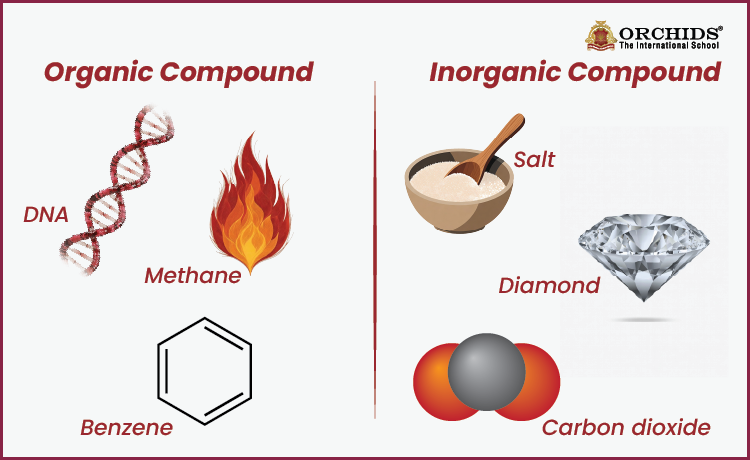
2. Inorganic Compounds include carbonates (CaCO₃ in limestone), oxides (CO₂, CO), and carbides (SiC used in abrasives).
Carbon exhibits the important and unique power of the Catenation property !! But what exactly is Catenation?
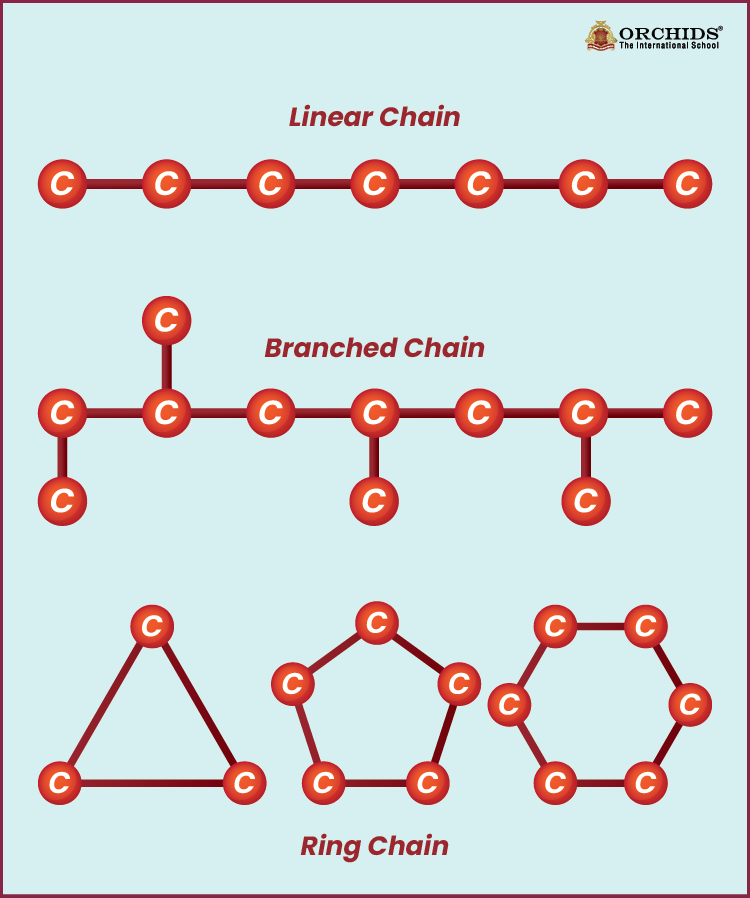
Catenation is carbon’s ability to bond with itself to form chains, rings, and complex frameworks. This happens because:
- Carbon-carbon bonds are strong and stable.
- The atom is small, allowing effective orbital overlap.
- It can form single, double, and triple bonds, adding to its structural diversity.
Thanks to catenation, carbon can create molecules ranging from simple methane to complex DNA.
Apart from that, it shows the below Special Properties of Carbon:
- Carbon shows tetravalency, which means four bonds can form with a wide variety of atoms.
- The interesting thing is that Multiple Bond Formation by carbon is the ability to make C=C and C≡C bonds adds complexity.
- Depending on its partners, carbon compounds can be polar (alcohols) or non-polar (hydrocarbons), according to Polarity Control.
- Allotropy is the most unique property of carbon due to which makes it capable of serving best in everyday life. It can exist in drastically different forms, from the hardest substance (diamond) to one of the softest (graphite).
Physical and Chemical Nature of Carbon Forming Compounds
Carbon is a non-metal, but interestingly, it exists in different forms known as allotropes. Each form is unique in its structure and properties:
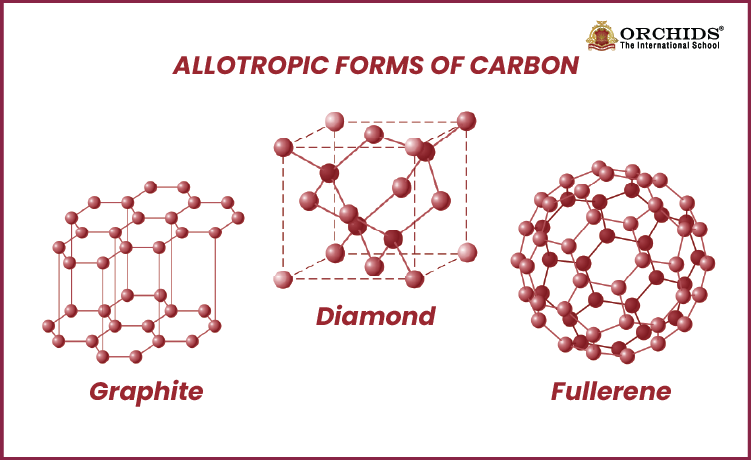
- Diamond is transparent, extremely hard, and a brilliant thermal conductor.
- Graphite is Opaque, soft, and an excellent electrical conductor due to its free-moving electrons.
- Fullerenes & Nanotubes are tiny, cage-like or tube-shaped structures with huge potential in nanotechnology.
At the atomic level, carbon has four valence electrons. This allows it to form four covalent bonds, which is the key to its versatility.
Carbon Compounds in Daily Life
- Carbon is considered to be the backbone of biomolecules, proteins, fats, carbohydrates, and nucleic acids in Biological roles.
- It contributes to industrial roles like in Fuels (coal, petroleum, natural gas), plastics, and synthetic fibres.
- In the Technologyera, Carbon fibres for strength, graphene for electronics, and carbon nanotubes for advanced materials.
As we learned that carbon is more than just an element; it’s the foundation of life and technology. Its ability to form stable, diverse, and complex molecules makes it unmatched in the periodic table.
Frequently Asked Questions on Carbon Compounds
1. What are some good questions about carbon?
You could ask about how carbon shapes life, why it bonds so easily with other elements, or how it forms so many different substances around us.
2. What are 5 facts about carbon?
Carbon bonds with itself, appears in countless forms, makes millions of compounds, is found in every living organism, and powers industries through fuels and materials.
3. What is the main importance of carbon?
Carbon is life’s building block, forming the structure of living cells. It’s also the foundation of fuels, plastics, and many essential materials we use daily.
4. What is carbon mostly made of?
Carbon is made up of carbon atoms, each with six protons, six neutrons, and six electrons, a setup that gives it incredible flexibility in forming bonds.
5. What are Carbon Compounds and Carbon Compounds?
Carbon compounds are substances in which carbon joins with other elements. Common examples include methane, glucose, carbon dioxide, and the industrial chemical ethylene.
6. What are Carbon types?
Carbon types are its different natural forms: diamond, graphite, graphene, and amorphous carbon, each with its look, strength, and special uses.
Science isn't just a subject, it's the way of seeing the world. Curious how Orchids The International School teaches it that way? Talk to our admissions team.
Admissions Open for 2026-27
What type of concept pages would you prefer?
CBSE Schools In Popular Cities
- CBSE Schools in Bangalore
- CBSE Schools in Mumbai
- CBSE Schools in Pune
- CBSE Schools in Hyderabad
- CBSE Schools in Chennai
- CBSE Schools in Gurgaon
- CBSE Schools in Kolkata
- CBSE Schools in Indore
- CBSE Schools in Sonipat
- CBSE Schools in Delhi
- CBSE Schools in Rohtak
- CBSE Schools in Bhopal
- CBSE Schools in Aurangabad
- CBSE Schools in Jabalpur
- CBSE Schools in Jaipur
- CBSE Schools in Jodhpur
- CBSE Schools in Nagpur
- CBSE Schools in Ahmednagar
- CBSE School In Tumkur











Orchids The International School is one of India's leading chains of CBSE and ICSE schools, with 110+ schools across the country.