

Sodium Hydroxide (NaOH) : Properties and Important Reactions Explained
Sodium hydroxide, also sometimes called lye or caustic soda, is a strong base known for its powerful, even corrosive nature. Yet behind that punch of reactivity is a chemical star: essential in everything from soap-making and cleaning to paper production and water treatment.
This article gives insight into the chemistry of sodium hydroxide’s structure, physical and chemical traits, its preparation, its uses, and its safety.
Table of Contents
- Sodium Hydroxide (NaOH) and Its Structure
- Chemical Properties of Sodium Hydroxide
- Preparation of Sodium Hydroxide
- Sodium Hydroxide Applications
- Health Hazards and Safety Precautions of Sodium Hydroxide
- Frequently Asked Questions on Sodium Hydroxide

Sodium Hydroxide (NaOH) and Its Structure
NaOH is white in colour when it is in the solid state and in the form of pellets or flakes. When we talk about a strong base, then sodium hydroxide (NaOH) is one of them, also called caustic soda or lye and is a common and familiar name because of its uses.
.webp)
Let's look at the Structure of Sodium Hydroxide :
It is made up of sodium ions (Na⁺) and hydroxide ions (OH⁻). Being a highly corrosive alkali, it completely dissolves in water to release OH⁻ ions, which makes it a strong electrolyte.
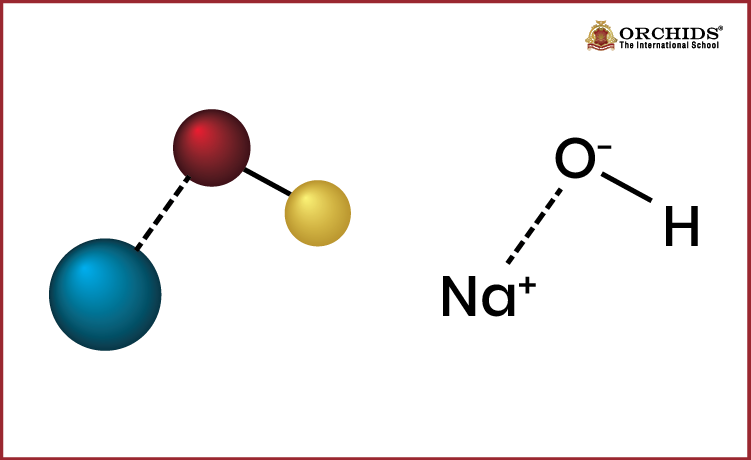
Interestingly! These ions are strongly bonded to each other by ionic bonds and remain as a solid crystalline material at room temperature.
It’s widely used in making soaps and detergents, paper, textiles, water treatment, and cleaning products.
Sodium Hydroxide possesses physical properties that help us to identify it.
Below is the table that summarises sodium hydroxide's Physical Properties in tabular form:
| Sodium Hydroxide | NaOH |
| Molecular Weight / Molar Mass | 39.997 g/mol |
| Density | 2.13 g/cm³ |
| Boiling Point | 1,388 °C |
| Melting Point | 318 °C |
| Appearance | White solid, found as pellets, flakes, or granules |
| Solubility | Extremely soluble in water, with a strong exothermic reaction |
| Taste/Feel | Slippery and soapy feel, but unsafe as it burns skin |
Chemical Properties of Sodium Hydroxide
- Sodium hydroxide is highly reactive with acids to give salt and water (neutralisation reaction).
- It can react with metals such as aluminium and zinc to give hydrogen gas.
- NaOH also reacts with carbon dioxide in the atmosphere to give sodium carbonate (Na₂CO₃).
These reactions make it very valuable in various industries, but also account for why it should be handled carefully.
Preparation of Sodium Hydroxide
In large-scale production, caustic soda (sodium hydroxide) is obtained by reacting a sodium carbonate (Na₂CO₃) solution with hot milk of lime, which is calcium hydroxide (Ca(OH)₂), inside an iron vessel:
(The arrow indicates that calcium carbonate forms as a precipitate.)
Once the insoluble calcium carbonate (CaCO₃) is filtered out, the remaining sodium hydroxide solution is collected. This solution is commonly used in paper manufacturing and in producing soaps and detergents.
Industrial preparation of sodium hydroxide is most commonly done by the Chlor-alkali process.
In this process, an electric current is supplied to an aqueous sodium chloride solution (brine). The process evolves chlorine gas at the anode, hydrogen gas at the cathode, and sodium hydroxide in solution.
- The process involves the following reaction:
Besides this bulk method, NaOH is also synthesised in the laboratory by reacting sodium carbonate with calcium hydroxide.
Sodium Hydroxide Applications
Sodium hydroxide is referred to as the "backbone of the chemical industry" due to its numerous applications:
- It facilitates the saponification of fats and oils to obtain soaps in the Soap and Detergent Industry
- In the Paper Industry,utilised in pulping and bleaching wood to produce paper.
- Sodium Hydroxide facilitates processing cotton and dyeing fabrics in the textile Industry.It has a major contribution in the food Industry that is applied in limited, controlled quantities for peeling fruits and vegetables.
It plays a big role in Water Treatment to remove heavy metal ions and neutralise acidity from wastewater.
- In Household Cleaning,it behaves as a Main component of most drain cleaners and oven cleaners.
Health Hazards and Safety Precautions of Sodium Hydroxide
Even when useful, NaOH can be very harmful if improperly handled:
- When it comes into Contact with skin and eyes causes severe burns.
- Inhalation of the dust or mist irritates the respiratory system.
- Inadvertent ingestion may lead to life-threatening damage to the digestive system.
Due to these dangers, care must be taken in handling.
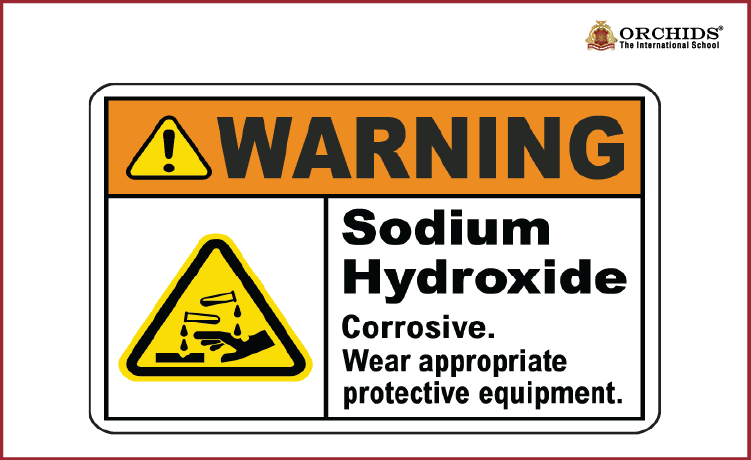
Safety Precautions
To remain safe when working with sodium hydroxide:
- Wear gloves, protective glasses, and lab coats at all times.
- Work in well-ventilated areas to prevent inhaling harmful vapours.
- Store NaOH in tightly sealed containers since it picks up moisture and carbon dioxide from the atmosphere.
Read More : Hydroxyl Group
As we have learned, Sodium hydroxide can appear to be a harmless white solid, but it contributes heavily to industries, labs, and homes. Its capacity to react vigorously with acids, metals, and organic substances makes it one of the most versatile bases of chemistry.
Frequently Asked Questions on Sodium Hydroxide
1. What is Sodium Hydroxide in simple words?
Sodium Hydroxide is a strong, white, corrosive base used widely in industries and homes. It is also called caustic soda or lye.
2. What is the sodium hydroxide formula?
The sodium hydroxide formula is NaOH, showing it has sodium (Na), oxygen (O), and hydrogen (H).
3. What is the sodium hydroxide chemical formula used for?
The sodium hydroxide chemical formula, NaOH, helps identify it as a strong alkali that produces hydroxide ions in water.
4. What are the important sodium hydroxide uses?
Sodium hydroxide uses include making soaps, paper, textiles, water treatment, and cleaning products.
5. What is the hazard of sodium hydroxide?
Sodium hydroxide can burn skin, damage eyes, and irritate the lungs if not handled carefully.
6. How is sodium hydroxide formed?
Sodium hydroxide is usually made by the electrolysis of brine, which also produces chlorine and hydrogen.
Science isn't just a subject, it's the way of seeing the world. Curious how Orchids The International School teaches it that way? Talk to our admissions team.
Admissions Open for 2026-27
What type of concept pages would you prefer?
CBSE Schools In Popular Cities
- CBSE Schools in Bangalore
- CBSE Schools in Mumbai
- CBSE Schools in Pune
- CBSE Schools in Hyderabad
- CBSE Schools in Chennai
- CBSE Schools in Gurgaon
- CBSE Schools in Kolkata
- CBSE Schools in Indore
- CBSE Schools in Sonipat
- CBSE Schools in Delhi
- CBSE Schools in Rohtak
- CBSE Schools in Bhopal
- CBSE Schools in Aurangabad
- CBSE Schools in Jabalpur
- CBSE Schools in Jaipur
- CBSE Schools in Jodhpur
- CBSE Schools in Nagpur
- CBSE Schools in Ahmednagar
- CBSE School In Tumkur











Orchids The International School is one of India's leading chains of CBSE and ICSE schools, with 130+ schools across the country.