

Difference Between Sodium Carbonate and Sodium Bicarbonate Explained with Important Reactions
Sodium carbonate and sodium bicarbonate are two common sodium compounds that play important roles in chemistry and daily life. While their names sound similar, they have distinct chemical compositions, properties, and applications, so understanding the difference between sodium carbonate and sodium bicarbonate makes things clear, as they are important and related to our daily lives.
This article aims to help students focus on the difference between sodium carbonate and sodium bicarbonate and understand their chemical formulas, properties, and practical applications to avoid confusion.
Table of Contents
- What are Sodium Carbonate and Sodium Bicarbonate
- Difference Between Sodium Carbonate and Sodium Bicarbonate
- Chemical Reactions of Sodium Bicarbonate from Sodium Carbonate
- Key Takeaways for Sodium Carbonate and Sodium Bicarbonate
- Frequently Asked Questions on Difference Between Sodium Carbonate and Sodium Bicarbonate

What are Sodium Carbonate and Sodium Bicarbonate?
Sodium carbonate and sodium bicarbonate are two of the most widely used sodium compounds in our daily lives and industry. Sodium carbonate, often called soda ash or washing soda, is mainly used in industries for water softening, glass production, and neutralising acids.
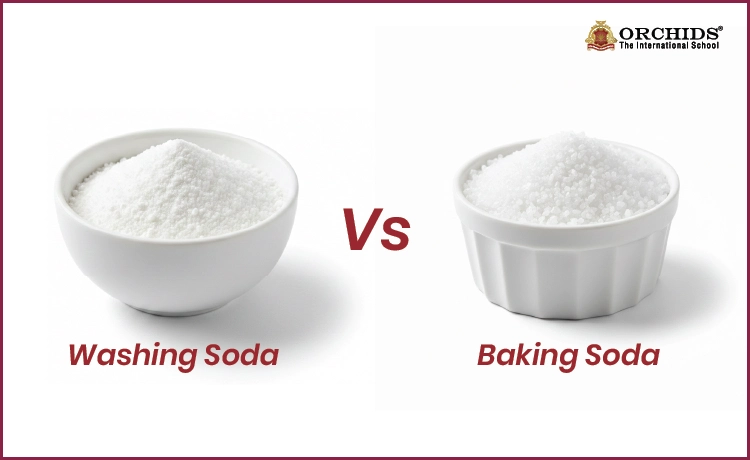
Sodium bicarbonate, commonly known as baking soda, is widely used at home for baking, cleaning, and even in personal care.
But how the Structure of Sodium Carbonate differs from Sodium Bicarbonate
Sodium carbonate has a carbonate ion ( ) at its core: one carbon atom in the middle bonded to three oxygen atoms in a triangle.
The two sodium ions ( ) balance the charge, hovering nearby like magnets. Its crystal structure makes it strong and highly alkaline, perfect for several uses.
On the other hand, Sodium bicarbonate has a bicarbonate ion ( ) similar to carbonate but with one hydrogen attached. Only one sodium ion ( ) is needed to balance it.
It’s gentler, that what makes it ideal for baking, cleaning, and even soothing stomach acidity. When it reacts with acids, it releases , giving cakes their fluff!
Difference Between Sodium Carbonate and Sodium Bicarbonate
|
Sodium Carbonate |
Sodium Bicarbonate |
|
Also known as soda ash or washing soda. |
Commonly referred to as baking soda. |
|
Chemical formula: |
Chemical formula: |
|
Composed of sodium and acid. |
Composed of sodium, acid, and hydrogen. |
|
A strong base derived from NaOH and a weak acid ; reacts with acids to form sodium bicarbonate. Also, it conducts electricity efficiently. |
A weaker base, typically monoprotic. |
|
Frequently used to neutralise acidic solutions in industries. |
Used as a deodoriser, cleaning agent, exfoliant, and occasionally as a fire extinguisher. |
|
Utilised in body processes or reactions. |
Essential in the body to regulate and neutralise high acidity in the blood. |
Chemical Reactions of Sodium Bicarbonate from Sodium Carbonate:
- Formation of Sodium Bicarbonate from Sodium Carbonate:
- Formation of Potassium Bicarbonate (for comparison):
- Formation of Ammonium Bicarbonate:
- Carbonic Acid Equilibrium:
Key Takeaways for Sodium Carbonate and Sodium Bicarbonate
- Sodium carbonate and sodium bicarbonate are chemically related but not identical.
- Sodium carbonate is more industrial-focused, while sodium bicarbonate is household-friendly.
- Both compounds demonstrate fundamental acid-base reactions, helping students understand neutralisation, basicity, and the formation of salts.
- Knowing these compounds’ properties and uses is valuable for chemistry education, practical applications, and daily life solutions.
Read More: Ammonium bicarbonate and Bicarbonates
Till now we have learned that how the difference between sodium carbonate and sodium bicarbonate,provide insight into both chemistry concepts and real-world applications. From industrial water treatment to baking cakes at home, these compounds show the significance of chemical knowledge in everyday life.
Frequently Asked Questions on Difference Between Sodium Carbonate and Sodium Bicarbonate
1. How to differentiate between sodium carbonate and sodium bicarbonate?
Sodium carbonate is strongly alkaline and feels soapy in water, while sodium bicarbonate is milder and often used in baking and medicine. You can also test with indicators: bicarbonate gives a milder pH change.
2. What are two important uses of sodium bicarbonate?
It’s used in baking as a leavening agent and in medicine to relieve acidity in the stomach. It also works as a gentle cleaning agent.
3. What are two reasons sodium carbonate is used?
Sodium carbonate is used in cleaning products because it’s strongly alkaline, and in water treatment to soften water by removing hardness.
4. What is similar to sodium bicarbonate?
Potassium bicarbonate is chemically similar to sodium bicarbonate and can be used as a sodium-free alternative in baking and buffering applications.
5. How many types of sodium bicarbonate are there?
There’s mainly one common type used in everyday life, but pharmaceutical and food-grade variants exist for different applications.
6. Which is better, sodium carbonate or sodium bicarbonate?
It depends on the use: sodium carbonate is better for strong cleaning or industrial purposes, while sodium bicarbonate is preferred for cooking, health, and mild applications.
7. What is the difference between sodium carbonate and sodium bicarbonate?
Sodium carbonate (Na₂CO₃) is more alkaline and used in cleaning and industry, whereas sodium bicarbonate (NaHCO₃) is milder, used in baking, medicine, and pH regulation.
8. Can sodium bicarbonate neutralise acids?
Yes, sodium bicarbonate reacts with acids to form carbon dioxide, water, and a salt, which is why it’s often used as an antacid.
9. Is sodium carbonate safe for food use?
No, sodium carbonate is too strong for most food applications, but sodium bicarbonate is safe and commonly used in cooking and baking.
Science isn't just a subject, it's the way of seeing the world. Curious how Orchids The International School teaches it that way? Talk to our admissions team.
Admissions Open for 2026-27
What type of concept pages would you prefer?
CBSE Schools In Popular Cities
- CBSE Schools in Bangalore
- CBSE Schools in Mumbai
- CBSE Schools in Pune
- CBSE Schools in Hyderabad
- CBSE Schools in Chennai
- CBSE Schools in Gurgaon
- CBSE Schools in Kolkata
- CBSE Schools in Indore
- CBSE Schools in Sonipat
- CBSE Schools in Delhi
- CBSE Schools in Rohtak
- CBSE Schools in Bhopal
- CBSE Schools in Aurangabad
- CBSE Schools in Jabalpur
- CBSE Schools in Jaipur
- CBSE Schools in Jodhpur
- CBSE Schools in Nagpur
- CBSE Schools in Ahmednagar
- CBSE School In Tumkur











Orchids The International School is one of India's leading chains of CBSE and ICSE schools, with 110+ schools across the country.