

Lead (Pb): Properties, Uses and Safety Concerns Explained
Lead is a heavy, bluish-grey metal that has been used by humans for thousands of years, dating back to 7000 BC. Known for its softness, high density, and corrosion resistance, it was historically used in pipes, paints, and coins.
This article explains lead’s properties, chemical behavior, uses, and safety considerations of why lead remains both valuable and potentially hazardous.
Table of Content
- Must Know Facts About Lead!
- What is Lead?
- Physical and Chemical Properties of Lead
- Uses of Lead
- Safety and Handling of Lead

Must Know Facts About Lead!
|
What is Lead?
Lead, with the symbol Pb and atomic number 82, is a post-transition metals from the periodic table.
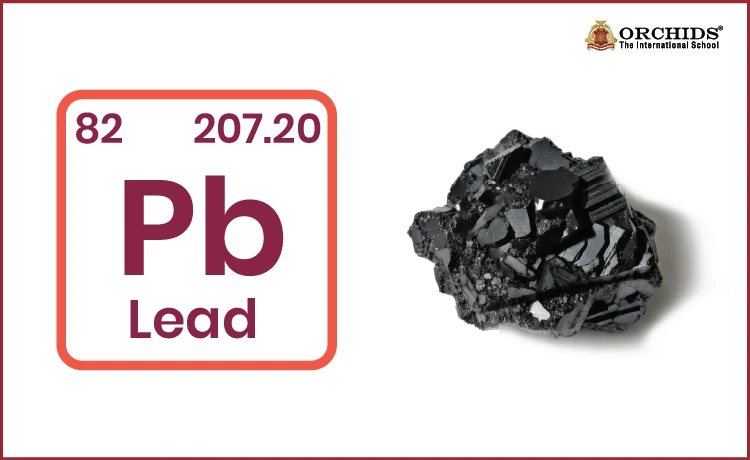
Historically, lead was used extensively by civilisations for pipes, coins, cosmetics, and construction materials. Alchemists considered it one of the oldest metals known to humanity.
When it comes to its existence it occurs naturally in small amounts in minerals, with galena (PbS, also called lead glance) also it is the main ore for commercial production. Apart from it there are Other minerals that include anglesite (PbSO₄) and cerussite (PbCO₃).
Lets Discuss the Occurrence and Extraction of Lead!
Lead is primarily extracted from galena (PbS). The extraction involves two key steps:
Roasting the ore to convert sulfide into oxide:
Reduction with carbon to obtain metallic lead:
Other lead-containing minerals include anglesite (PbSO₄) and cerussite (PbCO₃). Recycling of lead, especially from batteries, also reduces environmental impact.
Read More: Actinum
Lets now discuss the properties of lead that help us to easily identify it among the others.
Physical and Chemical Properties of Lead
|
Property |
Details |
|
Atomic Number |
82 |
|
Symbol |
Pb |
|
Appearance |
Bluish-grey, dulls on exposure |
|
Density |
11.34 g/cm³ |
|
Melting Point |
327.5 °C |
|
Boiling Point |
1749 °C |
|
Malleability |
Soft, can be hammered or shaped |
|
Conductivity |
Poor conductor of electricity |
|
Corrosion Resistance |
Highly resistant to corrosion |
Next Let's know its chemical properties:
Chemical Properties:
- Lead burns in powdered form to give a bluish-white flame.
- Lead reacts with oxygen to form lead oxide:
- Lead reacts with fluorine at room temperature to form lead fluoride:
- Lead reacts with nitric and sulfuric acids to form lead salts:
These properties explain lead’s usefulness in battery, coatings, and uses of alloys.
Uses of Lead
Lead has been used since Roman times for its corrosion resistance and malleability. Its major applications include:
- People of old ages were usinglead in corrosion-resistant pipes and decorative paints
- Not everyone is aware of the fact that lead is the main component of batteries like in lead-acid batteries for vehicles and UPS systems.
- Have you ever noticed the sparks while welding or in Soldering process that where the lead is used in Joining electrical and electronic components
- Lead is used in electrolysis and industrial processes as electrodes.
- Also it is used as a radiation Shielding inProtective barriers in hospitals and nuclear facilities
- Lead is used in alloys formation which is Combined with tin or antimony for specialized metal products
These applications showcase lead’s versatility in both ancient and modern industries.
Also can check: Arsenic
Safety and Handling of Lead:
- Prevent inhaling dust or ingestion of lead.
- Do not forget to wear protective gear when working with lead compounds.
- While working with lead, it is important that it be recycled and lead be disposed of in a proper manner so that the environment is not contaminated.
We have come to know that lead is a historically significant and industrially valuable metal possessing special characteristics such as softness, density, and resistance to corrosion. Also got to know its extensive applications in batteries, pipes, paints, and alloys make it irreplaceable.
Frequently Asked Questions on Lead
1. What type of element is lead?
Lead is a heavy, soft, and malleable metal found in Group 14 of the periodic table. It is classified as a post-transition metal with a bluish-gray color.
2. Is lead an element compound or mixture?
Lead is an element because it consists of only one kind of atom. It is not a compound or mixture.
3. How was the element lead named?
The name “lead” comes from the Old English word lead and the Latin word plumbum. Its symbol “Pb” is derived from plumbum.
4. Is lead a compound or element?
Lead is a pure chemical element with the symbol Pb. It is not a compound, as it cannot be broken down into simpler substances by chemical means.
5. What are the important facts about lead?
Lead is dense, corrosion-resistant, and has been used by humans for thousands of years. It is toxic, so its modern uses are strictly controlled.
6. What is important about lead?
Lead is important for batteries, shielding against radiation, and certain industrial processes. Its properties make it useful but require safe handling.
7. Why is lead important to humans?
Lead has played a key role in plumbing, batteries, and radiation protection. However, its toxicity means we must manage and reduce exposure.
8. How is lead formed?
Lead is formed naturally inside stars through nuclear fusion and is found on Earth in ores like galena (PbS). It is mined and refined for use.
9. Does lead catch fire?
No, lead does not catch fire under normal conditions. It has a high melting point and is generally considered non-flammable.
10. Mention the Lead element symbol
The lead element symbol is Pb, derived from the Latin word plumbum. It represents the chemical identity of lead in the periodic table.
Science isn't just a subject, it's the way of seeing the world. Curious how Orchids The International School teaches it that way? Talk to our admissions team.
Admissions Open for 2026-27
What type of concept pages would you prefer?
CBSE Schools In Popular Cities
- CBSE Schools in Bangalore
- CBSE Schools in Mumbai
- CBSE Schools in Pune
- CBSE Schools in Hyderabad
- CBSE Schools in Chennai
- CBSE Schools in Gurgaon
- CBSE Schools in Kolkata
- CBSE Schools in Indore
- CBSE Schools in Sonipat
- CBSE Schools in Delhi
- CBSE Schools in Rohtak
- CBSE Schools in Bhopal
- CBSE Schools in Aurangabad
- CBSE Schools in Jabalpur
- CBSE Schools in Jaipur
- CBSE Schools in Jodhpur
- CBSE Schools in Nagpur
- CBSE Schools in Ahmednagar
- CBSE School In Tumkur











Orchids The International School is one of India's leading chains of CBSE and ICSE schools, with 110+ schools across the country.