

Analytical Chemistry
Have you ever thought about how scientists test what's inside the food we eat or the water we drink? That’s the magic of analytical chemistry. It helps us understand what substances are made of and in what amounts.
This article provides insights into different methods used in analytical chemistry, both traditional and modern, and examines how they are used in everything from school labs to real-world industries.
Table of Contents
- What is Analytical Chemistry?
- Analytical Chemistry Methods
- Divisions of Analytical Chemistry
- Importance of Analytical Chemistry
- Tips to understand the Topic: Analytical Chemistry
- Frequently Asked Questions on Analytical Chemistry

What is Analytical Chemistry?
Analytical chemistry is an important and wide branch of chemistry that investigates what a substance is and how much of that substance is in the sample. It relates observation to accuracy, whether you are evaluating an unknown compound as part of a lab test or determining the amount of purity of a drug. This plays an important role in everyday life, from food safety to drug development in pharmaceuticals.
Analytical Chemistry Methods
In the Chemistry world, the major challenge is always finding out what substances are in a sample and how much is present. That's where Analytical Chemistry comes into play. To do this, scientists use a wide range of techniques, some traditional, some modern.
These techniques can be grouped into main categories:-
1. Classical (or Wet Chemistry) Methods
The hands-on methods that don't require advanced machines. Instead, they depend on observable reactions like changes in colour, formation of a solid (precipitate), or evolution of gas.
Common classical techniques used are:
Volumetric Analysis (Titration): This technique helps to determine the concentration of solutions. The major steps involve adding one solution to
another until the reaction is complete, and is determined by some changes.
2. Gravimetric Analysis: This involves measuring the mass of a substance formed during a reaction, such as finding water content in hydrated salts by heating and weighing the residue.
Even though these methods may seem simple, they are precise when performed carefully.
2. Instrumental Methods
Advanced instruments are mainly used in modern science as they provide faster, more accurate, and more detailed analysis.
These methods are essential in industries like pharmaceuticals, food safety, and environmental science.
-
Spectroscopy: The technique is the most interesting one as it tells how the sample interacts with light and how each substance absorbs or emits light based on the principle. It has many Types that include UV-Vis, Infrared (IR), and Atomic Absorption Spectroscopy (AAS).
-
Mass Spectrometry: The most useful method that breaks molecules into ions and provides the fingerprint to every compound as it sorts them based on their mass-to-charge ratio.
-
Electrochemical Analysis: The word itself suggests that the reactions or transfer of ions take place due to electricity. This is specially used to monitor pH, metal ions detection and many more.
-
Chromatography: This technique separates mixtures so individual components can be studied. It's useful in drug testing, food analysis, and even DNA fingerprinting.
-
Calorimetry: It measures the heat produced or absorbed during a chemical reaction. This helps understand energy changes and reaction rates.
Divisions of Analytical Chemistry
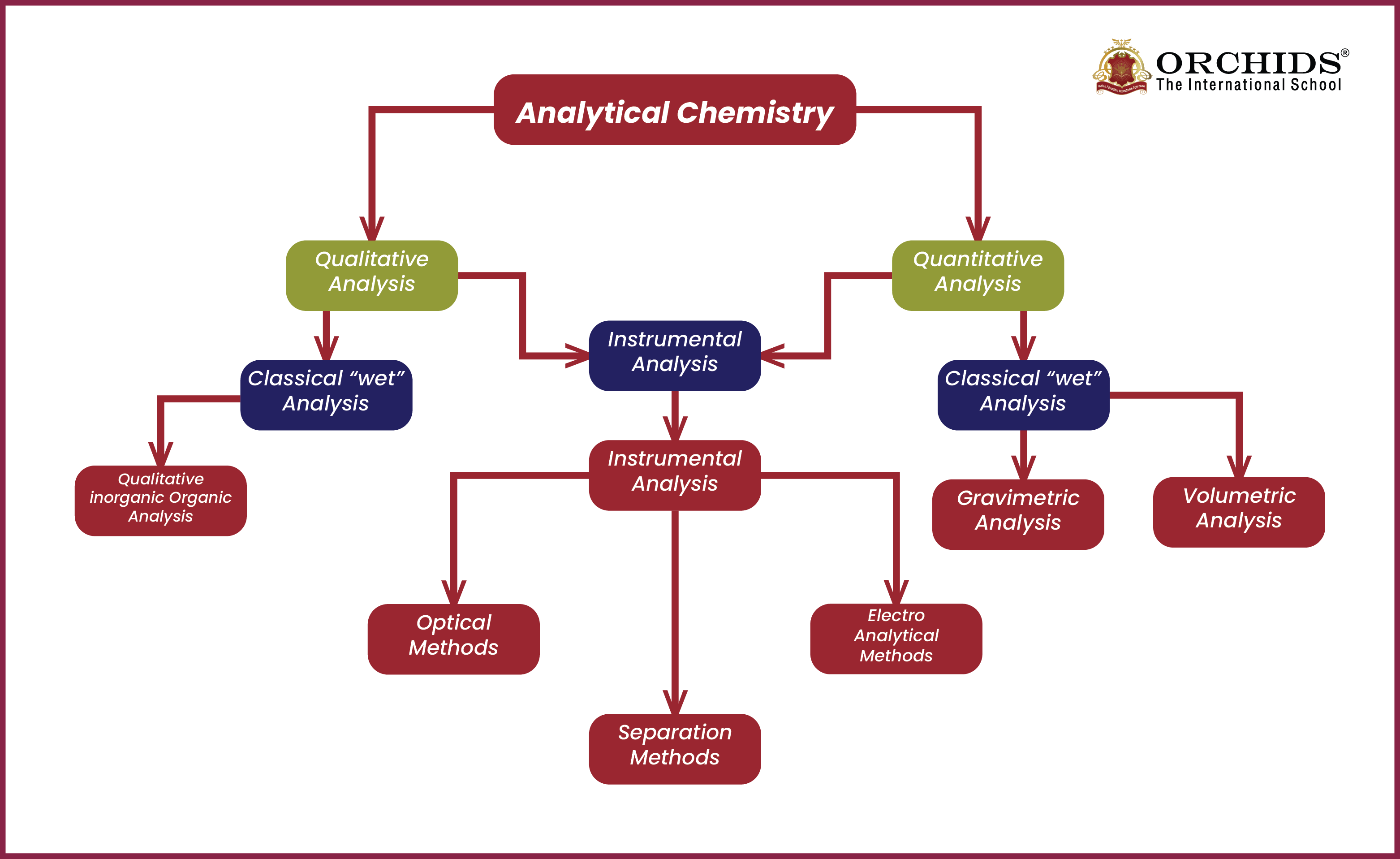
Analytical Chemistry is split into two areas:
A. Qualitative Analysis
Simply this area answers the question, "What is there?"
Qualitative analysis focuses on identifying what is present in a sample. Concentration or amount does not matter in qualitative analysis.
-
For example, identifying whether there is iron present in water or if a food is gluten-free is from qualitative analysis.
Typical methods include:
-
Flame Test: A useful technique to detect specific metal ions by the colour they produce in a flame. For example, sodium gives a bright yellow flame, while copper gives green.
-
Precipitation Reactions: Adding a chemical that causes a solid to form helps identify ions. This is common in salt analysis.
-
Spot Tests and Indicators: In forensic chemistry or for proteins, they help to detect the substances present in them. For example, in blood detection, the Kastle-Meyer test uses phenolphthalein.
B. Quantitative Analysis
This answers the question, "How much is there?"
Quantitative analysis provides the mass/volume/amount/concentration of a chemical in a sample.
It is important in drug formulation, pollution, and quality assurance.
Methods of analysis can include:
-
Gravimetric analysis
-
Volumetric (titration) analysis
-
Spectrophotometry
-
Chromatography (when combined with quantification)
Importance of Analytical Chemistry
Analytical chemistry is far more than a lab exercise; it's vital to progress in health, safety, environment, and technology. Here's why it matters:
-
In pharmaceuticals, it makes sure drugs are of the right composition, potency, and are safe.
-
In Environmental Science, it tracks pollutants in the atmosphere, bodies of water, and soil.
-
In the Food Industry, it can determine contaminants, additives, or nutrient content.
-
Forensic Science has wide applications in determining what substances are present in a crime scene, i.e. drugs or poisons.
-
It helps to analyse soil in the Agriculture domain and water to guide the appropriate use of fertilisers and help manage crops.
Whether it’s determining if a medication is safe, ensuring your food is free of toxins, or understanding climate data, analytical chemistry is behind the scenes, making it possible.
Tips to understand the Topic "Analytical Chemistry"
-
Make quick mind maps to link methods, like titration → volumetric → quantitative, to understand the Analytical terms in the Chemistry world.
-
Watch experiment videos to see how techniques like flame tests or chromatography work and how they work on a real-life basis.
-
Ask “why” before “how” to understand the purpose of each method better.
-
Relate concepts to real-life food testing, medicine quality, or pollution check
Analytical chemistry is a vital part of how we understand and improve the world around us. From testing medicine quality to checking food safety, its methods, both classical and instrumental, play a major role in our daily lives.
With the right understanding, even the most complex experiments become meaningful and manageable in the chemistry world.
Frequently Asked Questions on Analytical Chemistry
1. What are the important points of analytical chemistry?
Analytical chemistry helps us figure out what’s in a substance and how much of it is there. It’s all about understanding what things are made of through careful testing.
2. What are the four important areas of analytical chemistry?
The four key areas are finding out what’s present (qualitative), how much is there (quantitative), creating reliable methods, and using instruments to test samples accurately.
3. Who is known as the father of analytical chemistry?
Robert Boyle is often called the father of analytical chemistry. His early experiments helped shape the way we study and understand chemical substances today.
4. What are the two main types of analytical chemistry?
The two main types are qualitative analysis, which tells us what’s in a sample, and quantitative analysis, which tells us how much of each part is there.
5. Why is analytical chemistry important in daily life?
It has a variety of applications in our lives. From testing food and water to making sure our medicines are safe, analytical chemistry plays a quiet but vital role in keeping us healthy and informed.
6. How is modern analytical chemistry different from classical methods?
Modern methods in analytical chemistry use advanced machines for quicker and more precise results, while classical methods are hands-on chemical reactions and basic tools.
7. What is an analyte in chemistry?
In chemistry, an analyte is the specific substance or chemical component you are measuring or identifying in a sample during an analysis. For example, glucose is the analyte when testing blood sugar levels.
8. What is analytical chemistry?
Analytical chemistry is the branch of chemistry that focuses on identifying, separating, and measuring the components of substances to understand their composition and structure. It’s essential in fields like forensics, pharmaceuticals, and environmental testing.
Science isn't just a subject, it's the way of seeing the world. Curious how Orchids The International School teaches it that way? Talk to our admissions team.
Admissions Open for 2026-27
What type of concept pages would you prefer?
CBSE Schools In Popular Cities
- CBSE Schools in Bangalore
- CBSE Schools in Mumbai
- CBSE Schools in Pune
- CBSE Schools in Hyderabad
- CBSE Schools in Chennai
- CBSE Schools in Gurgaon
- CBSE Schools in Kolkata
- CBSE Schools in Indore
- CBSE Schools in Sonipat
- CBSE Schools in Delhi
- CBSE Schools in Rohtak
- CBSE Schools in Bhopal
- CBSE Schools in Aurangabad
- CBSE Schools in Jabalpur
- CBSE Schools in Jaipur
- CBSE Schools in Jodhpur
- CBSE Schools in Nagpur
- CBSE Schools in Ahmednagar
- CBSE School In Tumkur











Orchids The International School is one of India's leading chains of CBSE and ICSE schools, with 110+ schools across the country.