

Amines
Amines are vital nitrogen-containing chemicals used in nature and industry. From the amino acids in our bodies through dyes and drugs, amines play a diverse role.
This article is intended to make you aware of what amines are, how they are classified, how they are made, and why they are important.
Table of Contents
- About Amines
- Types of Amines
- Preparation of Amines
- Basicity of Amines
- Uses of Amines
- Easy Tricks to Remember Amines
- Frequently Asked Questions on Amines

About Amines
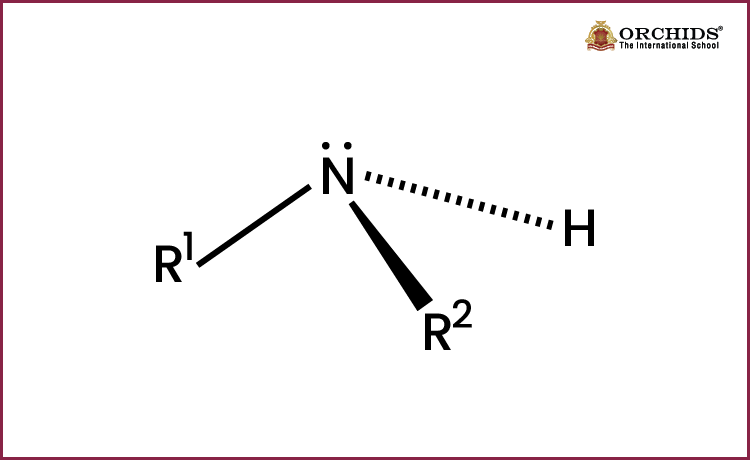
The general structure of an amine depends on how many hydrogen atoms in ammonia are replaced by alkyl or aryl groups. All amines contain a nitrogen atom that forms three sigma bonds and holds a lone pair of electrons, giving the nitrogen a pyramidal geometry. This lone pair is crucial for the chemical reactivity and basicity of amines.
-
Aliphatic Amines: Contain only alkyl groups.
- Aromatic Amines: Contain one or more aryl groups (e.g., aniline).
Types of Amines
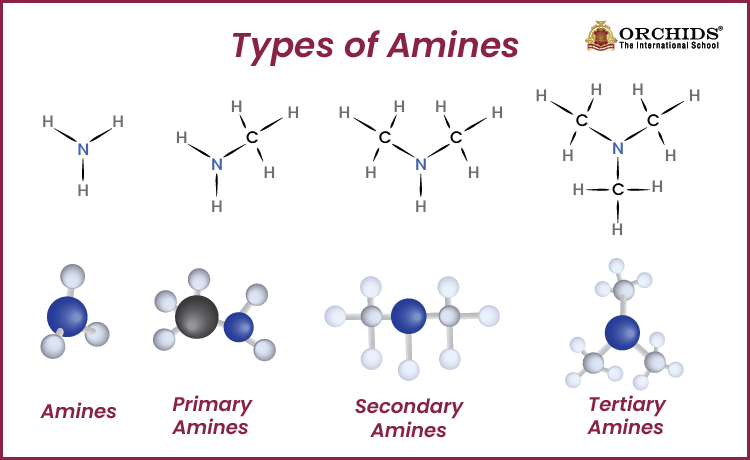
Amines are classified into 4 based on the number of organic groups attached to the nitrogen atom:
-
Primary Amines (1°): One carbon group on nitrogen.
-
Secondary Amines (2°): Two carbon groups.
-
Tertiary Amines (3°): Three carbon groups.
-
Quaternary Ammonium Salts: A positively charged nitrogen bonded to four groups, typically paired with an anion.
Preparation of Amines
Several methods are used in laboratories and industries to synthesise amines. Some of the most common are:
Ammonolysis of Alkyl Halides: Reacting alkyl halides with ammonia leads to a mixture of primary, secondary, and tertiary amines.
Example:
- Reduction of Nitriles: Nitriles (R–CN) can be reduced using hydrogen in the presence of catalysts or lithium aluminium hydride to form primary amines.
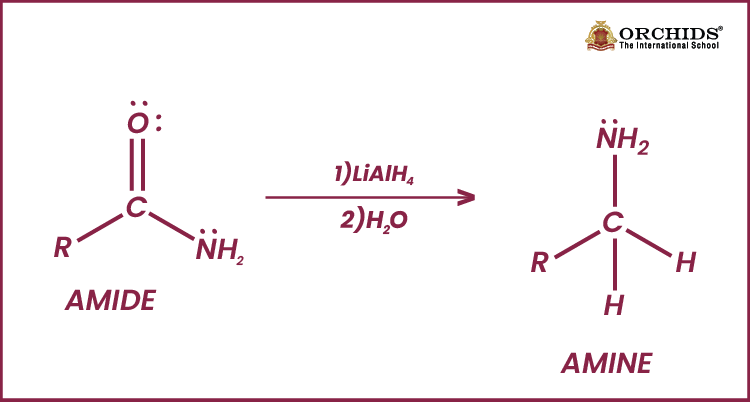
- Reduction of Amides: Amides can be reduced to amines using lithium aluminium hydride (LiAlH₄).
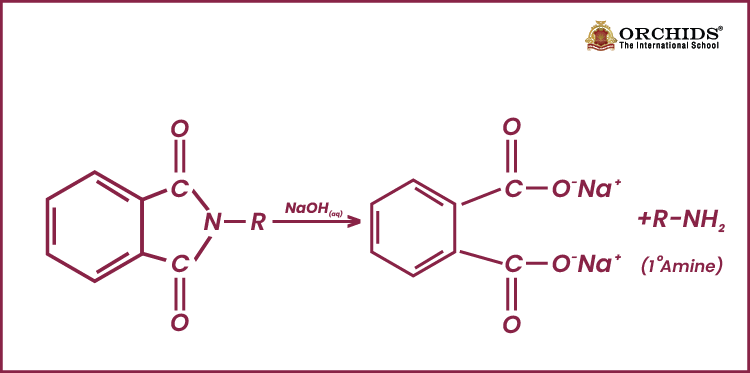
- Gabriel Phthalimide Synthesis: This method is specifically used to prepare primary amines using potassium phthalimide and alkyl halides.
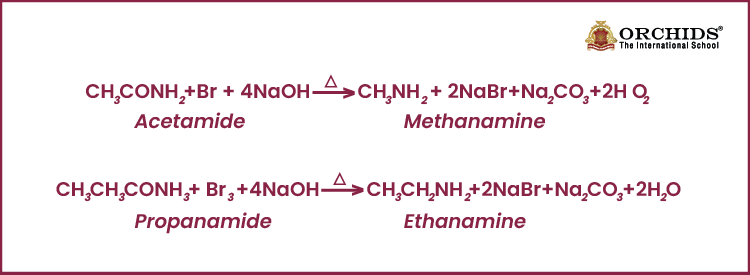
- Hofmann Bromamide Degradation: An amide reacts with bromine and aqueous sodium hydroxide to produce a primary amine with one carbon less.
Basicity of Amines
The basic nature of amines comes from the lone pair of electrons on the nitrogen atom, which can accept a proton (H⁺). However, the basic strength varies depending on:
-
Electronic effects of substituents
-
Solvent effects (especially hydrogen bonding in water)
-
Resonance effects in aromatic amines
In general:
-
Aliphatic amines are stronger bases than aromatic amines, because the lone pair of nitrogen in aromatic rings is delocalised into the ring.
-
Electron-donating groups increase basicity.
-
Electron-withdrawing groups decrease basicity.
The basicity order in an aqueous medium is:
Tertiary > Secondary > Primary > Ammonia
In gas phase: Primary > Secondary > Tertiary > Ammonia
Uses of Amines
Amines have wide applications across industries and biological systems:
-
Used in drugs like antihistamines, antidepressants, and anaesthetics.
-
Aromatic amines form the backbone of many azo dyes.
-
Some amine derivatives are used in agriculture as herbicides or insecticides.
-
Amines are used as antioxidants and vulcanisation accelerators.
-
Involved in the production of polyurethanes and epoxy resins.
-
Naturally occurring amines include amino acids, adrenaline, and serotonin.
Easy Tricks to Remember Amines
- Link to ammonia. Just keep in mind, there is no need to memorise amines; they are very simple, they are variations of ammonia.
- Group counting, you can determine if an amine is primary, secondary, or tertiary from the number of carbon groups bonded to the nitrogen.
- Think of examples. It would be beneficial to tie in where amines are used in real life, like medicines, dyes, etc.
- Mind the base: the more alkyl groups = the stronger base (generally); the more aryl = the weaker base (resonance).
As we learned till now, Amines are essential organic compounds; they bridge the gap between basic chemistry and much more complex biological systems. What makes amines interesting is the structure surrounding the nitrogen groups and the fact that they can be classified as first, second, third amines. They are comparatively basic and can be easily prepared. Learning about amines provides a lot of background related to organic.
Frequently Asked Questions on Amines
1. What are Amines?
Amines are organic compounds that contain nitrogen atoms bonded to carbon or hydrogen. They play key roles in chemistry, biology, and industry.
2. What is the difference between aliphatic and aromatic amines?
Aliphatic and aromatic amines differ in structure; aliphatic amines have straight or branched chains, while aromatic amines have the nitrogen attached to an aromatic ring like benzene.
3. How are amines and plasticisers connected?
Amines and plasticisers are often related in polymer industries, where amines help modify plastic flexibility and durability through chemical reactions.
4. What does Aromatic mean in amine chemistry?
Aromatic refers to amines where the nitrogen is directly bonded to an aromatic ring, influencing their reactivity and properties significantly.
5. What is a Secondary amine?
A secondary amine is a type of amine where the nitrogen atom is bonded to two carbon-containing groups and one hydrogen atom.
6. What is the importance of amines?
Amines play a vital role in our daily lives, found in medicines, dyes, and even DNA. They're key in biological processes and industrial production.
7. What are the most important amines?
Some important amines include methylamine, aniline, and ethylamine. They're widely used in pharmaceuticals, agrochemicals, and synthetic materials.
8. Is amine basic or acidic?
Amines are generally basic in nature due to the lone pair of electrons on nitrogen, which allows them to accept protons easily.
9. What is the importance of amine value?
The amine value helps in determining the reactivity of amines in resins and coatings. It's crucial in producing polymers with the right chemical balance.
Science isn't just a subject, it's the way of seeing the world. Curious how Orchids The International School teaches it that way? Talk to our admissions team.
Admissions Open for 2026-27
What type of concept pages would you prefer?
CBSE Schools In Popular Cities
- CBSE Schools in Bangalore
- CBSE Schools in Mumbai
- CBSE Schools in Pune
- CBSE Schools in Hyderabad
- CBSE Schools in Chennai
- CBSE Schools in Gurgaon
- CBSE Schools in Kolkata
- CBSE Schools in Indore
- CBSE Schools in Sonipat
- CBSE Schools in Delhi
- CBSE Schools in Rohtak
- CBSE Schools in Bhopal
- CBSE Schools in Aurangabad
- CBSE Schools in Jabalpur
- CBSE Schools in Jaipur
- CBSE Schools in Jodhpur
- CBSE Schools in Nagpur
- CBSE Schools in Ahmednagar
- CBSE School In Tumkur











Orchids The International School is one of India's leading chains of CBSE and ICSE schools, with 110+ schools across the country.