

Understanding Rocks and Minerals: Types, Features, and Examples
Rocks and minerals are nature’s fundamental building blocks, shaping the land beneath our feet and the resources we depend on every day. Minerals are pure substances, while rocks are made from a mix of these minerals. Understanding them helps us appreciate how our planet works, from the mountains we see to the tiny grains of sand on a beach.
This article aims to explain the definitions of rocks and minerals, differences, types, and uses in a more detailed way by our experts.
Table of Contents
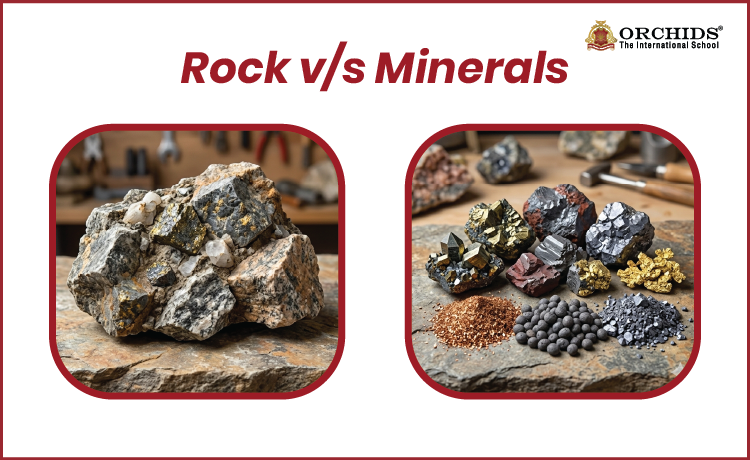

What Are Minerals?
Minerals are solid natural substances that have a fixed chemical composition and are created by geological processes. Each mineral possesses physical and chemical properties.
How these minerals are identified :
- They are formed naturally, not man-made.
- Minerals behave as solids at room temperature.
- They have fixed chemical composition (e.g., Quartz is SiO₂).
- It possesses a crystal structure (atoms are in a regular pattern).
Common examples are Quartz, Mica, Feldspar, and Diamond.
Uses of Minerals
- Quartz is used in glass and watches.
- Mica is used in electrical insulation.
- Diamond is utilised in jewellery and cutting tools.
What Are Rocks?
It's common to see a rock, although it seems the same in appearance, but the fact is it's not!! They are solid natural materials consisting of one or more minerals. They make up the Earth's outer layer and have a very diverse appearance, makeup, and hardness.
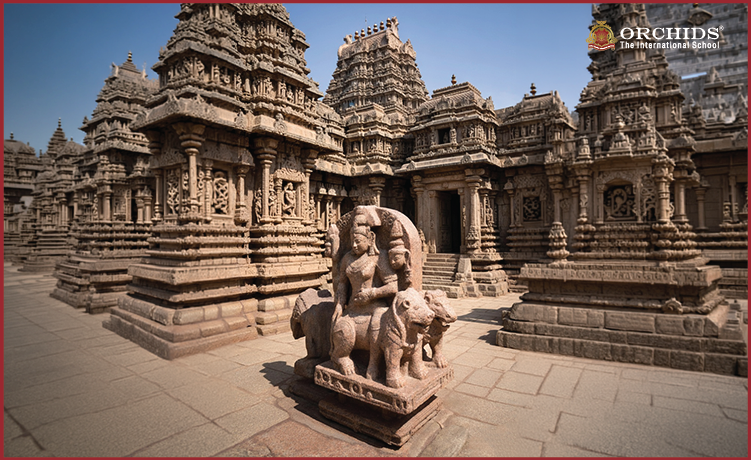
Minerals possess a set composition, whereas rocks can consist of various minerals.
Some common examples are: Granite (made of quartz, feldspar, and mica), Limestone, Sandstone.
Uses of Rocks:
- Granite is used in construction.
- Limestone is used to make cement.
- Sandstone is used for decorative stonework.
Let's Discuss Their Types
Types of Rocks
Rocks are classified based on how they are formed. There are three main types:
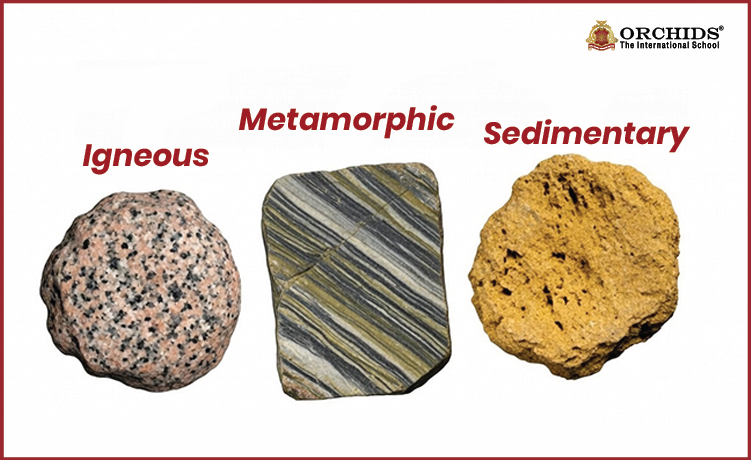
A. Igneous Rocks
Interestingly, they areformed when molten magma or lava cools and solidifies.
Types:
- Intrusive (Plutonic) is formed inside the Earth (e.g., Granite).
- Extrusive (Volcanic) is formed on the surface following volcanic eruptions (e.g., Basalt).
Features: Hard, crystalline texture.
Examples: Granite, Basalt, Obsidian.
B. Sedimentary Rocks
They are formed through the building up and compaction of sediments over long periods.
Features: Frequently have layers (strata) and may include fossils.
Examples: Sandstone, Limestone, Shale.
Significance: Many have fossil records, providing evidence about Earth's history.
C. Metamorphic Rocks
They are formed when rocks transform due to intense heat, pressure, or chemical processes.
Features: Can be more compact and harder than the parent rock.
Examples: Marble (from limestone), Slate (from shale).
Importance: Employed in building, sculpture, and ornamentation.
Have you heard about the “Rock Cycle”?
The rock cycle describes how rocks transform from one type into another over millions of years:
- Magma cools, and that's when the Igneous rock is formed.
- Weathering and erosion disintegrate rocks into sediments. These sedimentary rocks are formed after compaction.
- Heat and pressure transform rocks; that's when they form Metamorphic rocks.
- Metamorphic rocks can melt to become magma. This is how the cycle repeats.
Do you know the fact that the rock cycle is a never-ending process that demonstrates that rocks are constantly changing!
The Big question here is how these Rocks and Minerals Are Different?
Let's Discuss !!
|
Characteristic |
Rocks |
Minerals |
|
Composition |
Mixture of minerals |
Has a definite chemical composition |
|
Structure |
May lack a crystal structure |
Always has a crystal structure |
|
Examples |
Granite, Limestone, Sandstone |
Quartz, Mica, Feldspar |
|
Uses |
Building, decorative stone |
Jewellery, industry, technology |
How They Are Used in Our Lives :
- The construction of buildings using granite, limestone, and marble are commonly used to build buildings.
- For energy purposes, coal (a type of sedimentary rock) is a vital fuel.
- In thetechnology world, silica is used in electronics.
- Daily Products likeTalc in baby powder, graphite in pencils.
Rocks and minerals are the building blocks of life on Earth. Minerals are the building blocks, and rocks are composed of these minerals. They are forever changing as they go through the rock cycle, creating and changing our planet and giving us resources we use every day.
Frequently Asked Questions on Rocks and Minerals
1. What are the 7 most important rock-forming minerals?
The 7 most important rock-forming minerals are quartz, feldspar, mica, amphibole, pyroxene, olivine, and calcite. Together, they make up most of the Earth’s crust and are key to understanding different Rocks and Minerals Types.
2. What are the three main types of rocks?
The three main types of rocks are igneous, sedimentary, and metamorphic. Each type forms in a unique way from cooling magma, settling sediments, or changing under heat and pressure. This variety makes Rocks and Minerals fascinating to study.
3. What are some interesting Rocks and Minerals examples?
Interesting examples include granite, basalt, and marble for rocks, and quartz, diamond, and mica for minerals. Each has its own beauty, history, and uses, from construction to jewellery.
4. What are some common Rocks and Minerals Types used today?
Common types include igneous rocks like granite for buildings, sedimentary rocks like limestone for cement, and metamorphic rocks like slate for flooring. Minerals such as quartz and mica are used in technology and industry.
Science isn't just a subject, it's the way of seeing the world. Curious how Orchids The International School teaches it that way? Talk to our admissions team.
Admissions Open for 2026-27
What type of concept pages would you prefer?
CBSE Schools In Popular Cities
- CBSE Schools in Bangalore
- CBSE Schools in Mumbai
- CBSE Schools in Pune
- CBSE Schools in Hyderabad
- CBSE Schools in Chennai
- CBSE Schools in Gurgaon
- CBSE Schools in Kolkata
- CBSE Schools in Indore
- CBSE Schools in Sonipat
- CBSE Schools in Delhi
- CBSE Schools in Rohtak
- CBSE Schools in Bhopal
- CBSE Schools in Aurangabad
- CBSE Schools in Jabalpur
- CBSE Schools in Jaipur
- CBSE Schools in Jodhpur
- CBSE Schools in Nagpur
- CBSE Schools in Ahmednagar
- CBSE School In Tumkur











Orchids The International School is one of India's leading chains of CBSE and ICSE schools, with 130+ schools across the country.