

Ammonia
Ammonia is a common but powerful chemical that has an important role in both sciences and in everyday living. As Ammonia has many uses, from helping to grow crops to cleaning our homes.
This article provides the molecular structure, methods of generation both in the lab and industry, how its properties are defined, and its multiple practical applications will be examined.
Table of Contents
- What is Ammonia and Its Structure
- Preparation of Ammonia
- Properties of Ammonia
- Uses of Ammonia
- Quick Recap about Ammonia
- Frequently Asked Questions on Ammonia (NH3)

What is Ammonia and Its Structure
Ammonia is annotated NH₃. It is a simple compound, but it has some interesting and unique properties because of its shape. One molecule of ammonia is made of:
-
One nitrogen (N) atom
-
Three hydrogen (H) atoms
The atoms are bonded in the shape of a trigonal pyramidal.
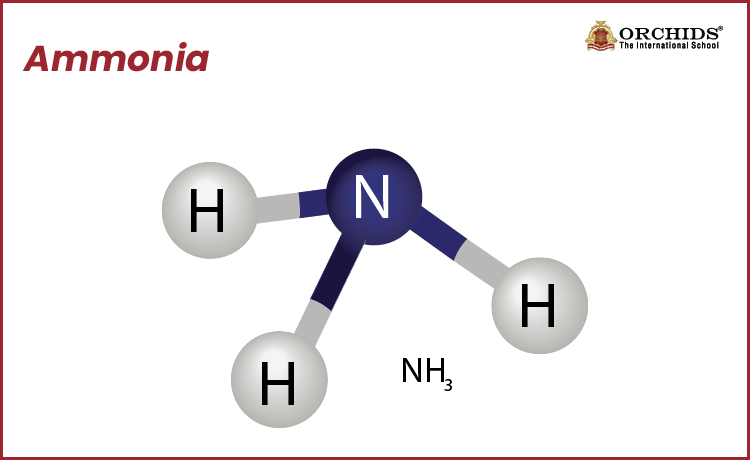
This means a nitrogen atom at the centre and three hydrogen atoms, like the vertices of a triangle below it, and one pair of electrons above.
The shape of this molecule makes ammonia a polar molecule, i.e., it has a positive and a negative terminus. This is why ammonia dissolves so well in water and can form hydrogen bonds, a perfectly adequate explanation of many of ammonia's chemical properties.
Preparation of Ammonia
Ammonia can be prepared in various ways, depending on whether it is being prepared in the laboratory, commercially or industrially.
1. Haber’s Process (Industrial Preparation)
This is the way that ammonia is mostly made in industry or for commercial manufacturing. The general principles:
-
Reactants: nitrogen (N₂) and hydrogen (H₂), both obtained from a source, such as natural gas or water.
-
Conditions: high pressure (approximately 200 atm); high temperature (approximately 450°C); uses an iron catalyst.
-
Reaction:
This is a reversible reaction, meaning that the reactant is not going to all convert to ammonia at once. Engineers will monitor and fine-tune the conditions for maximum yield.
2. Laboratory Preparation
In the lab, one method of preparing ammonia is prepared is by reacting a concentrated base (sodium hydroxide, for example) with an ammonium salt (ammonium chloride, for example) when heated:
-
Reaction:
The ammonia gas that escapes can be trapped by using an inverted funnel, or over dry surfaces - ammonium is extremely soluble in water.
Properties of Ammonia
Ammonia can appear harmless, but its characteristics make it incredibly potent in many ways.
- Physical Properties:
-
Appearance: Colourless gas at room temperature
-
Molecular Weight / Molar Mass: 17.031 g/mol
-
Density: 0.73 kg/m³
-
Boiling Point: -33.34 °C
-
Melting Point: -77.73 °C
-
Smell: Strong, pungent (easy to recognise)
-
Solubility: Highly soluble in water, forming a basic solution
Chemical Properties:
-
Basic Nature: Ammonia is a base. It forms ammonium hydroxide (NH₄OH), a weak base, when it reacts with water.
-
Combustibility: It will not easily burn, but in a high-oxygen environment, it will burn to produce nitrogen and water.
- Reaction with Acids: Ammonia reacts with acids to form ammonium salts.
Its odour and reactions with acids are just two of the reasons why it is part of so many cleaners and industrial products.
Uses of Ammonia
Ammonia is not just a gas - it is used by many industries:
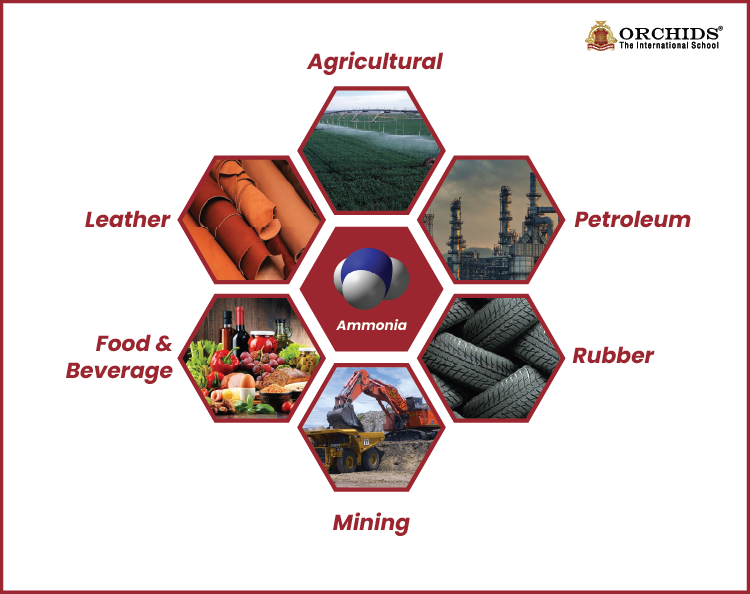
1. Agriculture
The largest application of ammonia is in fertilisers for agriculture. Ammonia enhances plant life. It provides nitrogen, an essential nutrient for healthy plants.
Examples of some fertilisers manufactured from ammonia are:
-
Urea
-
Ammonium sulfate
-
Ammonium nitrate
2. Household Products
Used in:
-
Glass cleaners
-
Disinfectants
-
Surface sprays
That strong odour is a hint! Ammonia works well at penetrating grease and stains.
3. Industrial Uses
Used to manufacture:
-
Plastics
-
Explosives (i.e., TNT)
-
Textiles
-
Synthetic fibers
Also used as a refrigerant in large industrial refrigeration plants before the ubiquity of modern refrigerants.
4. Water Treatment
-
Helps balance the water’s pH
-
Assists in removing impurities
5. Medical Uses
The level of ammonia in smelling salts sold to people who faint is very low.
Quick Recap about Ammonia
-
Ammonia (NH₃) is a colourless, pungent gas that has a trigonal pyramidal structure.
-
It is very soluble in water, where it acts as a weak base and forms ammonium hydroxide.
-
It is produced through the Haber’s Process (industrially), and via ammonium salt + base reaction (in labs).
-
Ammonia is generally used in fertilisers, household cleaning products, industrial chemicals, water treatment, and medical purposes.
Till now, we have known that Ammonia is a simple compound, but we use it in many aspects of our lives.
Ammonia's unique structure and potentially poisonous, reactive nature make it applicable in many fields. It contributes to feeding the world, as well as in many medical and industrial applications.
Frequently Asked Questions on Ammonia (NH3)
1. What are some important facts about ammonia?
Ammonia is a colourless gas; it has a strong, sharp smell and is made of nitrogen and hydrogen. It’s widely used in agriculture, cleaning, and various industries.
2. What is the most important use of ammonia?
The biggest use of ammonia is in making fertilisers that help plants grow faster and healthier. It supports global food production by improving soil nutrients.
3. What is ammonia best used for?
Ammonia is best known for its role in agriculture, especially as a key ingredient in fertilisers. It’s also used in cleaning products and refrigeration.
4. What is the main use of chemical ammonia?
Chemical ammonia is mainly used to produce nitrogen-based fertilisers like urea and ammonium nitrate, which boost crop yield and support farming worldwide.
5. What is ammonia?
Ammonia is a colourless gas with a strong, pungent smell. It is widely used in fertilisers, cleaning products, and industrial chemicals.
6. What is the valency of ammonia?
The valency of ammonia is 1, as nitrogen forms three covalent bonds with hydrogen, leaving one lone pair of electrons.
Science isn't just a subject, it's the way of seeing the world. Curious how Orchids The International School teaches it that way? Talk to our admissions team.
Admissions Open for 2026-27
What type of concept pages would you prefer?
CBSE Schools In Popular Cities
- CBSE Schools in Bangalore
- CBSE Schools in Mumbai
- CBSE Schools in Pune
- CBSE Schools in Hyderabad
- CBSE Schools in Chennai
- CBSE Schools in Gurgaon
- CBSE Schools in Kolkata
- CBSE Schools in Indore
- CBSE Schools in Sonipat
- CBSE Schools in Delhi
- CBSE Schools in Rohtak
- CBSE Schools in Bhopal
- CBSE Schools in Aurangabad
- CBSE Schools in Jabalpur
- CBSE Schools in Jaipur
- CBSE Schools in Jodhpur
- CBSE Schools in Nagpur
- CBSE Schools in Ahmednagar
- CBSE School In Tumkur











Orchids The International School is one of India's leading chains of CBSE and ICSE schools, with 110+ schools across the country.