

What is a Micelle? The Science Behind Cleaning for Class 10
Have you ever wondered how soaps and detergents remove oily dirt even with water? The answer lies in a fascinating chemical structure called a micelle. Micelles are tiny clusters of molecules that trap oil and grease, allowing them to be washed away easily.
This article explains micelles, how they form, their structure, types, and practical applications simply and engagingly.
Table of Contents
- What Are Micelles and Their Structure
- Types of Micelles
- Applications of Micelles
- Frequently Asked Questions on Micelle

What Are Micelles and Their Struture
In simple terms, a micelle is a spherical cluster of surfactant molecules (such as those found in soaps and detergents) that forms when they are added to water.
Each surfactant molecule has two parts :
- a hydrophilic (water-loving) head, and
a hydrophobic (water-repelling) tail.
Here's the Structure of a Micelle, how exactly it looks!!
A micelle resembles a small, round ball made of many soap and detergent molecules.
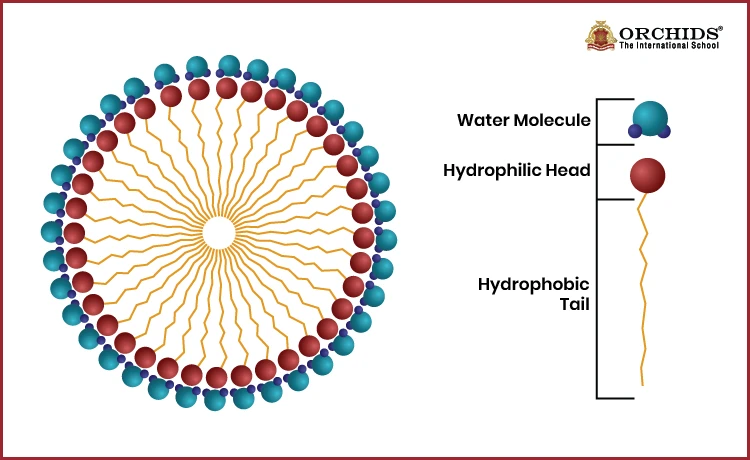
Its structure can be understood as follows:
- The core (centre) of the micelle contains the hydrophobic tails that attract and hold oily substances.
- The outer surface consists of hydrophilic heads that interact with water.
Interestingly, because of this dual nature, micelles act as a bridge between oil and water,a property that makes them essential in cleaning, emulsification, and biological systems.
Let's have a look at exactly how micelle formation takes place
When many of these molecules come together above a certain concentration called the Critical Micelle Concentration (CMC), they arrange themselves so that the tails hide inside (away from water), and the heads face outward (toward water).
This arrangement forms a micelle, which acts like a tiny cleaning capsule trapping oil, grease, and dirt inside so they can be washed away easily.
.webp)
Micelles form only when the soap or detergent concentration in water exceeds the
Critical Micelle Concentration (CMC).
Here’s how it happens:
- At low concentrations, the surfactant molecules float separately in water.
- As more surfactant is added, the molecules start arranging themselves to reduce repulsion between their hydrophobic parts.
- Once the CMC is reached, the molecules spontaneously organise into spherical micelles.
Temperature, pH, and the type of surfactant affect how easily micelles form. Warm water usually helps faster micelle formation, which is why cleaning with warm water is more effective.
Types of Micelles
1. Normal (Direct) Micelles, as these form in polar solvents like water. The hydrophobic tails stay inside, while the hydrophilic heads face outward.
This is the type seen in everyday soaps and detergents.
2. Reverse Micelles are mainly formed in non-polar solvents (like oils). Here, the hydrophilic heads point inward (toward trapped water molecules), while the hydrophobic tails face the outside.
The fact that Reverse micelles are used in biochemical research, especially for enzyme and protein studies.
3. Super Micelles or Supercells are large, organised assemblies of multiple micelles or nanoparticles. They can form stable structures that serve as carriers for drugs, dyes, or catalysts in advanced chemical and biological systems.
Applications of Micelles
Micelles have a wide range of uses, from daily cleaning to advanced science:
- In Cleaning and Emulsification of soaps and detergents, micelles dissolve oils and dirt that water alone cannot remove.
- In the pharmaceutical and Medicine sectors, Micelles are used as nanocarriers to deliver drugs, vitamins, or genetic material to specific cells in the body. They improve the solubility and efficiency of many medicines.
- In the Cosmetic and Skincare Industry, it is used as aMicellar water, a popular skincare product, that uses micelles to gently remove makeup and impurities without drying the skin.
- Micelles are applied in chromatography and electrophoresis for the separation of compounds, improving analysis and purification in Chemical and Industrial Processes.
- It has Biological Importance, as in the human body, micelles help in the absorption of fat-soluble vitamins (A, D, E, and K) and the digestion of fats through bile salts.
- In Environmental Science, Micellar systems help clean up oil spills and pollutants by converting insoluble wastes into washable forms.
Let's learn about the Factors Affecting Micelle Formation :
Several factors influence how and when micelles form:
- The major factor is temperature, which is Higher temperature reduces surface tension and aids micelle formation.
- The concentration of micelles only appears above the CMC level.
- pH of the solution affects the charge and stability of micelles.
- It also affects the type of surfactant, which are Ionic, non-ionic, or zwitterionic surfactants create different micelle structures.
- The presence of salt can change the size and shape of micelles by affecting ionic strength.
So far, we have learned that Micelles are one of the most interesting and useful molecular structures in chemistry. From cleaning our clothes to transporting medicines inside the body, these tiny spherical assemblies show how chemistry powers everyday life.
In short, micelles make chemistry visible in action, small in size, but mighty in impact!
Frequently Asked Questions on Micelle
1. Why are micelles formed?
Micelles are formed when soap or detergent molecules come together in water to trap oil and dirt. This process, called micelle formation, starts above the critical micelle concentration.
2. What are micelles also called?
Micelles are also called molecular aggregates or surfactant clusters. In simple words, what are micelles can be explained as tiny spherical structures formed through micelle formation in water.
3. Why are micelles important?
Micelles are important because they help remove grease, absorb nutrients, and deliver medicines in the body. Understanding what micelles are and micelle formation shows how chemistry works in real life.
4. What are the factors of micelles?
The key factors affecting micelles include temperature, pH, and critical micelle concentration. These control when and how micelle formation takes place efficiently.
5. What do micelles carry?
Micelles carry oily dirt, grease, and even drugs within their hydrophobic core. Their micelle formation above the critical micelle concentration makes them excellent tiny transporters in water.
6. What is the shape of a micelle?
A micelle is usually spherical, with hydrophilic heads outside and hydrophobic tails inside. This special shape results from micelle formation once the critical micelle concentration is reached.
Science isn't just a subject, it's the way of seeing the world. Curious how Orchids The International School teaches it that way? Talk to our admissions team.
Admissions Open for 2026-27
What type of concept pages would you prefer?
CBSE Schools In Popular Cities
- CBSE Schools in Bangalore
- CBSE Schools in Mumbai
- CBSE Schools in Pune
- CBSE Schools in Hyderabad
- CBSE Schools in Chennai
- CBSE Schools in Gurgaon
- CBSE Schools in Kolkata
- CBSE Schools in Indore
- CBSE Schools in Sonipat
- CBSE Schools in Delhi
- CBSE Schools in Rohtak
- CBSE Schools in Bhopal
- CBSE Schools in Aurangabad
- CBSE Schools in Jabalpur
- CBSE Schools in Jaipur
- CBSE Schools in Jodhpur
- CBSE Schools in Nagpur
- CBSE Schools in Ahmednagar
- CBSE School In Tumkur











Orchids The International School is one of India's leading chains of CBSE and ICSE schools, with 110+ schools across the country.