

Properties of the Boron Family: Trends , Characteristics and Uses Explained
The Boron family and its properties, also known as Group 13 elements in the periodic table, includes Boron (B), Aluminium (Al), Gallium (Ga), Indium (In), Thallium (Tl), and Nihonium (Nh). These elements share a common trait: three electrons in their outermost shell but display strikingly different physical and chemical properties.
This article provides the insights on Properties of the Boron Family for students by exploring their atomic structure, physical trends, and chemical behaviour in a clear and easy manner.
Table of Contents
- What is the Boron Family
- Properties of the Boron Family
- Trends in the Boron Family
- Applications of Boron Family Elements
- Frequently Asked Questions on Properties of Boron

What is the Boron Family?
The Boron family is positioned in Group 13 of the Modern Periodic Table and marks a transition from non-metallic to metallic behaviour.
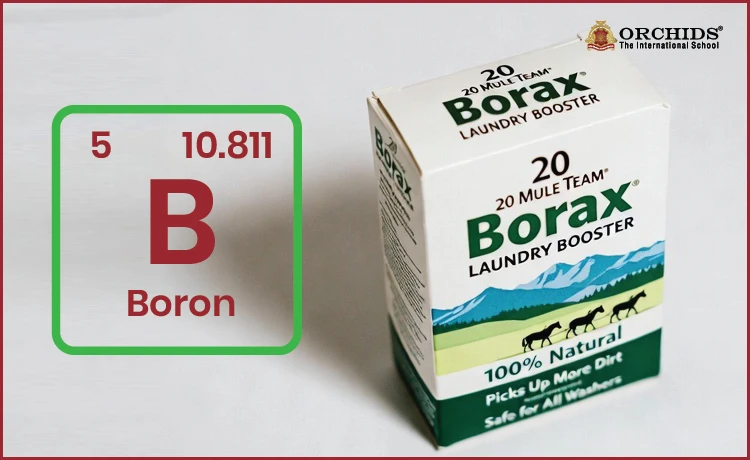
Let's have a look at its key features of properties of the Boron Family :
- Boron is the only non-metal in the group.
- The interesting thing to know is that Aluminium is a metal but shows some non-metallic characteristics.
- Gallium, Indium, and Thalliumare soft metals with high electrical conductivity.
- Nihonium, a synthetic radioactive element, is also metallic but unstable.
These variations occur due to differences in atomic size, ionisation energy, and the metallic character as we move down the group.
Do you know that the Boron family shows specific physical and chemical properties of the Boron family that help us identify them among all.
Properties of the Boron Family
Physical Properties of Boron
The Boron family exhibits both metallic and non-metallic characteristics, and their properties change gradually from Boron to Thallium.
Below is the table presenting all the physical properties of boron :
|
Property |
Trend / Description |
|
Physical State |
All are solids at room temperature. |
|
Appearance |
Boron is black and hard; others are silvery-white metals. |
|
Electrical Conductivity |
Boron is a poor conductor; others are good conductors. |
|
Melting & Boiling Points |
Boron has a very high melting point due to its strong covalent lattice. The melting point decreases down the group. |
|
Density |
Generally increases down the group, with Gallium being an exception as it melts near room temperature (about 29.8°C). |
|
Hardness |
Boron is extremely hard; other members are soft and malleable. |
|
Lustre |
Metals are shiny, while boron appears dull and non-metallic. |
Fun Fact: Gallium can melt in your hand due to its low melting point, an interesting demonstration often used in chemistry labs!
Also Read : 118 Elements and their symbols and Atomic numbers
Chemical Properties of Boron
Boron exhibits interesting chemical behaviour due to its small atomic size and tendency to form covalent bonds rather than ionic ones.
Let’s understand its main reactions step by step.
1. Reaction with Air, When boron is heated in air, it forms boron trioxide (B₂O₃), a glassy solid that is acidic in nature.
Based on observation, Boron does not react at room temperature due to a protective oxide layer but burns when heated, producing boron trioxide, which is used in borosilicate glass.
Aluminium forms a thin oxide layer (Al₂O₃) that prevents further oxidation.
Gallium, Indium, and Thallium react slowly with air, forming oxides and hydroxides.
2. Reaction with Nitrogen, At high temperatures, boron reacts with nitrogen to form boron nitride (BN), a compound that resembles diamond in hardness.
This Boron nitride formed is an extremely hard material used in abrasives, lubricants, and high-temperature crucibles.
3. Reaction with Acids and Alkalis, Boron is unreactive with most acids and alkalis at ordinary temperatures. However, it reacts with concentrated oxidising acids such as hot concentrated nitric acid (HNO₃) to form boric acid (H₃BO₃).
This reaction shows boron’s mild reactivity and its conversion into a common compound, boric acid, widely used in antiseptics and eye drops.
Aluminium reacts with both, showing amphoteric behaviour; it acts as both an acid and a base.
4. Reaction with Halogens,Boron readily reacts with halogens (fluorine, chlorine, bromine, iodine) to form boron trihalides (BX₃) such as BF₃, BCl₃, BBr₃, etc.
Importantly, Boron trihalides are volatile covalent compounds that act as Lewis acids, making them important in organic synthesis and industrial chemistry.
All members form trihalides (MX₃) except Thallium, which forms TlI instead of TlI₃ because +3 is less stable for heavier elements.
Example:
5. Reaction with Metals. When boron reacts with metals at high temperatures, it forms borides, which are extremely hard compounds.
But for what purpose are they famous?Borides like titanium boride (TiB₂) and magnesium boride (MgB₂) have high melting points and are used in cutting tools and superconductors.
6. Nature of Oxides, The oxide of boron, B₂O₃, is acidic, while the oxides of heavier group members (like Al₂O₃, In₂O₃, Tl₂O₃) become more amphoteric or basic as we move down the group.
This reaction shows boron’s tendency to form borates, which are used in detergents and glass manufacturing.
It's interesting to know how Boron and its family show the periodic trend that helps us to study each element and its applications. Let's have a closer look.
Trends in the Boron Family
Below are the properties of the Boron family, followed in the periodic table:
|
Property |
Trend Down the Group |
|
Atomic Size |
Increases |
|
Ionisation Energy |
Decreases |
|
Metallic Character |
Increases |
|
Melting Point |
Decreases (except Boron) |
|
Density |
Generally increases |
|
Electronegativity |
Decreases |
These periodic trends help students predict the chemical reactivity of group 13 elements in various compounds.
Applications of Boron Family Elements
The elements of the Boron family (Group 13) have wide and diverse applications in our daily lives as well as in industries:
- Boron (B) is used in making borosilicate glass, ceramics, and as a dopant in semiconductors to improve electrical properties.
- Interestingly! Aluminium (Al) finds applications in aircraft manufacturing, packaging materials, and electrical transmission lines due to its light weight and high conductivity.
- Majorly, Gallium (Ga) is mainly used in LEDs, semiconductors, and high-precision thermometers because it remains liquid over a wide temperature range.
- Indium (In) is an essential component in touchscreens, solar panels, and other electronic devices for its excellent conductivity and transparency.
- Thallium (Tl), though toxic, is used carefully in infrared detectors, electronic devices, and some specialised optical instruments.
These applications highlight the technological and industrial importance of the Boron family elements in modern science and engineering.
Read More: Aluminium
So far, we have learned how the Properties of the Boron Family highlight the interesting transition from non-metallic boron to metallic thallium. The Boron family, thus, beautifully bridges the gap between metals and non-metals, a true example of periodic diversity!
Frequently Asked Questions on Properties of Boron
1. What are the properties of the boron family?
The boron family shows a mix of non-metallic and metallic traits, with boron being a hard non-metal and others like aluminium and gallium being soft, shiny metals.
2. What is the reactivity of the boron family?
Reactivity in the boron family increases down the group. Boron is less reactive, while aluminium and heavier members react easily with air, acids, and halogens.
3. What makes the boron family unique?
The properties of the boron family are unique because they bridge the gap between metals and non-metals, showing a gradual shift in properties and bonding nature within one group.
4. What is the stability of the boron family?
The stability of compounds changes down the group. Lighter elements form strong covalent bonds, while heavier ones prefer ionic or metallic bonding.
5. What is the common oxidation state of the boron family?
All elements in the boron family commonly exhibit a +3 oxidation state, though heavier members like thallium can also show a +1 state due to the inert pair effect.
6. What is the most stable form of boron?
The most stable form of boron is its crystalline form, which is extremely hard, chemically resistant, and found in materials like boron carbide and boron nitride.
Science isn't just a subject, it's the way of seeing the world. Curious how Orchids The International School teaches it that way? Talk to our admissions team.
Admissions Open for 2026-27
What type of concept pages would you prefer?
CBSE Schools In Popular Cities
- CBSE Schools in Bangalore
- CBSE Schools in Mumbai
- CBSE Schools in Pune
- CBSE Schools in Hyderabad
- CBSE Schools in Chennai
- CBSE Schools in Gurgaon
- CBSE Schools in Kolkata
- CBSE Schools in Indore
- CBSE Schools in Sonipat
- CBSE Schools in Delhi
- CBSE Schools in Rohtak
- CBSE Schools in Bhopal
- CBSE Schools in Aurangabad
- CBSE Schools in Jabalpur
- CBSE Schools in Jaipur
- CBSE Schools in Jodhpur
- CBSE Schools in Nagpur
- CBSE Schools in Ahmednagar
- CBSE School In Tumkur











Orchids The International School is one of India's leading chains of CBSE and ICSE schools, with 130+ schools across the country.