

Resonance Effect: Types and Structures Explained with Examples
Have you ever wondered why some chemicals are more stable than others or why they react differently? The answer lies in how electrons move inside a molecule.In most molecules, electrons stay fixed between two atoms. But in some molecules, they spread out and move freely across several atoms at once. This movement is called the resonance effect, also known as the mesomeric effect.In this article, we will cover what the resonance effect is, how it works, its types, and why it is so important in organic chemistry.
Table of Contents
- What Is the Resonance Effect?
- Types of Resonance (Mesomeric) Effect
- Applications of Resonance in Chemistry
- Frequently Asked Questions on Resonance Effect

What Is the Resonance Effect?
Every molecule is made up of atoms that share electrons to form bonds. In most simple molecules, these shared electrons stay fixed between two atoms.
However, in some compounds, especially those that have double bonds or atoms with lone pairs of electrons, these electrons can move or shift between neighbouring atoms.
The fact that this shifting of electrons across more than two atoms is called resonance. It means that instead of having one single, fixed structure, the molecule can be represented by two or more different structures known as resonance structures.
Interestingly, the real molecule does not keep changing between these structures; rather, it exists as an average of all of them. This combined structure is called a resonance hybrid, which is more stable and balanced than any single structure.
Next is How Resonance Structures are presented?
To show resonance, chemists draw multiple Lewis structures for the same molecule, with arrows (↔) between them. Each structure shows a different way electrons could be arranged.
Let's have a look at Benzene (C₆H₆) structure
Benzene has six carbon atoms in a ring with alternating single and double bonds. But in reality, all bonds are the same length. This means that the six π-electrons are spread evenly around the ring.
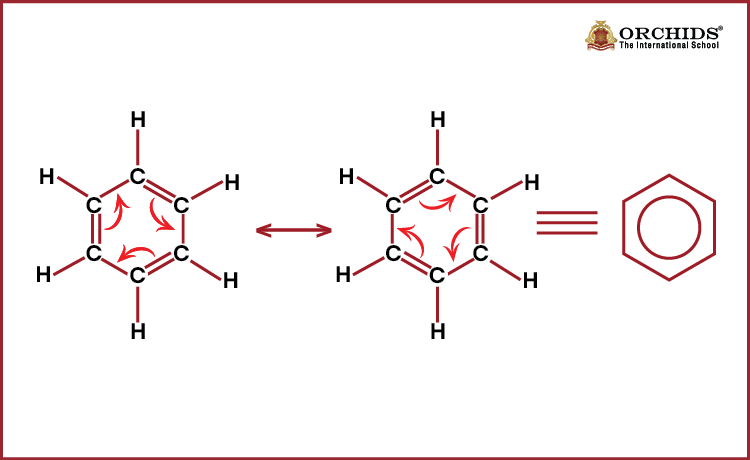
The true structure is a resonance hybrid, represented by a hexagon with a circle inside it.
Carbonate Ion (CO₃²⁻):
In the carbonate ion, the negative charge is not on one oxygen atom but shared equally among all three. That’s why the carbonate ion is more stable than expected.
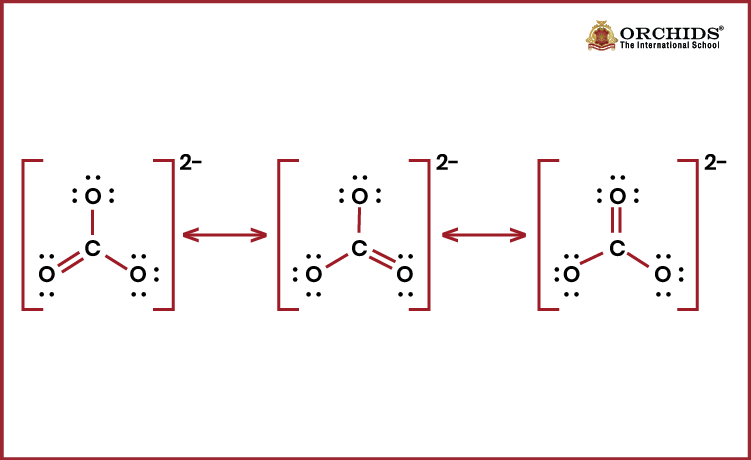
Let's understand if resonance and mesomeric effects are the same or not.
- The resonance effect is the movement or sharing of electrons between neighbouring bonds (usually double bonds or lone pairs) in a molecule, leading to a more stable structure.
- The mesomeric effect is another term for the same concept; it describes how electrons are transferred through a connected system of bonds in a molecule.
In short, both resonance and mesomeric effects demonstrate how electrons are shared within a molecule, providing it with extra stability and influencing its reactivity.
The next question that arises is, why does resonance happen?
Resonance occurs because electrons naturally move to make the molecule more stable and to spread out charge evenly. This happens when certain conditions are met:
- Conjugation (Alternating Bonds), that is, the molecule must have alternating single and double bonds so that the electrons can move easily through the chain of connected atoms.
- If an atom has lone pairs (like oxygen or nitrogen) next to a double bond, those electrons can join the movement and participate in resonance.
- Planar Structure (Flat Shape) is the major factor, as theatoms involved in resonance must lie in one plane so that their orbitals overlap properly and allow electron flow.
- Presence of charged atomsin a molecule, that is, the Ions with a positive or negative charge, can also show resonance when the charge can spread over several atoms.
It's considered that when these conditions exist, the electrons can move freely, and the molecule becomes more stable, symmetrical, and less reactive.
Also Read: Elements and Compounds
Types of Resonance (Mesomeric) Effect
The resonance or mesomeric effect can be divided into two main types depending on how the electrons move.
1. Positive Resonance Effect (+R or +M): The attached group donates electrons to the molecule. Electron density increases, making the molecule more reactive. The fact that this type usually activates the molecule for further reactions.
Groups Showing +R Effect: -OH, -OR, -NH₂, -SH, -OCH₃
Example:
In aniline (C₆H₅NH₂), the -NH₂ group donates electrons to the benzene ring through resonance. This increases the electron density on the ring, making it more active toward incoming reactants.
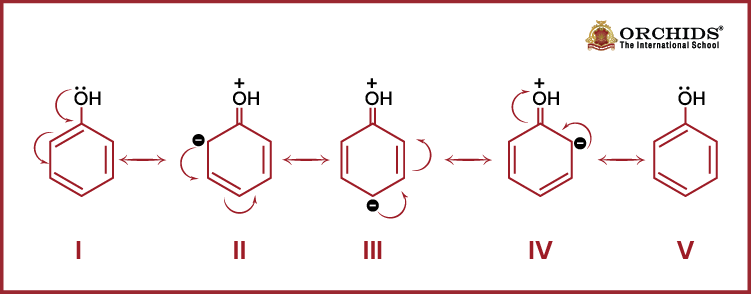
2. Negative Resonance Effect (-R or -M): The attached group withdraws electrons from the molecule. Electron density decreases, making the molecule less reactive. This type usually deactivates the molecule for further reactions.
Groups Showing -R Effect: -NO₂, -COOH, -CHO, -CN, -CO-
Example:
In nitrobenzene, the -NO₂ group pulls electrons from the ring, reducing its reactivity and directing new substituents to the meta position.
Here's the closure to the mechanism of resonance
To understand resonance, imagine electrons as being shared not just between two atoms, but by many atoms together. The way electrons move depends on the type of atom or group attached to the molecule.
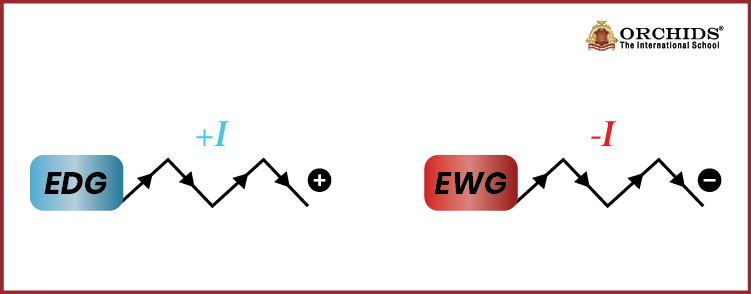
1. Electron-Donating Groups (EDGs): These are groups that push or donate electrons into the molecule. They increase the electron density and make the molecule more reactive. Importantly, they stabilise parts of the molecule that carry a positive charge.
Some Common Examples are -OH, -OR, -NH₂, -OCH₃
Let's understand with an Example: In phenol (C₆H₅OH), the -OH group donates electrons to the benzene ring through resonance.
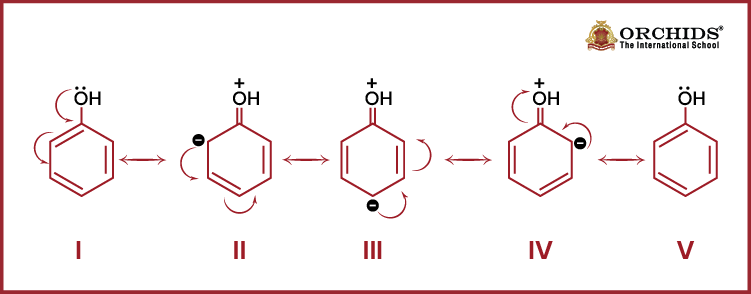
This makes the ring richer in electrons, so it reacts faster in substitution reactions than benzene itself.
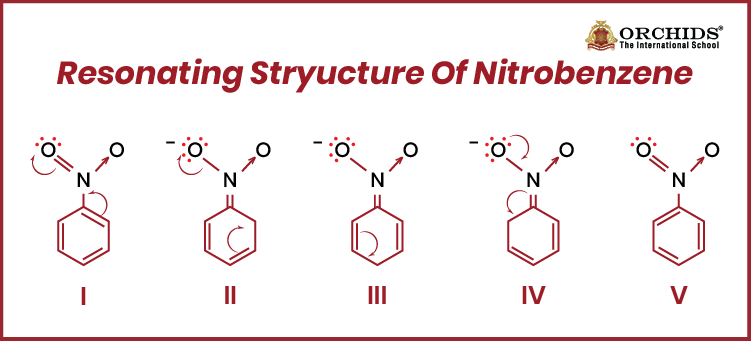
2. Electron-Withdrawing Groups (EWGs): These are groups that pull or attractelectrons away from the molecule. Unlike electron-donating groups, they decrease electron density and make the molecule less reactive.
Additionally, they stabilise parts of the molecule that carry a negative charge.
Some Common Examples are: -NO₂, -COOH, -CHO, -CN, -CO-
Let's Understand with an Example: In nitrobenzene (C₆H₅NO₂), the -NO₂ group pulls electrons away from the benzene ring. This makes the ring less reactive toward electrophilic substitution reactions.
Applications of Resonance in Chemistry
Resonance plays a key role in explaining many chemical properties:
1.Stability of Molecules helps to predict that Molecules that can show resonance are more stable because the charge or electrons are spread evenly across several atoms.
2. Reactivity in Reactionsthat is likeResonance explains why some compounds react faster (like phenol) while others react more slowly (like nitrobenzene).
3. When it comes toAcidity and Basicity, Resonance helps acids and bases distribute their charge after donating or accepting a proton.
For example, benzoic acid is more acidic because its negative charge can spread through resonance.
4. Many colored organic substances (like dyes and pigments) get their colour from resonance. When electrons move freely in a conjugated system, they absorb visible light, which gives them bright colours.
Below is a Quick Recap Table to sum up Resonance :
|
Type of Effect |
Direction of Electron Movement |
Examples of Groups |
Effect on Reactivity |
|
+R (Positive) |
Donates electrons |
-OH, -NH₂, -OCH₃ |
Increases reactivity |
|
-R (Negative) |
Withdraws electrons |
-NO₂, -COOH, -CN |
Decreases reactivity |
Read More: Atoms and Molecule
Till now, we have learned that the resonance (mesomeric) effect is one of the most important ideas in organic chemistry. It shows that electrons are not always fixed; they can move around within a molecule, spreading their charge and making the structure more stable.
In short, resonance helps us see the hidden movement of electrons, turning invisible chemistry into something we can easily understand.
Frequently Asked Questions on Resonance Effect
1. What is the resonance effect?
The resonance effect is the delocalisation of electrons in a molecule where multiple structures contribute to its stability. It helps explain why certain molecules are more stable than expected.
2. Why is the resonance effect important?
The resonance effect is important because it distributes charge evenly, increases stability, and explains the behaviour of conjugated systems like benzene.
3. What are the two types of resonance effects?
The two types of resonance effects are the +R (positive resonance effect) and -R (negative resonance effect), based on whether electron density is donated or withdrawn through conjugation.
4. Is resonance energy positive or negative?
Resonance energy is always positive, as it represents the extra stability gained by a molecule due to delocalisation of electrons.
5. What are the conditions for the resonance effect?
For the resonance effect to occur, a molecule must have a conjugated system with alternating single and multiple bonds, allowing delocalisation of π-electrons.
6. What are the causes of resonance?
Resonance is caused by the movement of delocalised electrons within π-bonds or lone pairs, which helps stabilise the molecule without changing its atomic positions.
7. What are the two features of resonance?
The two main features of resonance are delocalisation of electrons and the existence of multiple contributing structures that together describe the real molecule.
8. Is the resonance effect permanent?
Yes, the resonance effect is permanent because the delocalisation of electrons exists continuously within the molecule, contributing to its overall stability.
Science isn't just a subject, it's the way of seeing the world. Curious how Orchids The International School teaches it that way? Talk to our admissions team.
Admissions Open for 2026-27
What type of concept pages would you prefer?
CBSE Schools In Popular Cities
- CBSE Schools in Bangalore
- CBSE Schools in Mumbai
- CBSE Schools in Pune
- CBSE Schools in Hyderabad
- CBSE Schools in Chennai
- CBSE Schools in Gurgaon
- CBSE Schools in Kolkata
- CBSE Schools in Indore
- CBSE Schools in Sonipat
- CBSE Schools in Delhi
- CBSE Schools in Rohtak
- CBSE Schools in Bhopal
- CBSE Schools in Aurangabad
- CBSE Schools in Jabalpur
- CBSE Schools in Jaipur
- CBSE Schools in Jodhpur
- CBSE Schools in Nagpur
- CBSE Schools in Ahmednagar
- CBSE School In Tumkur











Orchids The International School is one of India's leading chains of CBSE and ICSE schools, with 130+ schools across the country.