

What is Electrophilic Substitution? Reactions and Mechanism Explained with Examples
Electrophilic substitution reactions are a core concept in organic chemistry, especially when studying aromatic compounds like benzene. The fact that these reactions occur when an electrophile replaces an atom or group most often hydrogen an organic molecule.
This article focuses on clear explanations of Electrophilic substitution mechanisms, stepwise with examples, so students can connect theory to real-world organic reactions confidently.
Table of Contents
- What is an Electrophilic Substitution Reaction
- Mechanism of Electrophilic Substitution Reaction
- Types of Electrophilic Substitution Reactions
- Importance of Electrophilic Substitution in Organic Chemistry
- Frequently Asked Questions on Electrophilic Substitution Reactions

What is an Electrophilic Substitution Reaction?
An electrophilic substitution reaction is a type of chemical reaction in which an electrophile (electron-loving species) replaces another atom or groupusually hydrogen, attached to a carbon atom in an organic compound.
In simpler terms, an electrophile attacks the electron-rich region of a molecule, displacing a weaker group.
Example:
When benzene reacts with chlorine in the presence of anhydrous aluminium chloride (AlCl₃), a hydrogen atom is replaced by chlorine, forming chlorobenzene.
Mechanism of Electrophilic Substitution Reaction
Intrestingly! This reaction usually proceeds through three main steps, each showing how an electrophile interacts with the compound.
Step 1: Generation of the Electrophile, which isthe attacking reagent, interacts with a catalyst to produce a positively charged species, known as an electrophile.
For example:
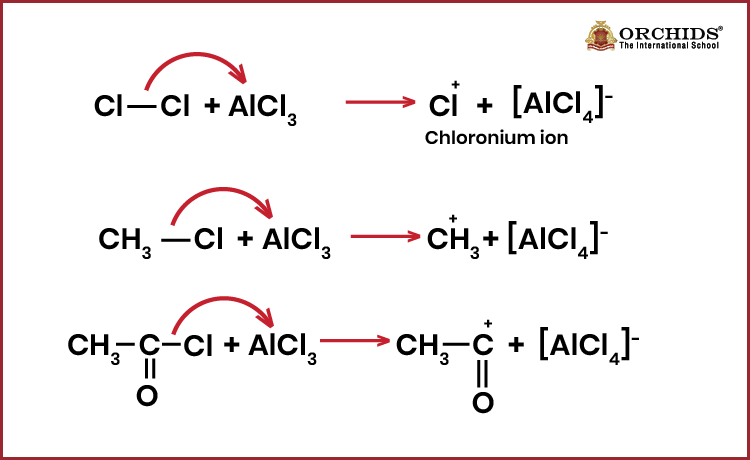
Here, the Cl⁺ ion acts as the electrophile.
Step 2: Formation of the Carbocation (Arenium Ion or Sigma Complex)
The first question that comes is what happens when the electrophile attacks the aromatic ring? The answer is the electrophile attacks the aromatic ring, temporarily disrupting its delocalised π-electron system.
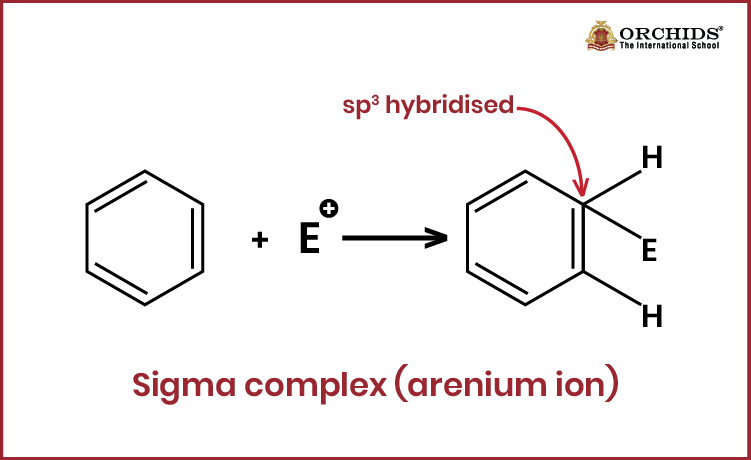
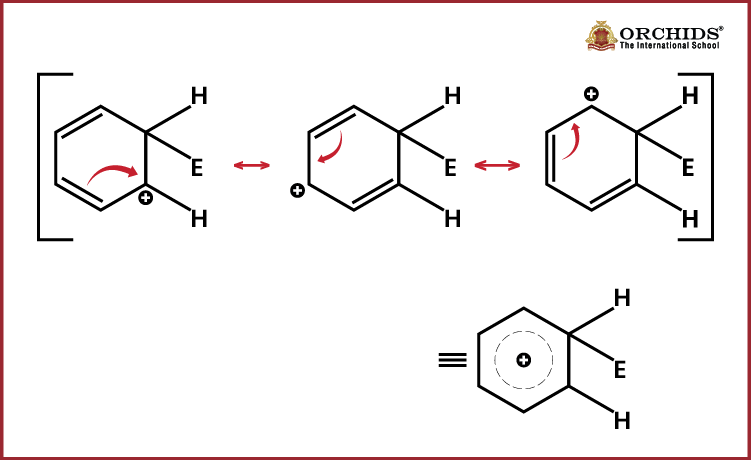
This forms a positively charged intermediate called a sigma complex or arenium ion, which is resonance-stabilised. This intermediate is less stable because aromaticity is momentarily lost.
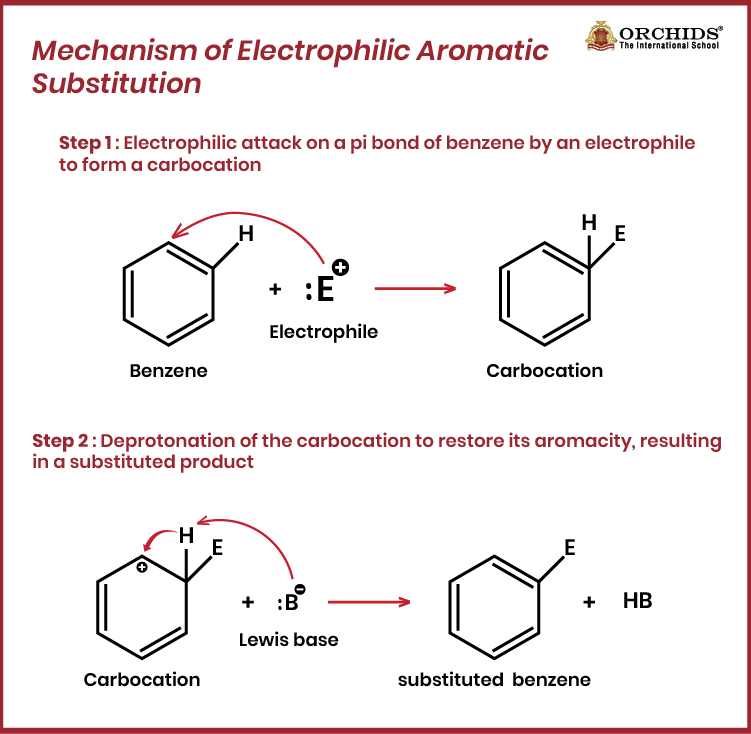
Step 3: Removal of a Proton and Restoration of Aromaticity
Finally, a base removes a proton from the same carbon where the electrophile attached. This restores aromaticity to the ring, forming the substituted aromatic product.
Thus, the final product is an aromatic compound with one substituent replaced by the electrophile.
Let's learn about the Kinetics of Electrophilic Substitution :
The overall rate of reaction depends mainly on the formation of the carbocation intermediate, which is the rate-determining step.
- : Formation of the arenium ion (forward rate)
- : Reverse reaction
- : Removal of the proton and restoration of aromaticity
Types of Electrophilic Substitution Reactions
1. Electrophilic Aromatic Substitution (EAS)
In these reactions, an electrophile replaces a hydrogen atom in an aromatic ring (like benzene). What's interesting to study the aromatic character of the ring is maintained after the reaction.
Common examples include:
- Nitration:
- Halogenation:
- Sulphonation:
- Friedel–Crafts Alkylation:
- Friedel–Crafts Acylation:
2. Electrophilic Aliphatic Substitution (EASu)
In this type, an electrophile replaces a functional group, commonly hydrogen or an aliphatic compound. These reactions often follow mechanisms similar to reactions.
Below is an illustration that shows how the electrophilic aromatic substitution differs from electrophilic aliphatic substitution:
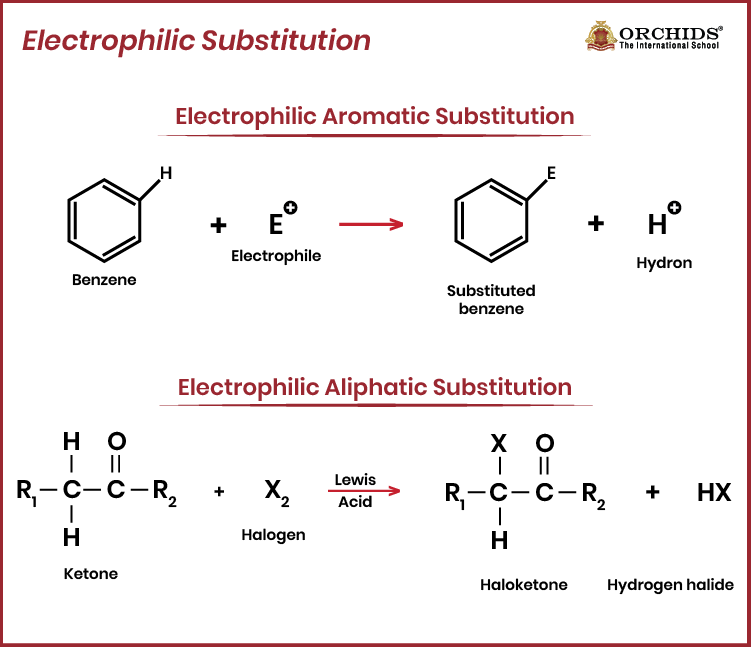
Some examples include:
- Halogenation of Ketones
- Nitrosation
- Keto–Enol Tautomerism
- Carbene Insertion
- Diazonium Coupling (Aliphatic)
If the electrophile attacks opposite to the leaving group (at 180°), inversion of configuration can occur, similar to nucleophilic substitution.
Have you ever wondered Why Benzene Undergoes Substitution Instead of Addition?
The fact that Benzene’s stability lies in its aromatic π-electron system a closed shell of six delocalised electrons known as an aromatic sextet.
What happens next is that an addition reaction would break this stable system, destroying aromaticity.
Hence, benzene prefers substitution, which allows replacement of an atom while preserving its aromatic stability.
Read More: Huckels Rule
Importance of Electrophilic Substitution in Organic Chemistry
- Electrophilic substitution involves replacing an atom or group with an electrophile.
- Benzene and other aromatic compounds undergo substitution to retain aromaticity.
- These reactions are essential for synthesising important industrial compounds like dyes, drugs, and polymers.
As we learned, electrophilic substitution reactions are a cornerstone of organic chemistry, forming the basis for many synthetic pathways in laboratories and industries.
Frequently Asked Questions on Electrophilic Substitution Reactions
1. What is an aromatic electrophilic substitution reaction?
An aromatic electrophilic substitution reaction happens when an electrophile replaces a hydrogen atom in an aromatic ring like benzene without losing its aromatic stability.
2. What are the major steps involved in an electrophilic aromatic substitution reaction?
An electrophilic aromatic substitution occurs in three main steps: formation of the electrophile, attack on the aromatic ring, and restoration of the ring’s stability.
3. What are the three types of substitution reactions?
The three main types are electrophilic substitution, nucleophilic substitution, and free radical substitution, each involving different reacting species.
4. What is the π-complex in aromatic electrophilic substitution?
In an electrophilic aromatic substitution, the π-complex forms when the electrophile weakly interacts with the π-electrons of the aromatic ring before the actual bond forms.
5. What is the sigma complex in electrophilic aromatic substitution?
The sigma complex is the temporary intermediate formed when the electrophile bonds to one carbon of the ring, momentarily disrupting aromaticity.
6. Why does benzene undergo electrophilic substitution?
Benzene undergoes electrophilic substitution because its delocalised π electrons attract electrophiles, and substitution helps preserve its aromatic structure.
7. Why does phenol undergo electrophilic substitution more easily than benzene?
Phenol undergoes electrophilic substitution faster than benzene because its -OH group donates electrons to the ring, increasing its electron density.
Science isn't just a subject, it's the way of seeing the world. Curious how Orchids The International School teaches it that way? Talk to our admissions team.
Admissions Open for 2026-27
What type of concept pages would you prefer?
CBSE Schools In Popular Cities
- CBSE Schools in Bangalore
- CBSE Schools in Mumbai
- CBSE Schools in Pune
- CBSE Schools in Hyderabad
- CBSE Schools in Chennai
- CBSE Schools in Gurgaon
- CBSE Schools in Kolkata
- CBSE Schools in Indore
- CBSE Schools in Sonipat
- CBSE Schools in Delhi
- CBSE Schools in Rohtak
- CBSE Schools in Bhopal
- CBSE Schools in Aurangabad
- CBSE Schools in Jabalpur
- CBSE Schools in Jaipur
- CBSE Schools in Jodhpur
- CBSE Schools in Nagpur
- CBSE Schools in Ahmednagar
- CBSE School In Tumkur











Orchids The International School is one of India's leading chains of CBSE and ICSE schools, with 130+ schools across the country.