

Benzene
Benzene is one of the most interesting organic compounds in chemistry. Represented by the formula C₆H₆, it’s a colourless liquid with a distinct sweet smell. It’s interesting as well as exciting to study that Benzene, though simple in appearance, its unique ring structure and resonance make it the foundation of aromatic chemistry.
The well-known fact is that from medicines and plastics to dyes and detergents, benzene plays a vital role in various industries.
This article helps students clearly understand the discovery, structure, resonance, aromaticity, properties, and real-life applications of benzene in a simple, conceptual way.
Table of Contents
- Discovery and History of Benzene
- Let’s have a look at the Benzene Structure!
- Have you ever wondered how this Resonance in Benzene plays an important role in benzene
- Aromaticity of Benzene
- Properties of Benzene
- Chemical Reactions of Benzene
- Uses of Benzene
- Frequently Asked Questions (FAQs) on Benzene

Discovery and History of Benzene
Benzene was discovered in 1825 by Michael Faraday, who isolated it from illuminating gas. It gained importance after 1842, when scientists realised its presence in petroleum.
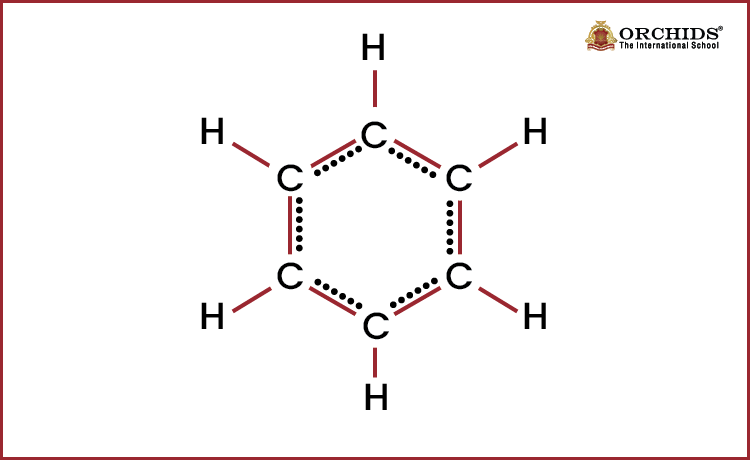
In chemistry terms, Benzene is a cyclic hydrocarbon consisting of six carbon atoms joined in a closed hexagonal ring, each bonded to one hydrogen atom. The structural Benzene formula is represented by .
And when it comes to its appearance, it is colourless, highly inflammable, and has a characteristic odour.
Let’s have a look at the Benzene Structure!
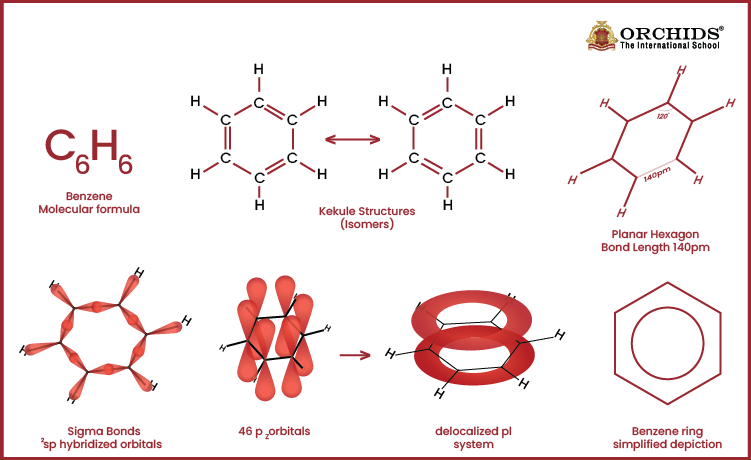
The structure of benzene has intrigued chemists for decades. August Kekulé proposed that benzene consists of a ring of six carbon atoms with alternating single and double bonds. However, this arrangement alone couldn’t explain its stability.
According to molecular orbital theory, benzene’s six carbon atoms are sp² hybridised, forming a flat, hexagonal structure.
Each carbon contributes one unhybridised p orbital, which overlaps sideways with neighbouring orbitals to form a delocalised π-electron cloud above and below the ring.
Whats interesting is that this delocalisation gives benzene its remarkable stability and symmetry.
Have you ever wondered how this Resonance in Benzene plays an important role in benzene
Benzene exhibits resonance, which means its electrons are not fixed between specific atoms but shared throughout the ring.
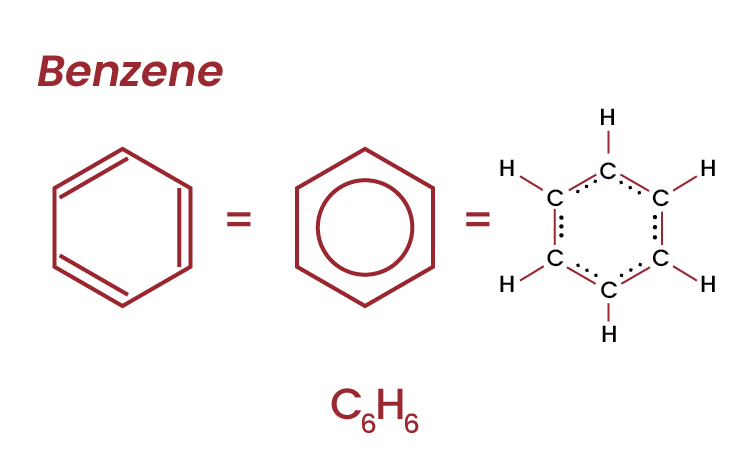
Kekulé suggested two possible structures for benzene that differ only in the position of the double bonds.
However, experimental evidence shows that all carbon-carbon bonds in benzene are of equal length (1.39 Å), intermediate between a single and double bond.
Hence, the true structure of benzene is a resonance hybrid, often represented by a hexagon with a circle inside, indicating delocalised electrons.
This resonance explains benzene’s high chemical stability and resistance to addition reactions.
After understanding the unique structure and resonance of benzene, it’s important to learn what truly sets it apart among hydrocarbons: its aromaticity, the key to its remarkable stability and chemical behaviour.
Aromaticity of Benzene
Benzene is classified as an aromatic compound, meaning it follows the Huckels Rule for aromaticity:
- The molecule must be planar (flat in shape).
- The π-electrons must be completely delocalised over the ring.
- It must have (4n + 2) π-electrons, where n is a whole number.
Interestingly! Benzene satisfies these conditions with 6 π-electrons (n = 1), making it aromatic.
Aromaticity gives benzene exceptional stability, and instead of undergoing addition, it participates in electrophilic substitution reactions, such as nitration, sulphonation, and halogenation.
Next is benzene, which shows physical and chemical trends which help them to identify among the other compounds in organic chemistry.
Properties of Benzene
Physical Properties:
|
Property |
Description |
|
State |
Colourless liquid with aromatic odour |
|
Formula |
C₆H₆ |
|
Molecular Weight |
78.11 g/mol |
|
Density |
0.87 g/cm³ (lighter than water) |
|
Melting Point |
5.5°C |
|
Boiling Point |
80.1°C |
|
Solubility |
Insoluble in water but soluble in organic solvents like alcohol, ether, and acetone |
|
Flammability |
Highly inflammable, burns with a sooty flame |
|
Chemical Behaviour |
Shows resonance; undergoes electrophilic substitution |
Chemical Reactions of Benzene
Benzene is quite stable because of its aromatic ring, so instead of undergoing addition reactions like alkenes, it usually undergoes Electrophilic Aromatic Substitution (EAS) reactions.
1. Nitration of Benzene - introduction of a nitro () group into the benzene ring. Sulfuric acid acts as a catalyst producing the nitronium ion (), which attacks the ring giving nitrobenzene.
Reagent: Concentrated HNO₃ and H₂SO₄.
Reaction:
2. Sulphonation of Benzene - introduction of a sulfonic acid () group using fuming sulfuric acid (oleum).
The reaction is reversible; sulphonation occurs in hot conditions and desulphonation in the presence of steam.
Reagent: Fuming H₂SO₄ + SO₃.
Reaction:
3. Halogenation of Benzene - a hydrogen atom is replaced by a halogen in the presence of a Lewis acid catalyst (, , or ).
The halogen molecule is polarised by the catalyst forming an electrophilic halonium ion that attacks the ring.
Reagents: or and a Lewis acid catalyst.
Reaction:
4. Friedel–Crafts Alkylation - an alkyl group is introduced using an alkyl halide in the presence of anhydrous .
The reaction proceeds via carbocation formation attacking the ring to give alkylbenzene.
Reagents: Alkyl halide and anhydrous .
Reaction:
5. Friedel–Crafts Acylation - an acyl group is introduced using an acyl chloride with anhydrous .
Proceeds through acylium ion () formation attacking the ring to give an aryl ketone.
Reagents: Acyl chloride and anhydrous .
Reaction:
Uses of Benzene
Benzene is widely used as a starting material in the manufacture of many industrial and household products:
- When it comes to Plastics & Polymers, benzene is used in producing styrene (for polystyrene), nylon, and synthetic rubbers.
- In Dyes and Detergents, derivatives of benzene, such as aniline and dodecylbenzene, are key components in dyes and cleaning agents.
- It plays a vital role in Pharmaceuticals as benzene is used to synthesise important drugs and intermediates.
- In Lubricants & Pesticides, it acts as a base chemical for making additives and agricultural chemicals.
- (Note: Due to toxicity, benzene use is controlled and replaced by safer alternatives in many industries.)
- Although industrially valuable, benzene is toxic and carcinogenic. Prolonged exposure can cause dizziness, fatigue, and in severe cases affect the bone marrow, leading to blood disorders like anaemia or leukaemia.
- In the environment, benzene contributes to air pollution as it evaporates easily and can contaminate water and soil.
Frequently Asked Questions (FAQs) on Benzene
1. What makes benzene special?
Benzene is special because of its stable ring-shaped structure, where electrons are shared evenly. This delocalisation gives it unique chemical stability and aromatic properties.
2. What is the smell of benzene?
Benzene has a sweet, gasoline-like odour. While its scent is easy to recognise, it should be handled carefully because benzene vapours can be harmful.
3. What are some interesting facts about benzene, and what is the benzene formula?
The benzene formula is C₆H₆, meaning it contains equal numbers of carbon and hydrogen atoms. Interestingly, all its bonds are the same length because of electron delocalisation.
4. What is benzene made of?
Benzene is made of six carbon and six hydrogen atoms arranged in a perfect hexagonal ring. This structure explains what benzene is and why it behaves differently from alkenes.
5. What is benzene?
Benzene is an aromatic hydrocarbon made up of six carbon atoms and six hydrogen atoms. It has a unique ring structure that gives it stability and a sweet odour.
6. What is the benzene formula?
The benzene formula is C₆H₆, showing that it contains equal numbers of carbon and hydrogen atoms arranged in a cyclic pattern.
7. What is the benzene structure?
The benzene structure is a hexagonal ring with alternating single and double bonds. However, due to resonance, all bonds in the ring are of equal length.
8. What is the molar mass of benzene?
The molar mass of benzene is 78.11 g/mol, which means one mole of benzene weighs 78.11 grams.
9. Why is benzene important in chemistry?
Benzene is important because it’s the parent compound of many aromatic substances and is used to make dyes, plastics, detergents, and medicines.
Science isn't just a subject, it's the way of seeing the world. Curious how Orchids The International School teaches it that way? Talk to our admissions team.
Admissions Open for 2026-27
What type of concept pages would you prefer?
CBSE Schools In Popular Cities
- CBSE Schools in Bangalore
- CBSE Schools in Mumbai
- CBSE Schools in Pune
- CBSE Schools in Hyderabad
- CBSE Schools in Chennai
- CBSE Schools in Gurgaon
- CBSE Schools in Kolkata
- CBSE Schools in Indore
- CBSE Schools in Sonipat
- CBSE Schools in Delhi
- CBSE Schools in Rohtak
- CBSE Schools in Bhopal
- CBSE Schools in Aurangabad
- CBSE Schools in Jabalpur
- CBSE Schools in Jaipur
- CBSE Schools in Jodhpur
- CBSE Schools in Nagpur
- CBSE Schools in Ahmednagar
- CBSE School In Tumkur











Orchids The International School is one of India's leading chains of CBSE and ICSE schools, with 110+ schools across the country.