

Reducing Agent : Reactions and Characteristics Explained with Example
Reducing agents may sound like a complex idea, but at their core, they are simply substances that give away electrons to process the chemical change. From extracting metals in huge furnaces to reactions happening quietly in our bodies, reducing agents are everywhere.
This article gives an in-depth explanation of reducing agents, their characteristics, the difference between strong and weak types, and some common examples.
Table of Contents
- What is a Reducing Agent
- Characteristics of a Reducing Agent
- Strong vs Weak Reducing Agents
- Frequently Asked Questions on Reducing Agent

What is a Reducing Agent?
In chemistry, a reducing agent (also called a reductant) is a substance that donates electrons to another substance during a chemical reaction. By giving away electrons, the reducing agent itself gets oxidised, while the substance that accepts those electrons gets reduced.
To put it simply, imagine a reducing agent as a "giver" in a reaction, it sacrifices its electrons so that another substance can be reduced.
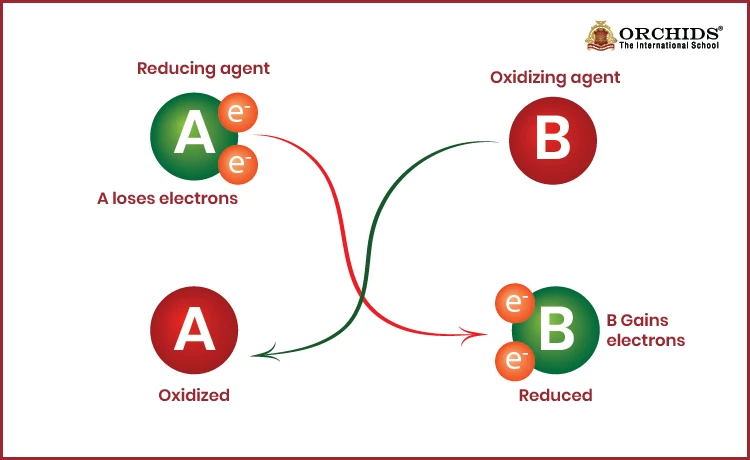
This process is central to redox reactions (reduction–oxidation reactions), which are some of the most common and important reactions in chemistry.
While a reducing agent donates electrons, an oxidising agent does the exact opposite: it accepts electrons during a chemical reaction. By gaining electrons, the oxidising agent itself gets reduced exactly as shown in the above illustrations. Common examples of oxidising agents include oxygen, chlorine, and hydrogen peroxide
For example, the reaction between Copper oxide and hydrogen gas is presented below :
Where;
Reducing agent (H₂) → donates electrons → gets oxidised to H₂O.
Oxidising agent (CuO) → accepts electrons → gets reduced to Cu.
Characteristics of Reducing Agent
Reducing agents have certain unique features that make them identifiable. Some important characteristics include:
- Reducing agents, also known as electron donors, readily give away electrons to another substance.
- The reducing agent itself undergoes oxidation in the process, which is indeed an oxidation of the agent.
- The fact that strong reducing agents are usually very reactive and easily participate in redox reactions.
- Interestingly !! Elements that tend to lose electrons, that is, the presence of electropositive elements (like alkali metals and hydrogen), often act as reducing agents.
- Many reducing agents release energy when they donate electrons, which drives the reaction forward.
Now, let's discuss the fact that not all reducing agents have the same strength. Their ability to donate electrons depends on their nature.
Strong vs Weak Reducing Agents
-
Strong Reducing Agents
These are substances that can very easily donate electrons and undergo strong reduction reactions. They are highly reactive and often dangerous if not handled properly.
Let's take an example of Hydrogen gas (H₂), carbon monoxide (CO), and alkali metals (like sodium and potassium). They are commonly used in industrial processes, like the extraction of metals from ores.
-
Weak Reducing Agents
These agents can donate electrons, but not as aggressively as strong ones. They still participate in redox reactions, but the process is milder and less vigorous than that of strong reducing agents.
Let's understand with an example:
Carbon (C) in the form of coke, and iron (Fe) in certain reactions. They are often used in controlled chemical reactions where too much reactivity isn’t needed.
Here are some everyday and industrial examples of reducing agents:
- Hydrogen (H₂) is used to reduce metal oxides to metals, e.g., tungsten oxide to tungsten.
- Carbon Monoxide (CO) plays a major role in extracting iron from its ore in a blast furnace.
- Carbon (C) in the form of coke is used in metallurgy to reduce metal oxides.
- Iron (Fe)acts as a reducing agent in certain high-temperature reactions.
- Lithium, Sodium, Potassium (Alkali Metals)are extremely strong reducing agents due to their high tendency to lose electrons.
Read More: Reactivity Series and Reactivity Series Experiment
Till now we have learned that how Reducing agents play a vital role in the world of chemistry. They make redox reactions possible by donating electrons and driving many industrial, biological, and environmental processes. From extracting metals to generating fuels, they are indispensable in both labs and industries.
Frequently Asked Questions on Reducing Agent
1. What is a Reducing Agent?
A reducing agent is a substance that donates electrons to another substance, causing that substance to be reduced. In the process, the reducing agent itself gets oxidised.
2. What is the reducing agent definition?
The reducing agent definition states that it is a chemical that loses electrons easily and helps other compounds gain them during a redox reaction.
3. What are some common reducing agent examples?
Common reducing agent examples include hydrogen, carbon monoxide, sodium, zinc, and lithium aluminium hydride. They are widely used in industries and labs.
4. How to identify a good reducing agent?
According to the Reducing agent definition, a good reducing agent easily loses electrons and gets oxidised quickly. Metals like sodium and zinc are common Reducing agent examples.
5. What is a strong reducing agent?
A strong Reducing Agent is a substance that donates electrons very easily during a chemical reaction. Alkali metals are considered strong reducing agents because of their high reactivity.
Science isn't just a subject, it's the way of seeing the world. Curious how Orchids The International School teaches it that way? Talk to our admissions team.
Admissions Open for 2026-27
What type of concept pages would you prefer?
CBSE Schools In Popular Cities
- CBSE Schools in Bangalore
- CBSE Schools in Mumbai
- CBSE Schools in Pune
- CBSE Schools in Hyderabad
- CBSE Schools in Chennai
- CBSE Schools in Gurgaon
- CBSE Schools in Kolkata
- CBSE Schools in Indore
- CBSE Schools in Sonipat
- CBSE Schools in Delhi
- CBSE Schools in Rohtak
- CBSE Schools in Bhopal
- CBSE Schools in Aurangabad
- CBSE Schools in Jabalpur
- CBSE Schools in Jaipur
- CBSE Schools in Jodhpur
- CBSE Schools in Nagpur
- CBSE Schools in Ahmednagar
- CBSE School In Tumkur











Orchids The International School is one of India's leading chains of CBSE and ICSE schools, with 130+ schools across the country.