

Electronegativity
Electronegativity- Why do some atoms cling tightly to electrons while others easily let them go? The secret lies in a property called electronegativity. This concept explains how atoms interact, why some bonds are strong, and why molecules behave differently in reactions.
This article simplifies the electronegativity by explaining its trends, and connecting it with real-life examples, so that students and curious learners can understand it without being confused.
Table of Contents
- What is Electronegativity
- Electronegativity Table
- Factors Affecting Electronegativity
- Real-Life Uses of Electronegativity and Some Misconceptions
- Frequently Asked Questions on Electronegativity

What is Electronegativity?
Electronegativity is the ability of an atom in a chemical bond to pull the shared electrons towards itself. Interestingly, the idea was first introduced by Linus Pauling, who also created the Pauling scale, the most widely used method to measure electronegativity.
And the fact that it is a dimensionless property, meaning it doesn’t have a unit, it’s just a comparative value.
If we observe the most electronegative element on the scale
It's found that:
- Fluorine (F) is the most electronegative element with a value of 4.0.
- Caesium (Cs) and Francium (Fr) are among the least electronegative, with values around 0.7.
This simple scale helps predict the type of bond formed between atoms, whether covalent, polar covalent, or ionic.
Next, it comes to Electronegativity doesn’t remain constant it follows predictable trends in the periodic table.
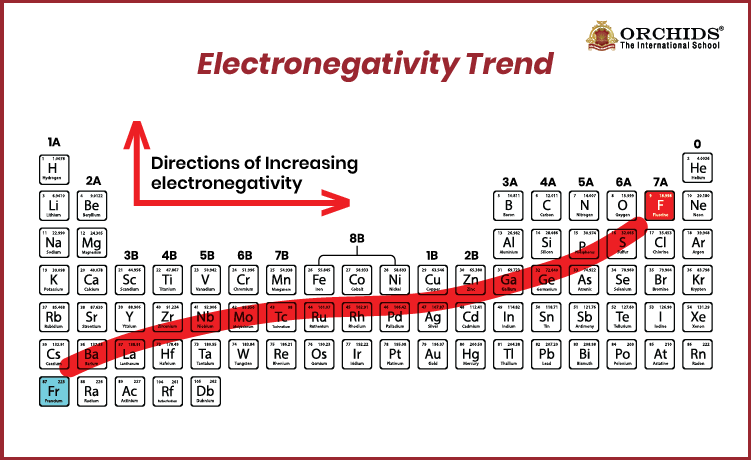
Let's Discuss:
What are the Periodic Trends in Electronegativity?
- Across a Period (left to right): Electronegativity increases because atoms gain more protons (higher nuclear charge) while their size shrinks. This makes them pull electrons more strongly.
- Down a Group (top to bottom): Electronegativity decreases as atoms get larger, and outer electrons are farther from the nucleus, reducing the pull.
Let's take an example, if we observe in halogens, fluorine is the strongest electron puller, while iodine and astatine are weaker, but why?
Based on the analysis, if we look at the halogen group in the periodic table, electronegativity decreases as we move down from fluorine to iodine and astatine.
It happens because of the fact that fluorine is the strongest electron puller because it has a small atomic size and a high nuclear charge, so its nucleus can attract bonding electrons very effectively.
But what happens to iodine and astatine?
In contrast, iodine and astatine have larger atomic sizes and more electron shells. This makes the outer electrons farther from the nucleus, reducing the pull on shared electrons.
As a result, these elements are less electronegative compared to fluorine.
So, the conclusion can be drawn that:
Most and Least Electronegative Elements
- Most electronegative: Fluorine (4.0) → It attracts electrons so strongly that it rarely lets go.
- Least electronegative: Caesium and Francium (0.7) → These atoms prefer to lose electrons and form positive ions.
There's a General rule to follow:
- Nonmetals(like oxygen, chlorine, fluorine) are highly electronegative.
- Metals(like sodium, potassium) have low electronegativity and are more electropositive.
Do you know? Electronegativity differences between atoms decide the type of bond!
Next, the question arise is what is the impact of Electronegativity on Bonding?
- Equal electronegativity results in pure covalent bonds (e.g., H₂, O₂, Cl₂).
- Small differences result in polar covalent bonds (e.g., H₂O, HCl), where electrons are pulled more by one atom.
- Large difference results in Ionic bonds (e.g., NaCl), where one atom gives up electrons completely.
The fact: This is why water (H₂O) is polar and dissolves many compounds, while oils (nonpolar) don’t mix with it.
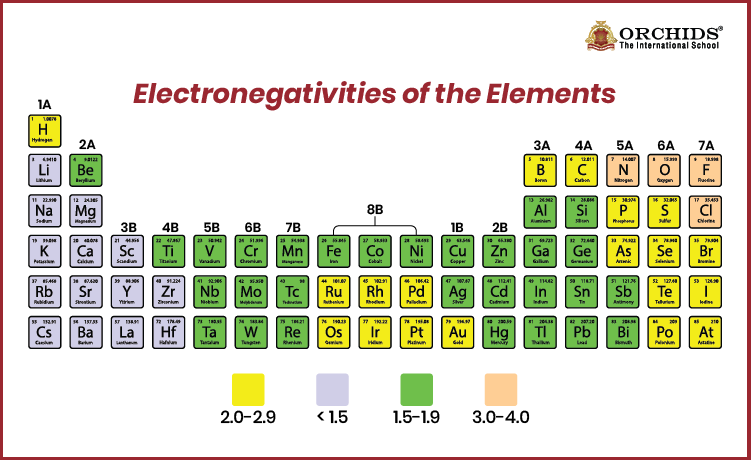
Electronegativity Table
These numbers help chemists predict bond types, polarity, and molecular stability.
Every element has a specific electronegativity value (except noble gases, which usually don’t bond).
On the Pauling scale, values range from about 0.7 (least) to 4.0 (most).
Factors Affecting Electronegativity
- Atomic Size: Larger atoms have lower electronegativity because their outer electrons are farther from the nucleus, so the nucleus exerts less pull on shared electrons because of the atomic size.
- Nuclear Charge: Atoms with a higher nuclear charge attract bonding electrons more strongly, increasing their electronegativity.
- Substituents: Electronegative atoms attached to a central atom can draw electron density toward themselves, effectively increasing the central atom’s electronegativity.
Frequently Asked Questions on Electronegativity
1. What is electronegativity meaning?
Electronegativity meaning refers to how strongly an atom can pull electrons toward itself in a molecule. It is a key factor in understanding chemical reactions.
2. What factors affect electronegativity?
Electronegativity is influenced by atomic size, nuclear charge, and the type of atoms attached. Smaller atoms with higher charge are more electronegative.
3. Which will have more electronegativity?
Atoms that are smaller and have a stronger nuclear charge will have more electronegativity. Nonmetals like fluorine often top the list.
4. What is the unit of electronegativity?
Electronegativity has no unit because it is a relative tendency, not a measurable physical quantity. It is expressed as a dimensionless number.
5. What are the important points about electronegativity?
Electronegativity predicts bond type, polarity, and reactivity. It generally increases across a period and decreases down a group in the periodic table.
Science isn't just a subject, it's the way of seeing the world. Curious how Orchids The International School teaches it that way? Talk to our admissions team.
Admissions Open for 2026-27
What type of concept pages would you prefer?
CBSE Schools In Popular Cities
- CBSE Schools in Bangalore
- CBSE Schools in Mumbai
- CBSE Schools in Pune
- CBSE Schools in Hyderabad
- CBSE Schools in Chennai
- CBSE Schools in Gurgaon
- CBSE Schools in Kolkata
- CBSE Schools in Indore
- CBSE Schools in Sonipat
- CBSE Schools in Delhi
- CBSE Schools in Rohtak
- CBSE Schools in Bhopal
- CBSE Schools in Aurangabad
- CBSE Schools in Jabalpur
- CBSE Schools in Jaipur
- CBSE Schools in Jodhpur
- CBSE Schools in Nagpur
- CBSE Schools in Ahmednagar
- CBSE School In Tumkur











Orchids The International School is one of India's leading chains of CBSE and ICSE schools, with 130+ schools across the country.