

Fehling’s Test: Principle and Procedure Explained
Fehling’s Test is a classic laboratory experiment used to detect reducing sugars and distinguish aldehydes from ketones. Developed by German chemist Hermann von Fehling, this test helps students understand redox (reduction-oxidation) reactions in chemistry through a simple colour change. When a reducing sugar or aldehyde is present, the blue solution turns red due to the formation of copper(I) oxide.
This article helps students clearly to understand what Fehling’s Test is,its preparations and how it is performed safely, and its importance in both educational and medical chemistry.
Table of Contents
- What is Fehling’s Test
- Procedure of the Fehling’s Test
- Lab Precautions to Note: Fehling’s Test
- Common Uses of Fehling’s Test
- Frequently Asked Questions on Fehling's Test

What is Fehling’s Test ?
Fehling’s Test is a qualitative test that identifies reducing sugars and aldehyde functional groups in organic compounds. 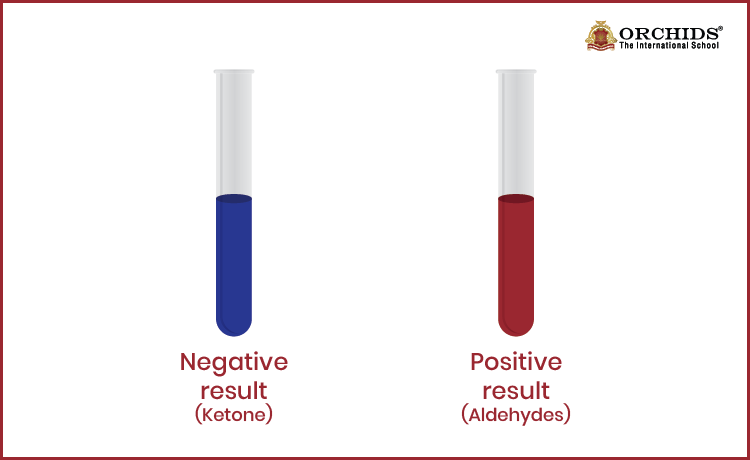
The fact about reducing sugars is that it can donate electrons to other molecules, a property that causes the characteristic color change in this experiment.
What is the principle of the Fehlings Test?
When the test is carried out, ions from copper(II) sulfate are reduced to Cu₂O, forming a brick-red precipitate. This visual change confirms the presence of a reducing substance.
As Reducing sugars or aldehydes are capable of reducing to Cu⁺, which then precipitates as red copper(I) oxide.
The general reaction of Fehling’s Test can be represented as:
Here, the aldehyde group (–CHO) is oxidised to a carboxylate ion (–COO⁻), while is reduced to Cu⁺.
In Fehling’s Test reaction, when tartrate ions are part of the solution, the reaction becomes:
Now, this red Cu₂O precipitate is the clear visual indicator of a positive result of the Fehling's test.
Do you know? The Fehling’s Test is commonly performed in schools because it demonstrates key chemistry concepts such as oxidation-reduction, complex formation, and reactivity of carbonyl compounds.
Next is how Fehling's solution is prepared?
Fehling’s Test uses two separately prepared solutions, Fehling’s A and Fehling’s B, which are mixed just before the experiment.
- Fehling’s A: A blue solution containing copper(II) sulfate . It provides the ions required for the redox reaction.
- Fehling’s B: A clear solution containing potassium sodium tartrate (Rochelle salt) and sodium hydroxide (NaOH).
The alkali provides the basic medium, and tartrate ions act as chelating agents to keep copper ions dissolved and prevent precipitation.
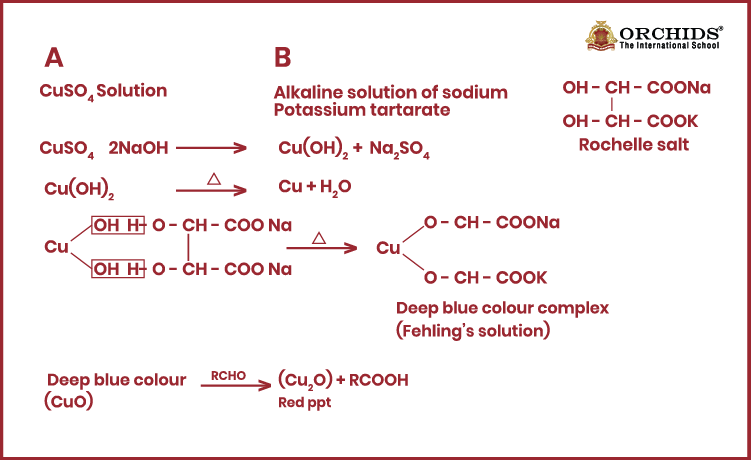
What happens is that when equal parts of Fehling’s A and B are mixed, a deep blue complex forms due to the reaction between and tartrate ions. This freshly mixed solution is Fehling's reagent.
Procedure of the Fehlings Test
Here’s how to perform Fehling’s Test step-by-step:
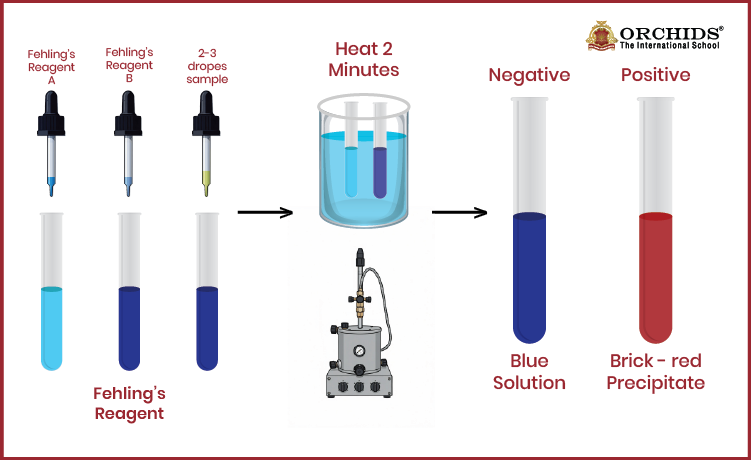
- Place the sample in a dry test tube.
- Use another test tube containing distilled water as a control.
- Add Fehling’s solution to both test tubes.
- Immerse the tubes in a water bath.
- Observe the reaction and record any formation of a red precipitate.
Also Read: Biuret Test
Lab Precautions to Note: Fehling's Test
- Fehling’s solution is alkaline and corrosive, so wear gloves and goggles.
- Keep a note that always prepares the solution fresh, as it decomposes over time.
- Handle the heating process carefully and do not directly flame the test tube.
Here's the Observation that comes from the test:
|
Type of Compound |
Reaction with Fehling’s Solution |
Observation |
Inference |
|
Glucose (Reducing sugar) |
Reacts |
Brick-red precipitate forms |
Positive result |
|
Sucrose (Non-reducing sugar) |
No reaction |
Solution remains blue |
Negative result |
|
Formaldehyde (Aldehyde) |
Reacts |
Brick-red precipitate forms |
Positive result |
|
Acetone (Ketone) |
No reaction |
No color change |
Negative result |
|
Alpha hydroxy ketones |
Reacts |
Brick-red precipitate forms |
Positive result |
Common Uses of Fehling’s Test
- It helps in the detection of reducing sugars,Fehling’s Test helps identify sugars like glucose and fructose that can reduce copper(II) ions.
- Aldehydes are oxidised by Fehling’s solution, giving a red precipitate, while ketones remain unaffected which makes the differentiation between aldehydes and ketones.
- In Medical Applications, earlier, Fehling’s Test was used to detect glucose in urine to screen for diabetes. Though replaced by advanced enzymatic tests today, it laid the foundation for early biochemical testing.
- It helps students visualise oxidation-reduction reactions, understand functional groups, and connect theory with laboratory practice, making it easier in the education sector.
Learn More: Acid -Base Titration and Benedict's Test
As we learned, the Fehling’s Test remains a simple yet powerful experiment that helps students grasp the fundamentals of redox chemistry and organic compound identification. While newer tests have replaced Fehling’s Test reaction in modern labs, its educational value in understanding chemical reactions continues to make it a favourite among students and teachers alike.
Frequently Asked Questions on Fehling's Test
1. What is the purpose of Fehling’s test?
Fehling’s test is used to identify reducing sugars and distinguish them from non-reducing ones. It also helps detect aldehyde functional groups in organic compounds.
2. What are the conditions for Fehling’s test?
The test is carried out in an alkaline medium and requires gentle heating for the reaction to take place.
3. What safety precautions are needed for Fehling’s test?
Since Fehling’s solution is corrosive, wear gloves and goggles, and handle all chemicals carefully to avoid skin or eye irritation.
4. What reagent is used in Fehling’s test?
The reagent is Fehling’s solution, which is freshly prepared by mixing Fehling’s A (copper(II) sulfate) and Fehling’s B (alkaline sodium potassium tartrate).
5. What is the colour of Fehling’s reagent?
Fehling’s reagent is a deep blue solution that turns brick-red when it reacts positively with a reducing sugar.
6. Who invented Fehling’s solution?
Fehling’s solution was developed by German chemist Hermann von Fehling in 1849 to detect reducing sugars.
7. What is Fehling’s Test?
It’s a qualitative test used to detect reducing sugars or aldehydes by observing a colour change from blue to red.
8. What is Fehling's Test Reaction ?
Aldehydes reduce blue copper(II) ions in Fehling’s solution to red copper(I) oxide, forming a reddish-brown precipitate.
9. Do ketones give Fehling’s test?
No, ordinary ketones do not react with Fehling’s reagent because they cannot be easily oxidised.
10. Does benzaldehyde give Fehling’s test?
No, benzaldehyde does not give a positive Fehling’s test because it is an aromatic aldehyde that resists oxidation under these conditions.
Science isn't just a subject, it's the way of seeing the world. Curious how Orchids The International School teaches it that way? Talk to our admissions team.
Admissions Open for 2026-27
What type of concept pages would you prefer?
CBSE Schools In Popular Cities
- CBSE Schools in Bangalore
- CBSE Schools in Mumbai
- CBSE Schools in Pune
- CBSE Schools in Hyderabad
- CBSE Schools in Chennai
- CBSE Schools in Gurgaon
- CBSE Schools in Kolkata
- CBSE Schools in Indore
- CBSE Schools in Sonipat
- CBSE Schools in Delhi
- CBSE Schools in Rohtak
- CBSE Schools in Bhopal
- CBSE Schools in Aurangabad
- CBSE Schools in Jabalpur
- CBSE Schools in Jaipur
- CBSE Schools in Jodhpur
- CBSE Schools in Nagpur
- CBSE Schools in Ahmednagar
- CBSE School In Tumkur











Orchids The International School is one of India's leading chains of CBSE and ICSE schools, with 130+ schools across the country.