

Fluorine: Occurrence ,Properties and Its Uses Explained
Fluorine is a intresting chemical element that belongs to the halogen family in Group 17 of the periodic table. With an atomic number of 9, it is known as the most reactive non-metal and one of the strongest electronegative elements found in nature. Because of its unique behaviour, fluorine plays an important role in understanding how highly reactive elements interact with other substances.From the toothpaste we use every day to advanced industrial processes, fluorine and its compounds are present in many aspects of modern life. Learning about fluorine not only helps students understand the chemistry of halogens but also provides insight into chemical bonding, reactivity, and the properties of elements that readily form compounds.This article covers Fluorine its properties, occurrence, uses, important compounds, and real-world applications.
Table of Contents
- Fluorine in Chemistry
- Electron Configuration and Reactivity of Fluorine
- Physical Properties of Fluorine
- Chemical Properties of Fluorine
- Important Reactions of Fluorine
- Compounds by Fluorine
- Frequently Asked Questions on Fluorine

Fluorine in Chemistry
Fluorine is the 13th most abundant element in the Earth’s crust, but it is never found in its elemental form due to its high reactivity. When it comes to its occurrence, it is mostly found combined with other elements, such as in fluoride minerals or coal. In the atmosphere, fluorine exists only in trace amounts, about 50 parts per billion.
Do you know the fact that the Industrial production of fluorine was virtually non-existent until the Second World War? Initially, chemists recognised fluorine for its ability to form salts, but its potential in nuclear chemistry, especially in uranium hexafluoride, accelerated its large-scale production.
Since then, fluorine has become crucial in various industries, from nuclear energy to pharmaceuticals.
Let's Discuss What is Fluorine and how it acts in the Chemistry world.
Fluorine plays a crucial role in chemistry due to its extreme reactivity and high electronegativity. As a halogen, it readily forms compounds with almost all elements, acting as a powerful oxidising agent.
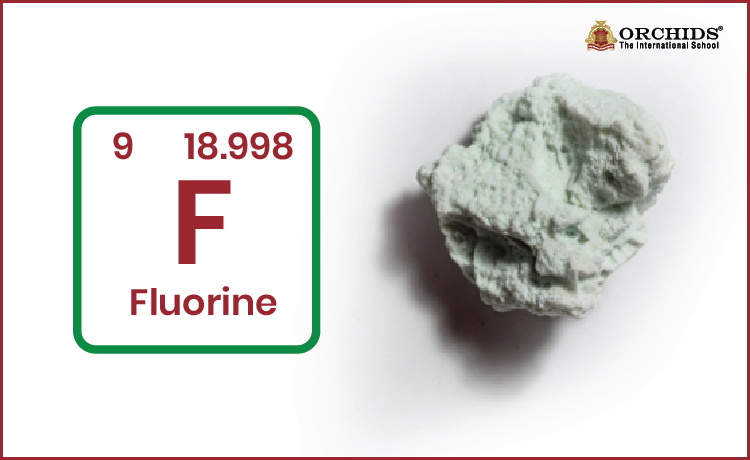
When we talk about its appearance at standard conditions, fluorine exists as a pale yellow, diatomic gas and is highly toxic. What makes it special is its ability to attract electrons more than any other element, which makes it a powerful oxidising agent, and it rarely occurs in its free form in nature.
In chemical studies, secondly, fluorine is often used to understand oxidation-reduction reactions, halogen reactivity, and the behaviour of highly electronegative elements. Importantly, it is also central to synthesising important industrial chemicals, pharmaceuticals, and materials.
Next, let's discuss the electron configuration and reactivity of fluorine.
Electron Configuration and Reactivity of Fluorine
Fluorine has an atomic number of 9, which means it has nine electrons arranged in the configuration 1s² 2s² 2p⁵, and its valency is one.
What we observe is that fluorine lacks just one electron to complete its outer shell, making it an electrophile that eagerly accepts electrons from other elements.
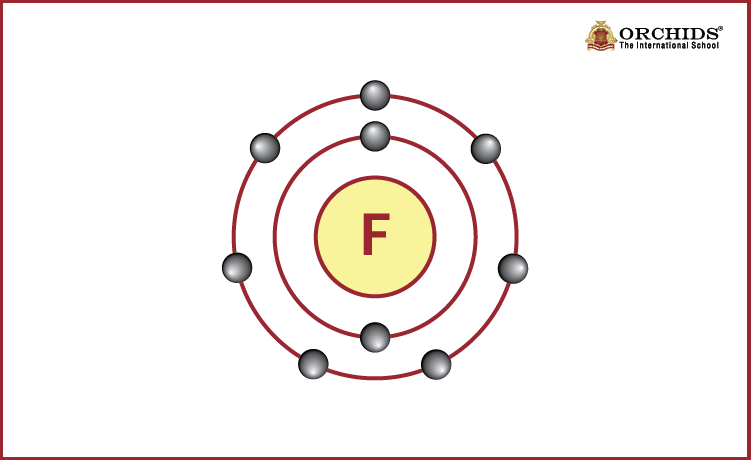
Because of this, fluorine is classified as the strongest oxidising agent among all halogens.
Also Read: Valency of Elements
When it comes to the Reactivity of Fluorine!
Fluorine’s first ionisation energy is extremely high at 1680.6 kJ/mol, showing its nucleus exerts a strong pull on its electrons.
The fact that its electronegativity of 3.98 on the Pauling scale and standard electrode potential of 2.87 V are the highest among all elements.
These exceptional values explain fluorine’s remarkable reactivity and why it rarely exists in its free state. Fluorine has only one stable isotope, known as fluorine-19.
Lets Understand what is the valency of fluorine in CaF2
In CaF₂ (Calcium Fluoride), the valency of fluorine is 1. Fluorine needs just one electron to complete its outermost shell,
so it gains one electron and forms a -1 ion (F⁻). Since calcium has a valency of 2, it combines with two fluorine atoms to form CaF₂. This is why fluorine is considered a monovalent element, meaning it has a valency of one.
Physical Properties of Fluorine
The properties of fluorine that help to easily identify them among others are listed in the table below.
|
Property |
Details |
|
Atomic Number |
9 |
|
Symbol |
F₂ |
|
Atomic Mass |
18.99 amu (≈19) |
|
State at Room Temp |
Gas |
|
Color |
Pale yellow |
|
Density |
1.696 g/L (at 0°C, 1 atm) |
|
Melting Point |
-219.6°C |
|
Boiling Point |
-188°C |
|
Atomic Radius |
147 pm |
Chemical Properties of Fluorine
- Fluorine’s chemical behaviour is dominated by its desire to gain one electron and form a complete octet.
This makes it extremely reactive with most elements, including metals, non-metals, and even water under certain conditions.
- Being an electron acceptor, fluorine is always an oxidising agent. Its reactions are often vigorous and sometimes explosive, particularly with hydrogen or organic compounds.
- Fluorine forms strong bonds due to its small size and high electronegativity. It readily forms compounds with almost every element in the periodic table, including noble gases like xenon, highlighting its reactivity.
- Despite its small size, it can participate in both ionic and covalent bonding, making it versatile in chemical reactions.
Below are some important reactions by Fluorine.
Important Reactions of Fluorine
Fluorine is highly reactive and participates in various chemical reactions due to its strong electronegativity:
Reaction with Hydrogen:
Fluorine reacts explosively with hydrogen to form hydrogen fluoride.
Reaction with Metals (Example: Sodium):
Fluorine forms ionic compounds like sodium fluoride with metals.
Reaction with Water:
Fluorine reacts even with water, releasing oxygen and forming hydrogen fluoride.
Reaction with Organic Compounds:
Fluorine can react with hydrocarbons to form fluorocarbons, which are used in refrigerants and Teflon production.
Compounds by Fluorine
Fluorine rarely exists freely in nature, but it forms a wide range of compounds with practical applications.
- Calcium fluoride (CaF₂) is commonly found in minerals and used in optics and glassmaking.
- Hydrogen fluoride (HF) is a precursor to many fluorine compounds and industrially important chemicals.
- Sodium fluoride (NaF) is used in dental care to prevent cavities, while stannous fluoride (SnF₂) also serves a similar purpose.
- Uranium hexafluoride (UF₆) gained prominence during World War II for its role in nuclear fuel production, illustrating fluorine’s industrial significance.
- Xenon difluoride (XeF₂) and dichlorodifluoromethane (CF₂Cl₂) are examples of fluorine’s ability to form rare and highly reactive compounds.
Read More: Chlorine
Till now, we have learned that Fluorine is an incredibly unique element that combines extreme reactivity, high electronegativity, and a small atomic size. Its ability to form diverse compounds and participate in various chemical reactions makes it indispensable in chemistry and industry.
Frequently Asked Questions on Fluorine
1. What is the main function of fluorine?
Fluorine is mainly used to form compounds that prevent tooth decay, strengthen materials, and act as a powerful oxidising agent in chemical reactions.
2. What is the state of fluorine?
Fluorine exists as a pale yellow gas under normal conditions and is highly reactive, never found freely in nature.
3. Who found fluorine?
Fluorine was first isolated by the French chemist Henri Moissan in 1886 after many years of experimental attempts.
4. What is the mass of fluorine?
The atomic mass of fluorine is approximately 19 amu, making it the lightest of all halogens.
5. What colour is fluorine?
Fluorine is a pale yellow gas, noticeable when concentrated, but it appears almost colourless in very small amounts.
6. How much does fluorine cost?
Fluorine is highly reactive and dangerous, so it is expensive to produce and handle, usually costing several hundred dollars per gram in pure form.
7. What is the valency of fluorine?
Fluorine has a valency of one because it needs just one electron to complete its outer shell and become stable.
8. What is fluorine?
Fluorine is a pale yellow, highly reactive halogen gas found in Group 17 of the periodic table with the atomic number 9.
9. What is the atomic mass of fluorine?
The atomic mass of fluorine is about 19 amu, making it the lightest member of the halogen family.
10. What is the symbol for fluorine?
The chemical symbol for fluorine is F, representing its diatomic gas form as F₂ in nature.
Science isn't just a subject, it's the way of seeing the world. Curious how Orchids The International School teaches it that way? Talk to our admissions team.
Admissions Open for 2026-27
What type of concept pages would you prefer?
CBSE Schools In Popular Cities
- CBSE Schools in Bangalore
- CBSE Schools in Mumbai
- CBSE Schools in Pune
- CBSE Schools in Hyderabad
- CBSE Schools in Chennai
- CBSE Schools in Gurgaon
- CBSE Schools in Kolkata
- CBSE Schools in Indore
- CBSE Schools in Sonipat
- CBSE Schools in Delhi
- CBSE Schools in Rohtak
- CBSE Schools in Bhopal
- CBSE Schools in Aurangabad
- CBSE Schools in Jabalpur
- CBSE Schools in Jaipur
- CBSE Schools in Jodhpur
- CBSE Schools in Nagpur
- CBSE Schools in Ahmednagar
- CBSE School In Tumkur











Orchids The International School is one of India's leading chains of CBSE and ICSE schools, with 110+ schools across the country.