

What Is Nylon? A Simple Guide to This Powerful Fibre
Nylon is one of the most important synthetic fibres used in our daily lives. It is known for its strength, durability, and lightweight nature. From clothes to ropes and parachutes, nylon plays a major role in making products that are strong and long-lasting.
This page aims to help you understand nylon, how it is made, its properties, and its everyday uses simply and clearly.
Table of Contents

About Nylon
Nylon
Nylon is considered the first fully synthetic fibre because its synthesis does not involve any natural fibre. It was first synthesised in the 1930s by a US scientist, Wallace H. Carothers and his coworkers. They used coal, air, water, and agricultural by-products to synthesise nylon. Nylon is a cheap and readily available substitute for silk.
Let's have a look at the Synthesis of nylon
Nylon is synthesised by the process of condensation polymerisation of two different monomers. Nylon 6, nylon 6, 6; nylon 5, 10 are the different types of nylon polymers.
Properties and Uses of Nylon
- It is a soft, shiny, smooth and elastic fibre.
• It is strong, tough and lightweight.
• It absorbs very little water, so it is easy to wash and dry.
• It is a wrinkle-free fabric, so easy to maintain.
• It is inexpensive and even stronger than silk and steel wires.
• Nylon has very good tensile strength.
• It is highly resistant to chemicals.
• It can be easily dyed.
Below are the Uses of Nylon
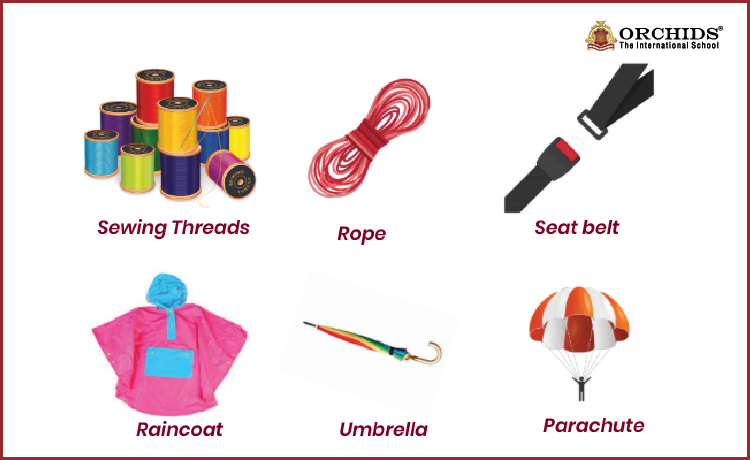
- It is light, absorbs less water and easily dries up, so it is used to make socks, sleeping bags, swimwear, stockings, tracksuits, raincoats, umbrellas, etc.
• It is wrinkle-free and easy to wash, so it is used to make garments such as tops, leggings, shirts, etc.
• It is strong, smooth, soft and elastic, so it is used to make climbing ropes, toothbrushes, fishing nets, car seat belts, racket strings, etc.
• Due to its properties, like strength, durability and lightness, it is also used to make parachutes, tents, windbreaks and sportswear.
We have learned that Nylon is a highly useful synthetic fibre that combines strength, flexibility, and durability. Its wide range of properties makes it suitable for various applications, from clothing to industrial uses. Understanding nylon helps us appreciate how science has made everyday materials more efficient and long-lasting.
Frequently Asked Questions on Nylon Fibre
1. Why is nylon called a fully synthetic fibre?
Nylon is called a fully synthetic fibre because it is completely made using chemical processes without using any natural fibres.
2. Who discovered nylon?
Nylon was first synthesised by Wallace H. Carothers and his team in the 1930s.
3. What are the main properties of nylon?
Nylon is strong, lightweight, elastic, wrinkle-free, and resistant to chemicals.
4. What are the common uses of nylon?
Nylon is used in clothes, ropes, parachutes, fishing nets, seat belts, and sportswear.
5. Why is nylon widely used?
Nylon is widely used because it is durable, affordable, easy to maintain, and has high tensile strength.
Science isn't just a subject, it's the way of seeing the world. Curious how Orchids The International School teaches it that way? Talk to our admissions team.
Admissions Open for 2026-27
What type of concept pages would you prefer?
CBSE Schools In Popular Cities
- CBSE Schools in Bangalore
- CBSE Schools in Mumbai
- CBSE Schools in Pune
- CBSE Schools in Hyderabad
- CBSE Schools in Chennai
- CBSE Schools in Gurgaon
- CBSE Schools in Kolkata
- CBSE Schools in Indore
- CBSE Schools in Sonipat
- CBSE Schools in Delhi
- CBSE Schools in Rohtak
- CBSE Schools in Bhopal
- CBSE Schools in Aurangabad
- CBSE Schools in Jabalpur
- CBSE Schools in Jaipur
- CBSE Schools in Jodhpur
- CBSE Schools in Nagpur
- CBSE Schools in Ahmednagar
- CBSE School In Tumkur











Orchids The International School is one of India's leading chains of CBSE and ICSE schools, with 110+ schools across the country.