

What is Ethyl Group: Structure, Formula, Properties and Uses
The ethyl group (–C₂H₅) may look simple, but it plays a powerful role in organic chemistry. The magic behind it is found in countless compounds; it helps to shape the way molecules behave, from their solubility to their reactivity, isn't that great!!
This article provides deep insight into its properties, formation, the process of ethylation, and how it differs from similar groups like methyl.
Table of Contents
- Ethyl Group in Chemistry
- Nomenclature of Ethyl Group
- Ethyl Group Formation
- What is Ethylation
- Frequently Asked Questions on Ethyl Group

Ethyl Group in Chemistry
In organic chemistry, the ethyl group is one of the most common substituents. It consists of two carbon atoms and five hydrogen atoms (–C₂H₅), making it slightly larger than the simpler methyl group (–CH₃).
The ethyl group is derived from ethane (C₂H₆) by removing one hydrogen atom. Because of this, it is classified as an alkyl group, represented as –C₂H₅.
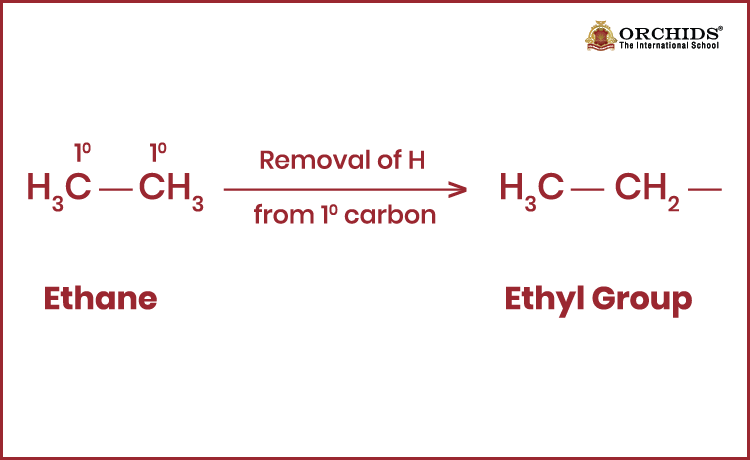
You will often see it attached to larger molecules as a branch or substituent.
Structurally, the ethyl group consists of two carbon atoms bonded in a short chain. One carbon bonds directly with the main molecule, while the other sits at the end of the chain. Ethyl Group Example : Both of these carbons are sp³ hybridised, giving the group a simple, tetrahedral shape.
When it comes to nature, the ethyl group is non-polar and hydrophobic. This means it does not dissolve in water, but it mixes well with organic solvents, such as alcohols or ethers.
An interesting fact about the stability of the ethyl group is also worth noting! Since it is smaller than larger alkyl groups, it faces fewer steric hindrances, making it more stable in reactions. Also, it can take part in substitution reactions and can be oxidised into aldehydes (–CHO) or carboxylic acids (–COOH) under the right conditions.
In short, the ethyl group acts as a simple “building block” that can modify the physical and chemical properties of a compound it is attached to.
Read More: Carboxyl Group
Nomenclature of Ethyl Group Example
In the IUPAC system, the ethyl group is written as a prefix when attached to the parent chain.
- Example 1: CH₃–CH₂–CH₃ is named propane. If we attach an ethyl group to it, it becomes butane (CH₃–CH₂–CH₂–CH₃).
- Example 2: Ethyl alcohol (common name) is systematically called ethanol (C₂H₅OH).
- Example 3: C₂H₅Cl is named chloroethane, but in common usage, it is called ethyl chloride.
So, whenever you see “ethyl” in a compound’s name, it means that a –C₂H₅ group is present as a substituent.
A common confusion that everyone comes across is between the Methyl and Ethyl groups.
Below is an understanding of the difference between the two in a clear explanation in tabular form.
|
Feature |
Methyl Group (–CH₃) |
Ethyl Group (–C₂H₅) |
|
No. of carbons |
1 |
2 |
|
Formula |
–CH₃ |
–C₂H₅ |
|
Derived from |
Methane (CH₄) |
Ethane (C₂H₆) |
|
Size |
Smaller |
Larger |
|
Effect on Molecule |
Adds minimal bulk |
Adds more bulk, affects solubility and reactivity |
|
Examples |
Methyl chloride (CH₃Cl), methyl alcohol (CH₃OH) |
Ethyl chloride (C₂H₅Cl), ethyl alcohol (C₂H₅OH) |
Ethyl Group Formation
The ethyl group can be formed in multiple ways during organic reactions. Some common methods are:
- Homolytic Cleavage of Ethane: When ethane is exposed to heat or ultraviolet light, the C–H bond breaks, producing an ethyl radical.
Ethyl halides (like ethyl chloride) can form ethyl radicals when treated with zinc.
Reduction of Ethyl Alcohol, where ethyl alcohol can also give the ethyl group when reduced with zinc amalgam and hydrochloric acid.
Ethyl halides undergo nucleophilic substitution to yield useful compounds, releasing an ethyl group in the process.
What is Ethylation?
Ethylation is the process of adding an ethyl group (–C₂H₅) to a molecule. It is widely used in both laboratory and industrial chemistry.
One of the common ways to introduce an ethyl group (−C2H5-) into an organic compound is through the reaction between benzene and acetylene (ethyne).
In this process, the ethyne molecule attaches to the benzene ring, leading to the formation of ethylbenzene.
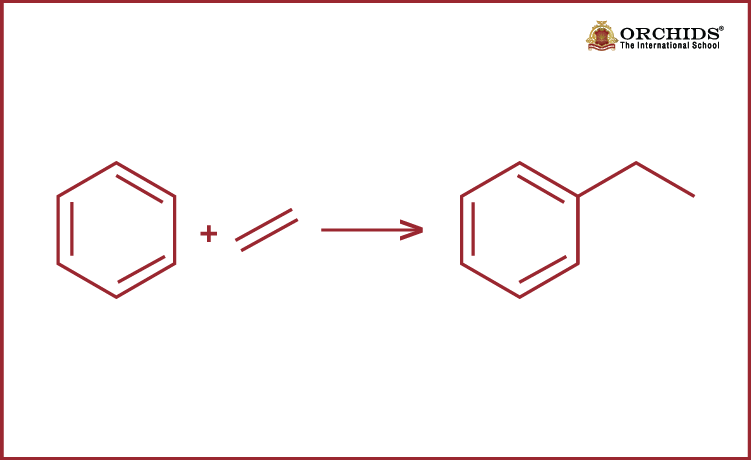
Here’s what happens step by step:
- Benzene (C6H6C_6H_6C6H6) acts as the aromatic base.
- Ethyne (HC≡CHHC \equiv CHHC≡CH) provides the ethyl group through addition.
- The product is ethylbenzene, where the benzene ring is now bonded to an ethyl substituent.
This reaction is important because it shows how simple hydrocarbons like ethyne can be used to build more complex organic molecules by adding functional groups such as ethyl.
Also Read: Carbon-Compounds
Let's Discuss the Other Methods of Ethylation:
- The Alkyl Halide Methodis processed using ethyl halides like ethyl chloride or ethyl bromide.
- The Ethyl Sulfate/Ethanol Method reacts with strong bases or acids to transfer the ethyl group.
- Catalytic Ethylation is often carried out with catalysts such as aluminium chloride (AlCl₃) in Friedel–Crafts alkylation.Below are Ethylation applications :
- Preparation of ethylbenzene (a precursor for styrene).
- Modification of drug molecules in pharmaceutical chemistry to alter solubility and activity.
- Production of fuels and polymers.
Frequently Asked Questions on Ethyl Group
1. What is the Ethyl Group?
The ethyl group is a simple two-carbon chain (–C₂H₅) that attaches to larger molecules and changes their properties.
2. What is the Ethyl Group Formula?
The formula of the ethyl group is (–C₂H₅), derived from its parent hydrocarbon, ethane.
3. Can you give an Ethyl Group Example?
A Ethyl Group example is ethyl alcohol (ethanol), where the ethyl group is bonded to a hydroxyl group.
4. What is ethyl also known as?
Ethyl is also known as the ethyl radical or simply the ethyl substituent in organic chemistry.
5. What are the 10 uses of ethanol?
Ethanol, containing the ethyl group, is used as a fuel, solvent, sanitiser, preservative, in medicines, perfumes, cosmetics, cooking extracts, chemical synthesis, and beverages.
6. What is the pH of ethyl alcohol?
Pure ethyl alcohol is neutral, with a pH close to 7, but the value can change when mixed with water or other substances.
7. What is the chemical name of ethyl?
The chemical name of ethyl is “ethyl,” though in practice it is commonly referred to as the ethyl group.
8. Why is the ethyl group important in chemistry?
The ethyl group acts as a building block that can make compounds more stable, more soluble in organic solvents, and more reactive in certain reactions.
Science isn't just a subject, it's the way of seeing the world. Curious how Orchids The International School teaches it that way? Talk to our admissions team.
Admissions Open for 2026-27
What type of concept pages would you prefer?
CBSE Schools In Popular Cities
- CBSE Schools in Bangalore
- CBSE Schools in Mumbai
- CBSE Schools in Pune
- CBSE Schools in Hyderabad
- CBSE Schools in Chennai
- CBSE Schools in Gurgaon
- CBSE Schools in Kolkata
- CBSE Schools in Indore
- CBSE Schools in Sonipat
- CBSE Schools in Delhi
- CBSE Schools in Rohtak
- CBSE Schools in Bhopal
- CBSE Schools in Aurangabad
- CBSE Schools in Jabalpur
- CBSE Schools in Jaipur
- CBSE Schools in Jodhpur
- CBSE Schools in Nagpur
- CBSE Schools in Ahmednagar
- CBSE School In Tumkur











Orchids The International School is one of India's leading chains of CBSE and ICSE schools, with 110+ schools across the country.