

Ethane (C₂H₆): Chemical Formula, Structure and Applications Explained
Ethane is one of the simplest hydrocarbons and a vital part of natural gas. Belonging to the alkane family, this compound contains only single bonds, making it a saturated hydrocarbon. Interestingly! Its simple structure and clean-burning nature make it an essential fuel and a building block for countless chemical products.
This article focuses on Ethane (C₂H₆) ,its structure and preparation methods to its physical properties and practical uses.
Must Know Facts about Ethane
|

Table of Contents
- What is Ethane and Its Structure
- Physical and Chemical Properties of Ethane
- Preparation of Ethane (C₂H₆)
- Chemical Reactions of Ethane
- Uses and Applications of Ethane
- Frequently Asked Questions on Ethane
What is Ethane and Its Structure
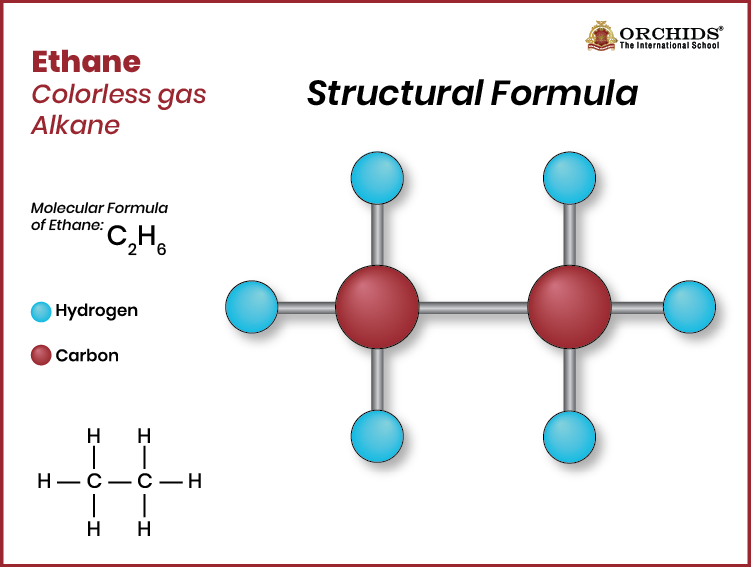
Ethane is one of the simplest members of the alkane family compounds made only of carbon and hydrogen with single covalent bonds. It is a saturated hydrocarbon, meaning all the carbon–carbon and carbon–hydrogen bonds are single bonds (σ-bonds).
In simple terms, ethane is a colorless, odorless gas that burns cleanly and is an important part of natural gas. It is found in petroleum and natural gas fields and is separated during natural gas processing.
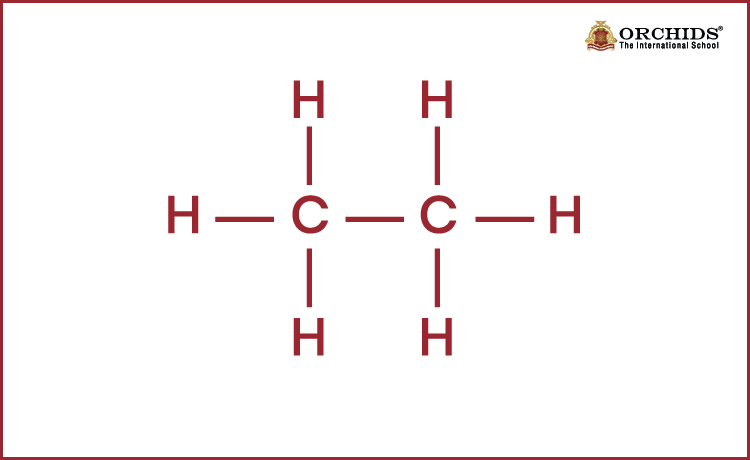
It consists of two carbon atoms and six hydrogen atoms, giving the ethane formula :
When it comes to Ethane Structure and Hybrisation!
Ethane has the simple structural formula:
Each carbon atom forms four single (σ) bonds three with hydrogen atoms and one with the other carbon atom. This arrangement makes ethane a stable and symmetrical molecule.
The fact that Both carbon atoms in ethane are sp³ hybridised.
Each carbon uses its sp³ orbitals to form:
- Three C–H σ bonds
- One C–C σ bond
Also Read: Carbon Compounds
Lets Discuss about the Geometry of Ethane !
Ethane has a tetrahedral geometry with a bond angle of approximately 109.5°.
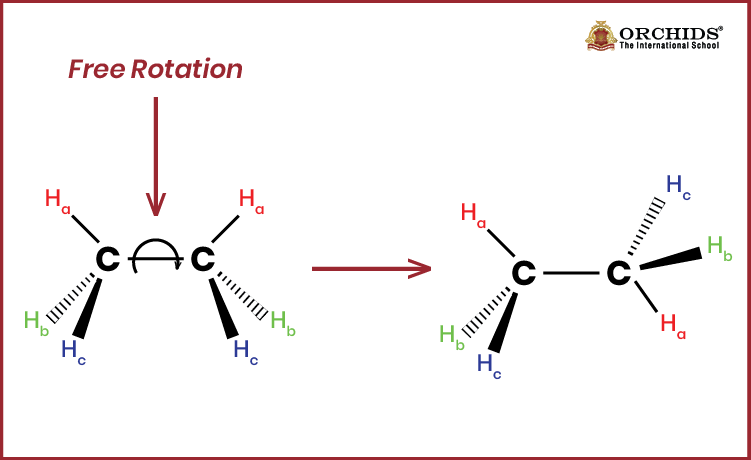
The exciting thing to know about its structure is Because of its single C–C bond, the molecule can rotate freely, giving rise to different conformations such as staggered and eclipsed forms an important concept in conformational analysis.
Do you know? Ethane is the second simplest alkane, right after methane (CH₄), and is used as both a fuel and a raw material in the chemical industry.
Have you ever wander that Ethane is identified by the Other Names as well ,
Interestingly! Ethane is known by several alternative names in chemistry depending on its molecular structure:
- Methyl methane
- Dimethyl
- Bimethyl
- Ethyl hydride
These names reflect that ethane can be seen as two methyl groups (–CH₃) joined together.
Also, read: Methane
Physical and Chemical Properties of Ethane
|
Property |
Details |
|
Ethane Formula |
C₂H₆ |
|
Molecular Mass (Molar Mass) |
30.07 g/mol |
|
Appearance |
Colorless, odorless gas |
|
Density |
1.36 kg/m³ |
|
Boiling Point |
–89°C |
|
Melting Point |
–182.8°C |
|
Nature of Compound |
Saturated hydrocarbon |
|
Hybridisation |
sp³ |
|
Solubility |
Slightly soluble in water, highly soluble in organic solvents |
|
Odour |
Odourless in pure form |
|
Bond Type |
Covalent (σ bonds only) |
Preparation of Ethane (C₂H₆)
There are several ways to prepare ethane in the laboratory and industry. The two most common lab methods are:
1. Reduction of Ethyl Iodide
When it comes to synthesis process of Ethane, it can be prepared by reducing ethyl iodide with a zinc–copper couple in the presence of alcohol.
- The reaction proceeds as follows:
Here, hydrogen atoms reduce ethyl iodide to ethane, while hydrogen iodide forms as a byproduct.
2. Wurtz Reaction
This is one of the most famous reactions in organic chemistry for forming C–C bonds.
When methyl iodide reacts with sodium metal in dry ether, ethane is produced:
This reaction demonstrates how two alkyl halide molecules join together to form a larger hydrocarbon.
Chemical Reactions of Ethane
While ethane is relatively less reactive due to the stability of C–C and C–H bonds, it can undergo a few key reactions:
1. Combustion Reaction
Ethane is a flammable gas that burns in oxygen to produce carbon dioxide and water vapour while releasing heat energy:
This exothermic reaction makes ethane a useful fuel. However, incomplete combustion may produce carbon monoxide (CO) and soot.
2. Halogenation Reaction
When ethane reacts with chlorine or bromine under sunlight or UV light, hydrogen atoms are replaced by halogen atoms a type of substitution reaction:
This is the basis for forming compounds like ethyl chloride and ethyl bromide.
Uses and Applications of Ethane
Ethane has significant importance in both industry and research:
1. Majorly in Petrochemical Feedstock Ethane is a key raw material used to produce ethylene (C₂H₄) through steam cracking, Also, Ethylene is used to make plastics, synthetic rubber, and antifreeze.
2. Ethane is used as a clean-burning gaseous fuel, especially in power generation and heating.
3. In Chemical Synthesis process Ethane acts as a starting material for producing ethanol, acetic acid, and acetaldehyde, which are widely used in:
- Paints and varnishes
- Adhesives and solvents
- Plastics and resins
4. In Scientific Research, Ethane is used as a volatile marker in studying lipid oxidation and as a cryogenic coolant due to its low boiling point.
So far we learned that how Ethane (C₂H₆) may look like a simple molecule, but it plays a powerful role in chemistry and industry. From producing plastics and fuels to serving as a clean energy source, ethane bridges the gap between basic hydrocarbons and complex organic compounds.
Frequently Asked Questions on Ethane
1. What is special about Ethane?
Ethane is special because it’s a simple hydrocarbon with the Ethane Formula C₂H₆, yet it plays a key role in making everyday products like plastics and fuels.
2. What are the five uses of Ethane?
Ethane is mainly used to produce ethylene, a building block for plastics, and also in refrigeration, welding, fuel, and as a research gas.
3. Does Ethane rise or sink?
Ethane gas is slightly heavier than air, so it tends to sink in still air, though it can easily disperse when mixed or ventilated.
4. What is the purpose of Ethane?
The main purpose of Ethane is to serve as a raw material for producing ethylene, which is vital in making plastics, detergents, and solvents.
5. What is Ethane also called?
Ethane is also called C₂H₆, which is the Ethane Formula, representing its two carbon and six hydrogen atoms.
6. Who produces Ethane?
Ethane is produced during natural gas processing and petroleum refining by separating it from methane and other hydrocarbons.
7. What is the formula of ethane ?
The formula of Ethane is C₂H₆, showing that it contains two carbon atoms bonded with six hydrogen atoms a simple yet vital hydrocarbon.
Science isn't just a subject, it's the way of seeing the world. Curious how Orchids The International School teaches it that way? Talk to our admissions team.
Admissions Open for 2026-27
What type of concept pages would you prefer?
CBSE Schools In Popular Cities
- CBSE Schools in Bangalore
- CBSE Schools in Mumbai
- CBSE Schools in Pune
- CBSE Schools in Hyderabad
- CBSE Schools in Chennai
- CBSE Schools in Gurgaon
- CBSE Schools in Kolkata
- CBSE Schools in Indore
- CBSE Schools in Sonipat
- CBSE Schools in Delhi
- CBSE Schools in Rohtak
- CBSE Schools in Bhopal
- CBSE Schools in Aurangabad
- CBSE Schools in Jabalpur
- CBSE Schools in Jaipur
- CBSE Schools in Jodhpur
- CBSE Schools in Nagpur
- CBSE Schools in Ahmednagar
- CBSE School In Tumkur











Orchids The International School is one of India's leading chains of CBSE and ICSE schools, with 110+ schools across the country.