

Battery Definition
Batteries are everywhere, silently powering the devices and machines we use every day. From your TV remote to an electric car, batteries act as compact energy storage units that release power whenever needed. But what exactly is a battery, how does it work, and why are there so many different kinds?
This article is the perfect guide focusing on the battery, its main categories, and the most widely used examples, simplifying how batteries work and why they matter in our lives.
Table of Contents
- What is a Battery Definition
- Types of Batteries
- Important Examples of Batteries
- Frequently Asked Questions on Battery

What is a Battery Definition?
A battery is an electrochemical device that stores energy in chemical form and converts it into electrical energy when required.
But the question is, how exactly is its structure?
It is made up of one or more electrochemical cells, each consisting of two electrodes (anode and cathode) and an electrolyte that allows ions to move between them.
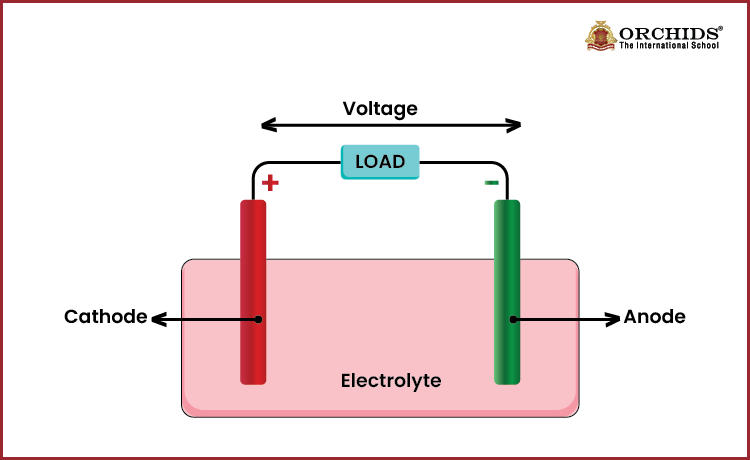
Traditionally, the word battery meant a collection of multiple cells connected.
Interestingly, however, today even a single cell, like the one in your wristwatch, is often referred to as a battery. The basic idea remains the same: it’s a device designed to provide portable, controlled power.
Let's learn why batteries matter today.
- In today’s world, batteries are not just powering small devices; they are reshaping industries.
- Electric vehicles, renewable energy storage systems, and even large-scale power grids rely on efficient batteries.
- With research focusing on solid-state batteries, sodium-ion cells, and safer chemistries, the future of batteries promises even greater performance, sustainability, and accessibility.
Next, let's understand the principle of a Battery :
The working principle of a battery is based on redox (reduction–oxidation) reactions.
- At the anode, oxidation releases electrons:
- At the cathode, reduction consumes electrons:
Together, these reactions drive the flow of current in the external circuit.
Here's the short must-know Important battery terminologies:
- Cathode: Positive electrode where electrons are gained.
- Anode: Negative electrode where electrons are lost.
- Electrolyte: A Medium that allows ion exchange to maintain electrical balance.
- Voltage (V): Potential difference between anode and cathode.
- Capacity (Ah or mAh): Amount of charge a battery can deliver.
- Energy Density (Wh/kg): Amount of energy stored per unit weight or volume.
Types of Batteries
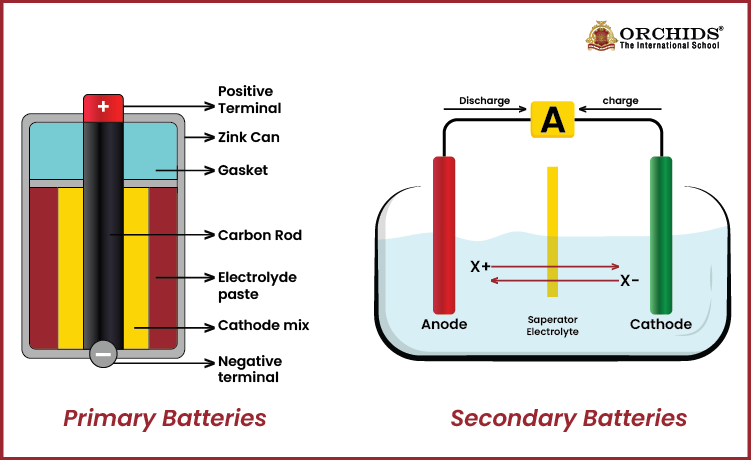
Batteries are generally classified into two major types based on whether they can be reused after discharging:
1. Primary Batteries
Primary batteries are single-use or non-rechargeable. Once the chemical reaction inside them is complete, they cannot be recharged.
When it comes to the reaction is irreversible, which means these batteries must be disposed of after use.
- They are commonly used in remotes, toys, flashlights, and clocks.
- It is often referred to as “use-and-throw” batteries.
2. Secondary Batteries
Secondary batteries are rechargeable and can go through multiple charging and discharging cycles. Here, the chemical reaction is reversible, so when electricity is supplied, the products are converted back into reactants, making the battery ready to use again.
- They are found in smartphones, laptops, power banks, and electric vehicles.
- Also known as rechargeable batteries.
Important Examples of Batteries
.webp)
Lead-Acid Battery
Invented in 1859 by Gaston Planté, the lead-acid battery is one of the oldest rechargeable batteries still in use today.
Reaction:
- Lead-acid battery is also known for its ability to deliver strong surge currents.
- It is widely used in automobiles to start engines.
- Some Advantages are: reliable, inexpensive, and can store a charge for years.
- Limitation: heavy and low energy-to-weight ratio.
Nickel-Cadmium Battery (NiCd)
The Nickel-Cadmium (NiCd) battery uses nickel oxide hydroxide and metallic cadmium as electrodes.
Reaction during discharge:
- It provides a steady discharge and can withstand frequent usage.
- It is found commonly in toys, cordless tools, and older electronic devices.
- Some Advantages are: durable, affordable, and fast charging.
- Limitations: Cadmium is toxic and poses disposal challenges.
Lithium-Ion Battery (Li-ion)
The lithium-ion battery is one of the most widely used modern rechargeable batteries.
Reaction:
- When it comes to its working, it works by moving lithium ions between electrodes during charging and discharging.
- Some Applications are smartphones, laptops, electric vehicles, and even aerospace technology.
- Some Advantages are: high energy capacity, lightweight, long lifespan, and minimal self-discharge.
- Limitation: relatively expensive compared to older batteries.
As we learned that batteries are more than just power packs; they are the backbone of modern life. From small household gadgets to electric cars and renewable energy storage, they keep our world running efficiently. As technology advances, batteries will continue to play a crucial role in building a sustainable, energy-efficient future.
Frequently Asked Questions on Battery
1. What is the Battery Definition?
The Battery Definition refers to it as an electrochemical device that stores chemical energy and converts it into electrical energy whenever needed.
2. What is a Battery?
A Battery is a portable power source made of one or more cells that supply electricity to devices like mobiles, laptops, cars, and even renewable energy systems.
3. Which chemical is used in a battery?
Different batteries use different chemicals. For example, lead-acid batteries use lead and sulfuric acid, while lithium-ion batteries use lithium compounds.
4. What is the principle of a battery?
The principle of a battery is based on electrochemical reactions where chemical energy is converted into electrical energy through electron flow.
5. What is a battery made of?
A battery is made of two electrodes (an anode and a cathode) and an electrolyte that allows ions to move, enabling the flow of electric current.
Science isn't just a subject, it's the way of seeing the world. Curious how Orchids The International School teaches it that way? Talk to our admissions team.
Admissions Open for 2026-27
What type of concept pages would you prefer?
CBSE Schools In Popular Cities
- CBSE Schools in Bangalore
- CBSE Schools in Mumbai
- CBSE Schools in Pune
- CBSE Schools in Hyderabad
- CBSE Schools in Chennai
- CBSE Schools in Gurgaon
- CBSE Schools in Kolkata
- CBSE Schools in Indore
- CBSE Schools in Sonipat
- CBSE Schools in Delhi
- CBSE Schools in Rohtak
- CBSE Schools in Bhopal
- CBSE Schools in Aurangabad
- CBSE Schools in Jabalpur
- CBSE Schools in Jaipur
- CBSE Schools in Jodhpur
- CBSE Schools in Nagpur
- CBSE Schools in Ahmednagar
- CBSE School In Tumkur











Orchids The International School is one of India's leading chains of CBSE and ICSE schools, with 110+ schools across the country.