

Benedict's test
Benedict’s test is a simple and visual chemical experiment used to detect reducing sugars in food, beverages, and biological samples like urine. Reducing sugars, such as glucose and fructose, have a free aldehyde or ketone group that can act as a reducing agent.
This article aims to help students understand and perform Benedict’s test, a widely used method to detect reducing sugars in food, beverages, and biological samples like urine
Table of Contents
- What is Benedict’s Test
- Preparation of Benedict’s Reagent
- Procedure for Benedict’s Test
- Precautions of Benedict’s Test
- Frequently Asked Questions on Benedict's Test

What is Benedict’s Test?
In the chemistry world, Benedict’s test is a qualitative chemical test that identifies reducing sugars in a given analyte.
But the question is, how does this test work?
Reducing sugars include glucose, fructose, maltose, and lactose, which contain free aldehyde or ketone groups.
What happens next is when these sugars react with Benedict’s reagent under heat, a series of redox reactions occur, producing a brick-red precipitate of cuprous oxide (Cu₂O).
Which results in the formation of this coloured precipitate confirms the presence of reducing sugars.
Next is for what purpose is the test mainly used?
This test is also commonly used in urine analysis to detect glucose levels, which can be an indicator for medical conditions such as diabetes.
NOTE: Some other reducing substances, such as ascorbic acid or homogentisic acid, can also give positive results.
It is widely used in school and undergraduate laboratories to help students understand redox reactions, qualitative analysis, and precipitation reactions.
Let's know about the Principle of Benedict’s Test
The principle of Benedict’s test is based on an oxidation-reduction reaction.
When a reducing sugar is heated in an alkaline medium, it undergoes the following changes:
- The sugar forms an enediol intermediate, a strong reducing agent.
- The cupric ions (Cu²⁺) in Benedict’s reagent are reduced to cuprous ions (Cu⁺).
- Cu⁺ reacts further to form insoluble cuprous oxide (Cu₂O), which precipitates out in shades of green, yellow, orange, or red, depending on the sugar concentration.
So the end result that justifies this visible colour change allows students to qualitatively and semi-quantitatively estimate reducing sugar content in a sample.
Next lets understand the preparation of Benedict's reagent.
Preparation of Benedict’s Reagent
To prepare 1 litre of Benedict’s reagent, the requirement is:
- Copper sulfate pentahydrate (CuSO₄·5H₂O): 17.3 g
- Sodium carbonate (Na₂CO₃): 100 g
- Sodium citrate: 173 g
Then dissolve these in distilled water up to 1000 mL, marking and making sure it is properly mixed in the volumetric flask.
What are the roles of these components?
- Copper sulfateprovides Cu²⁺ ions
- Sodium carbonate creates an alkaline medium
- Sodium citrate stabilises Cu²⁺ ions in solution
Purity check: Heat a small amount of the reagent. If it remains blue with no precipitate, the reagent is pure and ready for use.
Now, it is followed by the procedure to carry out the test in a systematic manner.
Procedure for Benedict’s Test
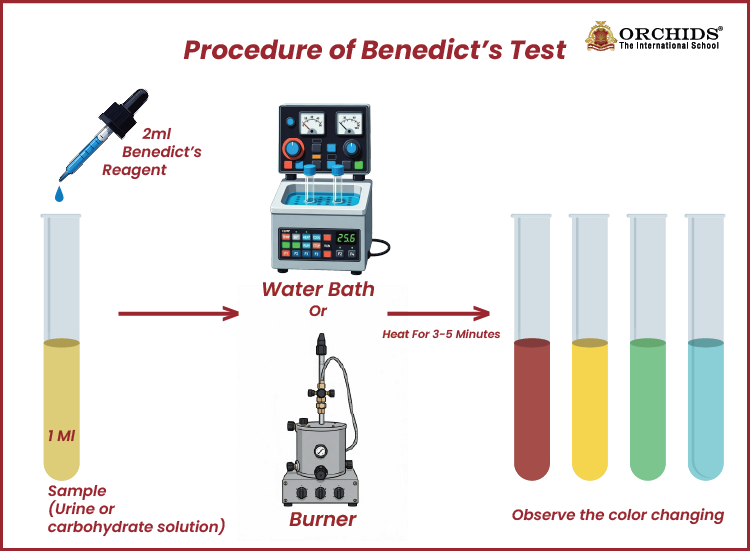
- Take 1 mL of the sample in a clean test tube.
- Add 2 mL of Benedict’s reagent.
- Heat the mixture in a boiling water bath for 3–5 minutes.
- Observe the colour change.
At the final stage, the result is interpreted based on the following chart values.
Interpreting Results of Benedict's Test:
|
Colour of Precipitate |
Approx. Reducing Sugar (%) |
|
Green |
0.5% |
|
Yellow |
1% |
|
Orange |
1.5% |
|
Brick-Red |
2% |
- Green colour indicates the very low sugar concentration
- Yellow/Orange shows moderate sugar concentration
- Brick-red clarifies the high sugar concentration
This helps students estimate the amount of reducing sugar visually.
Also, refer to learn more about the limitations of Benedict's test.
Precautions of the Benedict's Test
- Ensure all measurements of the solution and sample are taken accurately to get reliable results.
- Always heat the test tube slowly using a water bath instead of placing it directly on a flame to prevent splashing or overheating.
- Hold the test tube with a test-tube holder while heating to avoid burns or accidents.
- Keep the test tube’s mouth pointed away from yourself and others during heating for safety.
- Repeat the heating process at least three times before concluding that the result is negative, as some reactions may take longer to show colour change.
Till now, we have learned how Benedict’s test is a simple, safe, and visually engaging experiment for detecting reducing sugars in food and biological samples. It helps students understand chemical reactions, redox principles, and practical laboratory skills.
By observing the clear colour changes and precipitation, learners can connect theoretical knowledge with real-life applications.
Frequently Asked Questions on Benedict's Test
1. What is Benedict's test?
Benedict's test is a chemical test used to detect reducing sugars in a sample. It produces a colour change or brick-red precipitate if sugars are present.
2. What is the main purpose of Benedict's test?
The main purpose of Benedict's test is to identify reducing sugars in foods, beverages, or biological samples. It helps students observe simple redox reactions visually.
3. What disease is Benedict's test positive for?
Benedict’s test can be positive in diabetes, where glucose is present in urine. However, other reducing substances can also cause a positive result.
4. What are the limitations of the Benedicts test?
It cannot quantify sugars precisely and may give positive results with other reducing agents. The test is qualitative, not definitive for diagnosis.
5. What are the precautions in Benedict's test?
Always use clean test tubes and fresh reagents. Avoid prolonged heating to prevent decomposition or false results.
6. What reduces Benedict's reagent?
Reducing sugars, such as glucose, fructose, and maltose, reduce Benedict's reagent. They convert Cu²⁺ ions to Cu⁺, forming a colored precipitate.
7. What temperature is needed for Benedict's test?
The sample and reagent should be heated in a boiling water bath (around 100°C). This ensures the redox reaction occurs efficiently.
8. What is the Benedict test principle?
The Benedict test principle is that reducing sugars in alkaline solution reduce cupric ions (Cu²⁺) to cuprous ions (Cu⁺). These form a brick-red precipitate on reaction.
Science isn't just a subject, it's the way of seeing the world. Curious how Orchids The International School teaches it that way? Talk to our admissions team.
Admissions Open for 2026-27
What type of concept pages would you prefer?
CBSE Schools In Popular Cities
- CBSE Schools in Bangalore
- CBSE Schools in Mumbai
- CBSE Schools in Pune
- CBSE Schools in Hyderabad
- CBSE Schools in Chennai
- CBSE Schools in Gurgaon
- CBSE Schools in Kolkata
- CBSE Schools in Indore
- CBSE Schools in Sonipat
- CBSE Schools in Delhi
- CBSE Schools in Rohtak
- CBSE Schools in Bhopal
- CBSE Schools in Aurangabad
- CBSE Schools in Jabalpur
- CBSE Schools in Jaipur
- CBSE Schools in Jodhpur
- CBSE Schools in Nagpur
- CBSE Schools in Ahmednagar
- CBSE School In Tumkur











Orchids The International School is one of India's leading chains of CBSE and ICSE schools, with 110+ schools across the country.