

Boyle’s Law
Boyle’s Law is one of the fundamental gas laws in physics and chemistry that explains how gases behave under pressure. Proposed by Robert Boyle in 1662, it reveals a beautiful connection between pressure and volume of a gas when the temperature remains constant.
This article is on Boyle’s Law simply and practically, along with its formula, derivation, and everyday applications.
Table of Contents
- What is Boyle’s Law?
- Graphical Representation of Boyle’s Law
- Real-Life Examples of Boyle’s Law
- Solved Example Problems
- Frequently Asked Questions on Boyle's Law

What is Boyle’s Law?
Boyle’s Law states that the pressure of a gas is inversely proportional to its volume, provided the temperature and the amount of gas remain constant.
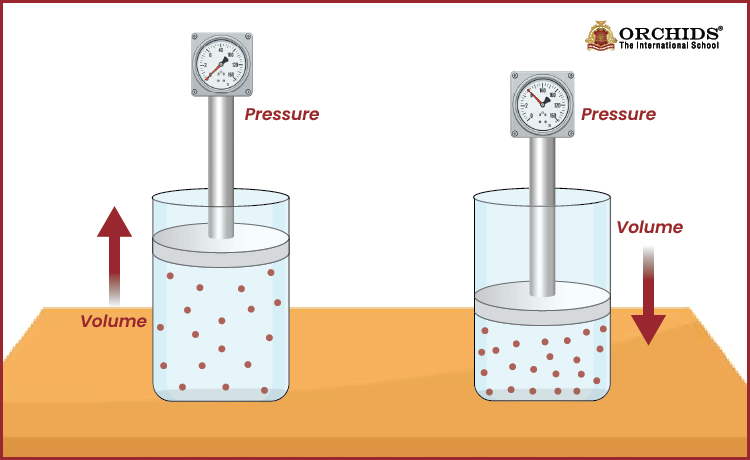
In simple terms, when the volume of a gas decreases, its pressure increases and vice versa.
Mathematically, this can be written as:
When a constant of proportionality (k) is introduced, it becomes:
Here,
-
P = Pressure of the gas
-
V = Volume of the gas
-
k = Constant for a given mass of gas at constant temperature
This means that for a fixed amount of gas, the product of its pressure and volume remains constant.
Let's understand with the help of an example:
When you press a filled balloon with your hands, you reduce the space (volume) inside it. Since the air molecules now have less room to move, they collide more frequently with the inner surface of the balloon. As a result, the pressure inside the balloon increases.
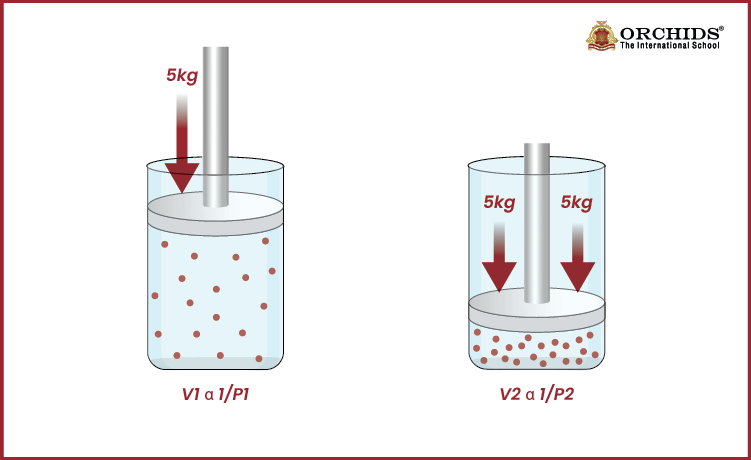
What happens if you continue to squeeze? The pressure rises until the balloon bursts.
This is a simple yet perfect example of Boyle’s Law decrease in volume leads to an increase in pressure.
Let's have a look at the Derivation of Boyle’s Law Formula
Consider a gas that changes from an initial state (pressure } P_1, \text{ volume } V_1) to a final state (pressure } P_2, \text{ volume } V_2), while temperature remains constant.}
The fact that the product of a gas’s initial pressure and volume is equal to the product of its final pressure and volume, provided the temperature and the number of moles remain constant.
Since P \times V = k \text{ for both states,
We can write the Boyle's law formula:
. This is the mathematical expression of Boyle’s Law. Where,
Below is the Graphical Representation of Boyle's Law
If you plot Pressure (P) on the Y-axis and Volume (V) on the X-axis, the graph forms a curved hyperbola, showing an inverse relationship.
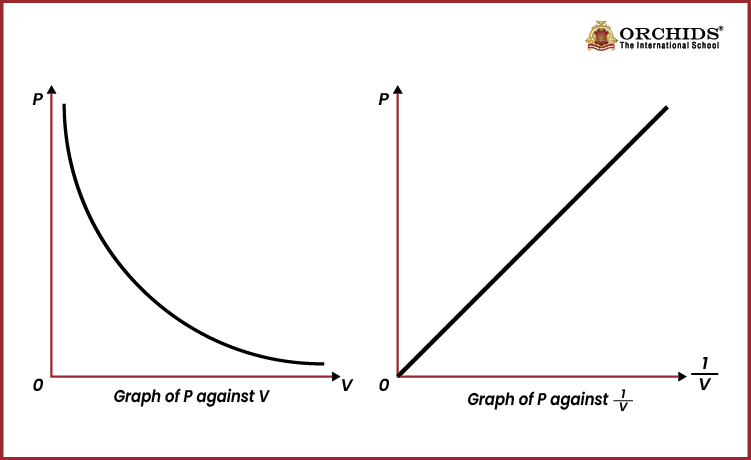
However, if you plot Pressure (P) against 1/V, the graph becomes a straight line, indicating direct proportionality between P and 1/V.
Real-Life Examples of Boyle’s Law
1. Breathing Process: When you inhale, the diaphragm moves downward, increasing lung volume and reducing air pressure inside. Air rushes in.
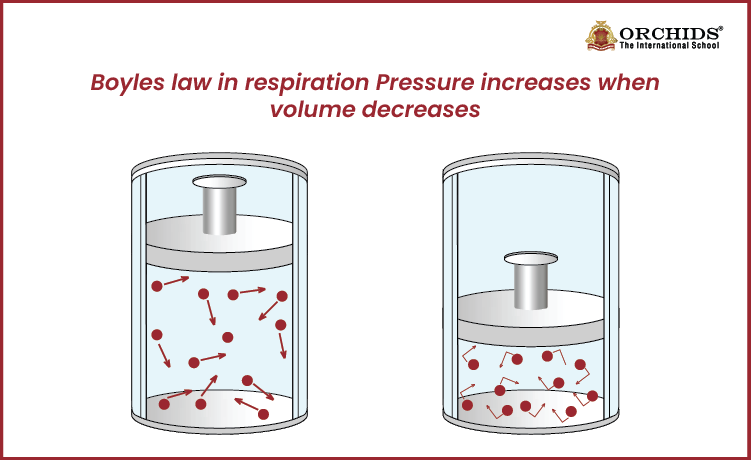
When you exhale, lung volume decreases, pressure rises, and air moves out, perfectly demonstrating Boyle’s Law.
2. Inflating a Balloon, Squeezing a balloon reduces its volume, causing internal air pressure to increase until it pops.
3. Syringe Action, have you ever noticed? Pulling back the plunger increases volume, lowers pressure, and draws liquid in. Pushing it down reduces volume, raising pressure and expelling the liquid.
4. Scuba Diving, As a diver ascends, the surrounding pressure decreases, causing air bubbles in the body to expand. This is why divers must rise slowly, Boyle’s Law in action for safety!
Also, students can check Charles' law for a better understanding of concepts.
Solved Example Problems
Example 1
A gas occupies a volume of 2 L at a pressure of 300 kPa. If the volume expands to 6 L, what is the new pressure?
Final Answer: The new pressure is 100 kPa.
Example 2
A gas at 1 atm pressure has a volume of 500 mL. What will be the pressure if the volume is reduced to 250 mL, keeping the temperature constant?
Final Answer: The pressure becomes 2 atm when the volume is halved.
As we learned how Boyle’s Law beautifully explains the relationship between the pressure and volume of gases under constant temperature. It is a cornerstone concept in physics and chemistry that helps us understand natural phenomena and engineering systems from breathing to balloon flights.
Frequently Asked Questions on Boyle's Law
1. What is Boyle's law?
Boyle’s law states that when the temperature of a gas remains constant, its pressure increases as its volume decreases, showing an inverse relationship between pressure and volume.
2. State Boyle's law.
According to Boyle’s law, at constant temperature, the pressure of a fixed mass of gas is inversely proportional to its volume. Simply put, if one doubles, the other halves.
3. What is the Boyle's law formula?
The Boyle’s law formula is P₁V₁ = P₂V₂, where P stands for pressure and V for volume of the same gas at constant temperature.
4. What are the important points of Boyle's law?
Boyle’s law applies only when temperature and gas quantity remain constant, and it shows that pressure multiplied by volume always gives a constant value.
5. Under what conditions is Boyle's law applicable?
Boyle’s law holds for ideal gases when the temperature is constant and no gas escapes or enters the system during compression or expansion.
6. What is the main principle of Boyle's law?
The main principle of Boyle’s law is that gas pressure and volume change in opposite directions when temperature stays the same.
7. Which gases obey Boyle's law?
Ideal gases follow Boyle’s law perfectly, while real gases approximately obey it under low pressure and moderate temperature.
8. How is Boyle's law used in real life?
Boyle’s law is seen in everyday life, from breathing and scuba diving to the working of syringes and spray cans.
9. What is Boyle's temperature?
Boyle’s temperature is the temperature at which a real gas closely follows Boyle’s law and behaves almost like an ideal gas.
Science isn't just a subject, it's the way of seeing the world. Curious how Orchids The International School teaches it that way? Talk to our admissions team.
Admissions Open for 2026-27
What type of concept pages would you prefer?
CBSE Schools In Popular Cities
- CBSE Schools in Bangalore
- CBSE Schools in Mumbai
- CBSE Schools in Pune
- CBSE Schools in Hyderabad
- CBSE Schools in Chennai
- CBSE Schools in Gurgaon
- CBSE Schools in Kolkata
- CBSE Schools in Indore
- CBSE Schools in Sonipat
- CBSE Schools in Delhi
- CBSE Schools in Rohtak
- CBSE Schools in Bhopal
- CBSE Schools in Aurangabad
- CBSE Schools in Jabalpur
- CBSE Schools in Jaipur
- CBSE Schools in Jodhpur
- CBSE Schools in Nagpur
- CBSE Schools in Ahmednagar
- CBSE School In Tumkur











Orchids The International School is one of India's leading chains of CBSE and ICSE schools, with 110+ schools across the country.