

Methane Explained: Structure, Characteristics, and Everyday Applications
Methane, a simple but vital compound in chemistry and energy, plays a crucial role in our everyday lives. Found naturally in the Earth’s atmosphere and natural gas reserves, this colourless and odourless gas is more than just a fuel. It’s a fundamental building block in organic chemistry.
In this article, we’ll learn what methane is, how it’s structured, its properties, its uses, and more.
Table of Contents
- What is Methane
- Physical and Chemical Properties of Methane
- Methane Uses in Real Life
- Frequently Asked Questions on Methane

What is Methane?
Methane is a colourless and odourless gas that occurs naturally in the environment. It is the simplest hydrocarbon in the alkane family and has the chemical formula CH₄. Interestingly, Methane is also a key greenhouse gas that plays a role in global warming when released into the atmosphere in large quantities.
Methane is found in natural gas, swamps, and even in the digestive systems of animals like cows. It’s produced both naturally and through human activities such as agriculture, fossil fuel and more.
Let's discuss the Structure of Methane (CH₄)
Methane has a tetrahedral structure, which means the four hydrogen atoms are arranged around the carbon atom at equal distances and angles of 109.5 degrees. This structure gives methane a very stable shape. All the bonds in methane are single covalent bonds, making it a saturated hydrocarbon.
Next is Derivatives of Methane (Tetracyanomethane) are as interesting to study as Methane. Let's discuss how it is different from the Methane molecule.
.webp)
Tetracyanomethane, also known as carbon tetracyanide, which all four hydrogen atoms replaced by cyanide groups (−CN). Its chemical formula is C(CN)₄.
- Thestructure of Tetracyanomethane consists of a central carbon atom that is bonded to four cyanide groups. You can identify it as a crystalline solid.
- WhenReactivity comes to play, this compound is more reactive and less stable than methane due to the presence of highly electronegative cyanide groups.
- Tetracyanomethane is mostly used in research and not in common industrial or household applications.
Physical and Chemical Properties of Methane
Let’s take a closer look at the key properties of methane:
Physical Properties:
Property |
Description |
Appearance |
Methane is a colourless and odourless gas at room temperature. |
Boiling Point |
–161.5 °C |
Melting Point |
–182.5 °C |
Solubility |
Slightly soluble in water but dissolves well in organic solvents like alcohol. |
Density |
Less dense than air. |
Next comes Methane reacts chemically and shows well-identified reactions in chemistry.
Chemical Properties of Methane:
- The most familiar reaction is Combustion, whereMethane burns in the presence of oxygen to form carbon dioxide and water, releasing energy.
CH₄ + 2O₂ → CO₂ + 2H₂O - Methane reacts with halogens like chlorine in the presence of sunlight to form compounds like chloromethane, which is said to be a Halogenation reaction.
- Methane also rules in organic chemistry by participating in Substitution Reaction: In these reactions, one or more hydrogen atoms in methane are replaced by other atoms or groups of atoms.
These properties make methane an efficient fuel, but they also mean it can be dangerous if not handled properly.
Methane Uses in Real Life:
Methane is one of the most widely used gases in both households and industries.
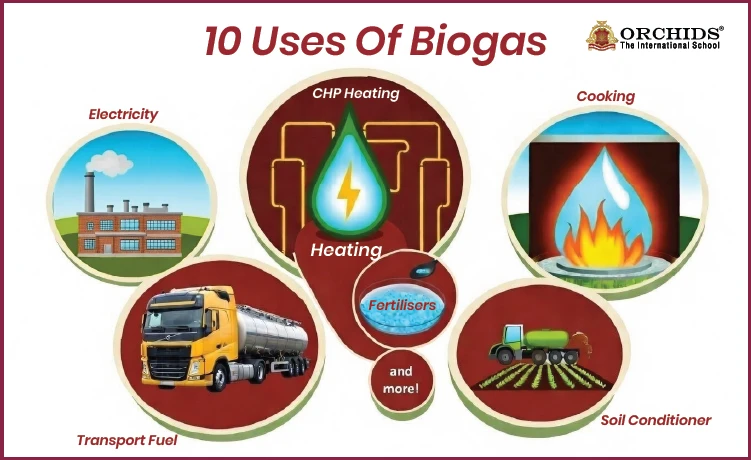
Here’s how:
- Methane as Cooking Fuel is commonly used in LPG (Liquefied Petroleum Gas) and natural gas for cooking.
- In Electricity Generation, such as in Power plants, burning methane to produce electricity plays an excellent role.
- Methane serves as a starting material in the Chemical Industry by making chemicals like methanol and hydrogen.
- Methane makes a major contribution to vehicle Fuel, where it is used as Compressed Natural Gas (CNG) for fuelling vehicles.
- Welding and Cutting, Methaneisused in the form of gas mixtures in metal cutting and welding operations
Learn More: Carbon Compounds
As we have learned that Methane is not just a source of energy; it’s an interesting compound with wide-ranging applications in science and industry. From powering homes to playing a role in chemical reactions, methane’s simplicity is what makes it so important.
Frequently Asked Questions on Methane
1. What are 5 facts about Methane that make it unique?
Methane is a colourless, odourless gas, lighter than air, and highly flammable. It's the simplest hydrocarbon and a major part of natural gas used for fuel.
2. What is the biggest cause of Methane in the environment?
The largest source of methane emissions comes from agriculture, especially livestock like cows, which release it during digestion.
3. What are the important points of Methane everyone should know?
Methane is a greenhouse gas, a key energy source, and plays a major role in atmospheric chemistry. It's also formed naturally and through human activities.
4. Why is Methane important to life on Earth?
Methane helps meet global energy needs and supports life by playing a role in Earth's carbon cycle. It also helps scientists study planetary atmospheres.
5. What are some everyday Methane Uses in our homes and industries?
Methane is used for cooking, heating systems, and generating electricity. Industries also use it to produce chemicals like hydrogen and methanol.
6. How is Methane different from other fuels we use?
Methane burns cleaner than coal and oil, making it a preferred energy source. It releases less carbon dioxide when used as a fuel.
Science isn't just a subject, it's the way of seeing the world. Curious how Orchids The International School teaches it that way? Talk to our admissions team.
Admissions Open for 2026-27
What type of concept pages would you prefer?
CBSE Schools In Popular Cities
- CBSE Schools in Bangalore
- CBSE Schools in Mumbai
- CBSE Schools in Pune
- CBSE Schools in Hyderabad
- CBSE Schools in Chennai
- CBSE Schools in Gurgaon
- CBSE Schools in Kolkata
- CBSE Schools in Indore
- CBSE Schools in Sonipat
- CBSE Schools in Delhi
- CBSE Schools in Rohtak
- CBSE Schools in Bhopal
- CBSE Schools in Aurangabad
- CBSE Schools in Jabalpur
- CBSE Schools in Jaipur
- CBSE Schools in Jodhpur
- CBSE Schools in Nagpur
- CBSE Schools in Ahmednagar
- CBSE School In Tumkur











Orchids The International School is one of India's leading chains of CBSE and ICSE schools, with 110+ schools across the country.