

Neutralisation Reaction: Important Reactions with Examples Explained
Neutralisation reaction is a simple but important chemical reaction where an acid and a base meet and cancel each other out, forming salt and water and plays an important role in our daily lives.
This article explains what neutralisation reactions are, the main equations, their everyday applications and more, as it shows how chemistry balances the world around us.
Table of Contents
- What is a Neutralisation Reaction and Its Examples
- Uses of Neutralisation Reactions in Everyday Life
- Frequently Asked Questions on Neutralisation Reaction

What is a Neutralisation Reaction and Its Examples
Neutralisation reaction is a chemical reaction whereby an acid is mixed with a base to give salt and water. This is because the hydrogen ions (H⁺) from the acid bond with the hydroxide ions (OH⁻) from the base to give water.
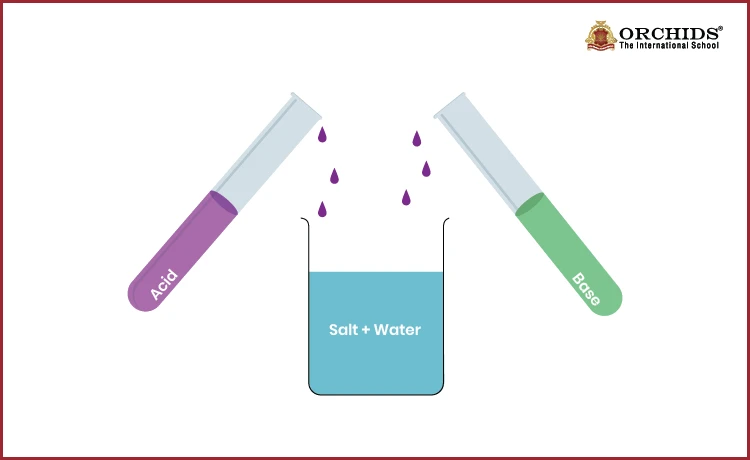
It is represented by the General formula:
Acid + Base → Salt + Water
Let's take an example:
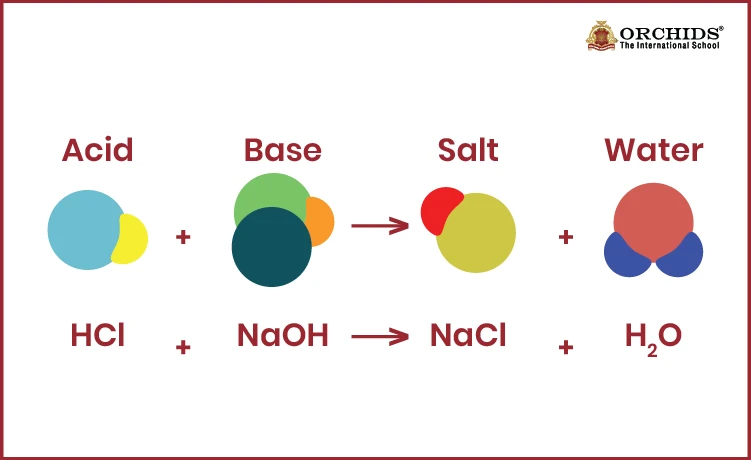
Here, sodium hydroxide and hydrochloric acid react to produce common table salt, sodium chloride (NaCl) and water.
“Imagine two opposites uniting and cancelling out each other's strengths just like fire and water balancing each other out.”
Now, let's discuss how the Relation Between the Strength of Reactants and Final pH affects the neutralisation reaction.
The fact that not all neutralisation reactions reach the same conclusion. The final solution pH relies on whether the base and acid used are strong or weak.
Here are some common examples:
- Strong acid + strong base → Neutral solution (water + neutral salt).
Let's look at how:
Both the acid Hydrochloric acid (HCl) and the base sodium hydroxide (NaOH) completely dissociate in water. This means all H⁺ ions from the acid find OH⁻ ions from the base, forming water.
So, no extra H⁺ or OH⁻ ions remain in the solution, resulting ina neutral solution, pH ≈ 7.
- Strong acid + weak base → Acidic solution because excess H⁺ ions are left behind.
The strong acid completely dissociates (all H⁺ released), but the weak base does not fully neutralise it because it doesn’t supply enough OH⁻ ions.
Extra H⁺ ions remain in the solution. Which results in an Acidic solution, pH < 7.
- Weak acid + strong base → Basic solution because excess OH⁻ ions are left behind.
The weak acid doesn’t fully release H⁺ ions, while the strong base fully releases OH⁻ ions. Some OH⁻ ions are left unneutralised. Forms sodium acetate, producing a slightly basic solution pH > 7.
- Weak acid + weak base → Final pH depends on which one is stronger (their dissociation constants, Ka and Kb).
The resulting pH is a function of whether the acid or the base is slightly stronger.
- Key Insight:
In ionic form, the principal tale of neutralisation is actually quite straightforward:
This relationship helps chemists predict the final nature of the solution in both labs and real-life uses.
Let's have a quick summary of the above:
|
Acid Strength |
Base Strength |
Nature of Solution |
Expected pH |
|
Strong Acid |
Strong Base |
Neutral |
≈ 7 |
|
Strong Acid |
Weak Base |
Acidic |
< 7 |
|
Weak Acid |
Strong Base |
Basic |
> 7 |
|
Weak Acid |
Weak Base |
Depends on Ka vs Kb |
< 7, ≈ 7, > 7 |
Uses of Neutralisation Reactions in Everyday Life
Neutralisation is not only a lab reaction, it’s everywhere surrounding us!
- The Medicine (Antacids), which is useful when there is excess acid in the stomach that leads to heartburn, we consume antacids such as magnesium hydroxide or calcium carbonate.
These are bases that neutralise stomach acid and provide relief.
- The neutralisation reaction also contributes to agriculture.If the soil is excessively acidic, lime (calcium carbonate) is added to neutralise it, making the soil a better place for crops to grow.
- Industries tend to discharge acidic or basic wastewater. Neutralising it with appropriate chemicals renders it safe for discharge into rivers or lakes. This reaction plays a key role in Environmental Protection and (Wastewater Treatment).
- Bacteria in our mouth break down food into acids that harm teeth. Toothpaste, being slightly basic, neutralises these acids and saves enamel.
- It is mainly used for food preservation, like vinegar (acidic), which is sometimes balanced with bases in recipes to preserve flavour and avoid spoilage.
- Neutralisation is applied in titration experiments to determine the concentration of a known acid or base.
- Most neutralisation reactions give out heat. For instance, when HCl reacts with NaOH, energy is released, making it an exothermic process.
Read More: Acid,Base and Salts and Acid Base Titration
We have learned that Neutralisation reactions can seem like a simple concept, but it has a significant impact on our daily lives. From soothing a queasy stomach to safeguarding crops and more, this reaction extends well beyond the confines of the chemistry lab.
Frequently Asked Questions on Neutralisation Reaction
1. What is a neutralisation reaction?
A neutralisation reaction is when an acid and a base combine to cancel out each other’s properties, forming a salt and water. It’s a balancing act in chemistry.
2. Can you share some neutralisation reaction examples?
Yes, For example, HCl + NaOH → NaCl + H₂O. Another is CH₃COOH + NaOH → CH₃COONa + H₂O. Both show acids and bases forming a salt and water.
3. Why is neutralisation important in everyday life?
Neutralisation helps in many ways, from antacids soothing heartburn to treating acidic soils in farming and cleaning wastewater in industries.
4. What is a neutralisation reaction also known as?
A neutralisation reaction is also known as an acid-base reaction, because it happens between an acid and a base.
5. What does neutralisation take place between?
Neutralisation takes place between hydrogen ions (H⁺) from an acid and hydroxide ions (OH⁻) from a base, which combine to form water.
6. How does neutralisation work?
Neutralisation works by acids donating H⁺ ions and bases donating OH⁻ ions, which join together to make water. The leftover parts form a salt.
Science isn't just a subject, it's the way of seeing the world. Curious how Orchids The International School teaches it that way? Talk to our admissions team.
Admissions Open for 2026-27
What type of concept pages would you prefer?
CBSE Schools In Popular Cities
- CBSE Schools in Bangalore
- CBSE Schools in Mumbai
- CBSE Schools in Pune
- CBSE Schools in Hyderabad
- CBSE Schools in Chennai
- CBSE Schools in Gurgaon
- CBSE Schools in Kolkata
- CBSE Schools in Indore
- CBSE Schools in Sonipat
- CBSE Schools in Delhi
- CBSE Schools in Rohtak
- CBSE Schools in Bhopal
- CBSE Schools in Aurangabad
- CBSE Schools in Jabalpur
- CBSE Schools in Jaipur
- CBSE Schools in Jodhpur
- CBSE Schools in Nagpur
- CBSE Schools in Ahmednagar
- CBSE School In Tumkur











Orchids The International School is one of India's leading chains of CBSE and ICSE schools, with 110+ schools across the country.