

Acid-Base Titration
Acid-base titration is a practical chemistry method used to determine the exact concentration of an unknown acid or base by neutralising it with a known one. It plays a key role in laboratory experiments and helps students understand the nature of acids, bases, and their reactions.
This article breaks down the entire process in a simple and student-friendly way, from choosing indicators to reading titration curves, making it easier to understand for the learners.
Table of Contents
- What Is Acid-Base Titration
- Theory: What Acid-Base Titration Tells Us
- Types of Titrations
- Titration Curves and the Equivalence Point
- Identifying the Titration Curves with Their Distinct Features
- Role and Choice of Indicators
- Quick Tricks to Understand the Acid Test Easily
- Conclusion
- Frequently Asked Questions on Acid-Base Titration

What is Acid-Base Titration?
Acid-base titration is a method used in chemistry to determine the concentration of an unknown acid or base by neutralising it with a base or acid of known concentration. It is a widely used technique in laboratories, especially for analytical chemistry and volumetric analysis.
The process involves the slow addition of one solution to another until the reaction reaches completion - a point called the equivalence point.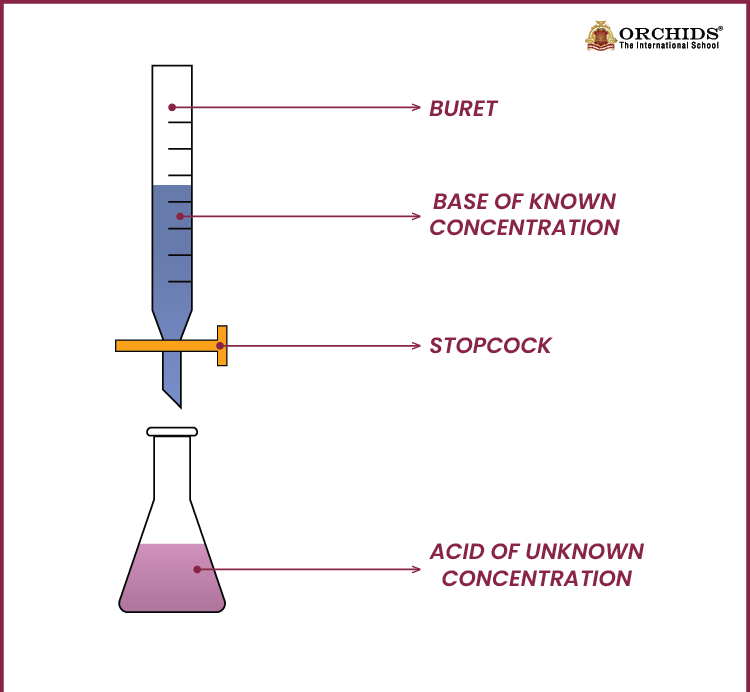
Theory – What Acid-Base Titration Tells Us
Acid-base titration is a method used to figure out:
- The exact concentration of an acid or base
- Whether it's strong or weak
- The pKa or pKb values of unknown solutions
How It Works:
In water, acids release H⁺ (or form H₃O⁺), and bases accept H⁺ or release OH⁻.
Example Reactions:
Resulting Reaction:
Acid + Base ⇋ Conjugate base + Conjugate acid
Why It Matters:
- Use constants like Ka, Kb, and Kw to understand how strong an acid or base is and calculate the pH.
Types of Titrations
There are four common combinations of acids and bases in titrations:
- Strong acid + Strong base
- Weak acid + Strong base
- Strong acid + Weak base
- Weak acid + Weak base
Each of these combinations results in different titration curves and requires a specific type of indicator.
Titration Curves and the Equivalence Point
The most critical stage of a titration is the equivalence point, which is defined as the stage where the total moles of Added Base are equal to the total moles of Acid in the vessel. At this point, both H ions and OH ions will not be present as they would all be neutralised, and thus no more titration would be required.
Main points:
- In this case, the acid is usually found in the flask, and the base that is being reacted to is dispensed by means of a burette.
- As described in the previous section, the titration curve is the graph showing how pH changes with time as base is injected.
Identifying the Titration Curves with Their Distinct Features
The described curves vary due to the used strength of the acid and a base being titrated, including acids and bases of different strengths: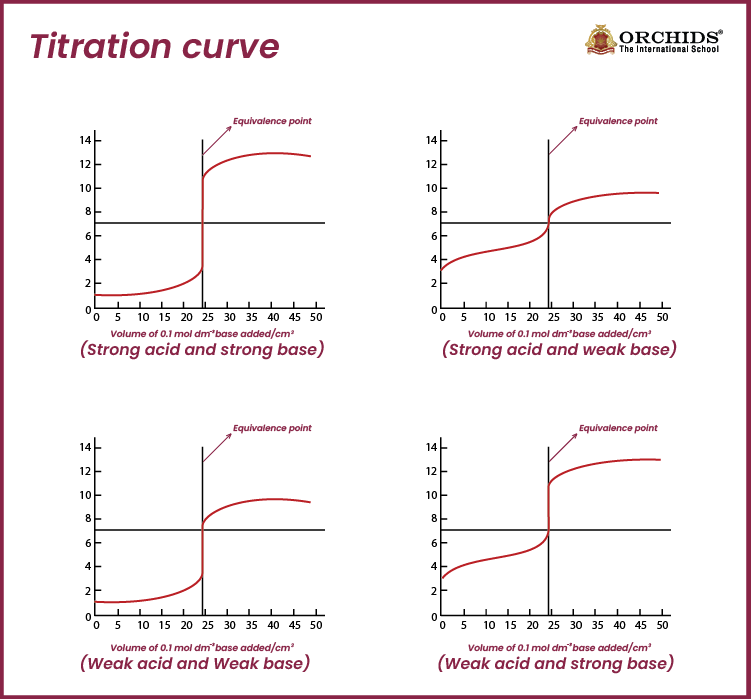
- Strong Acid + Strong Base: Sharp increase in pH, and the equivalence point is reached at neutral pH 7.
- Weak Acid + Strong Base: Equivalence point sits above 7, usually around the 10 to 12 range.
- Strong Acid + Weak Base: Equivalence point suspended below 7 (acidic).
- Weak Acid + Weak Base: Little to no drop in pH: gradual changes in pH observed.
Rationale:
- With both strong acid and strong base present, the sharp rise in pH means that an appropriate indicator can be chosen, such as phenolphthalein or methyl orange, which would clearly show the endpoint of the titration.
- For weak acid - weak base titrations, the equilibrium does not shift far enough at the equivalence point for any indicator to change colour.
Role and Choice of Indicators
Indicators are organic compounds that change colour depending on the pH of the solution. They help visually identify when the equivalence point is reached.
They work because of resonance and electron shifts in their chemical structure. Their ionisation constants vary, so they change colour at different pH levels.
Categories of Indicators:
- Phthaleins and Sulphophthaleins - e.g., Phenolphthalein
- Azo indicators - e.g., Methyl orange
- Triphenylmethane indicators - e.g., Malachite green
Common Indicators Used for Different Titrations
|
Type of Titration |
Suitable Indicator |
|
Strong acid - Strong base |
Phenolphthalein |
|
Weak acid - Strong base |
Phenolphthalein |
|
Strong acid - Weak base |
Methyl orange |
|
Weak acid - Weak base |
No suitable indicator |
Note: For weak acid-weak base titrations, there's no sharp vertical pH shift, so no indicator provides an accurate endpoint.
Quick Tricks to Understand the Topic Acid-Base Titrations
- Neutralisation is the goal - acid + base → salt + water.
- Burette = known solution, flask = unknown.
- Indicator shows endpoint - pick based on acid/base strength.
- Equivalence ≠ endpoint, but both should be close.
- Titration curves tell the strength:
Strong acid + base → pH 7
Weak acid + strong base → pH > 7
Strong acid + weak base → pH < 7
- Use N₁V₁ = N₂V₂ for quick volume/concentration calculations.
Conclusion
Acid-base titration is an important method for analysing an unknown concentration of acids or bases. From plotting titration curves and choosing the proper indicator, the entire process is critical for yielding correct lab results. If you're studying for your upcoming board exams or getting ready for work, getting these fundamentals out of the way is a great way to get a good start.
Frequently Asked Questions on Acid-Base Titration
1. What is the main use of acid-base titration?
Acid-base titration helps find the exact concentration of an unknown acid or base. It’s widely used in labs, especially for accurate chemical analysis.
2. What is the choice of indicator in acid-base titration?
The indicator depends on the strength of the acid and base used. For example, phenolphthalein suits strong base titrations, while methyl orange fits strong acids.
3. What is the endpoint of the acid-base titration?
The endpoint is when the indicator changes colour, showing the reaction is complete. It’s ideally very close to the actual equivalence point.
4. What are the limitations of acid-base titrations?
They don’t work well for weak acid-weak base pairs, as no sharp pH change occurs. Also, choosing the wrong indicator can lead to inaccurate results.
5. What is acid-base titration used for?
Acid-base titration is mainly used to figure out the exact concentration of an unknown acid or base by slowly adding one to the other until they balance out.
6. How can we define acid-base titration in easy words?
Acid-base titration is a step-by-step method to find out how strong or weak an acid or base is by reacting it with a solution of known strength.
7. Why is phenolphthalein used when working with a base?
Phenolphthalein is used in base titrations because it clearly changes colour - it stays colourless in acid but turns pink when a base is present, helping us know when the reaction is done.
8. What do we mean by titrant and titrate in a titration process?
In a titration, the titrant is the solution you already know the strength of and add using a burette, while the titrate is the unknown solution you're testing in the flask.
9. What do we observe in a titration between a weak acid and strong base?
When a weak acid reacts with a strong base, the final pH goes above 7, and phenolphthalein is often used as the indicator because it works well in this setup.
Science isn't just a subject, it's the way of seeing the world. Curious how Orchids The International School teaches it that way? Talk to our admissions team.
Admissions Open for 2026-27
What type of concept pages would you prefer?
CBSE Schools In Popular Cities
- CBSE Schools in Bangalore
- CBSE Schools in Mumbai
- CBSE Schools in Pune
- CBSE Schools in Hyderabad
- CBSE Schools in Chennai
- CBSE Schools in Gurgaon
- CBSE Schools in Kolkata
- CBSE Schools in Indore
- CBSE Schools in Sonipat
- CBSE Schools in Delhi
- CBSE Schools in Rohtak
- CBSE Schools in Bhopal
- CBSE Schools in Aurangabad
- CBSE Schools in Jabalpur
- CBSE Schools in Jaipur
- CBSE Schools in Jodhpur
- CBSE Schools in Nagpur
- CBSE Schools in Ahmednagar
- CBSE School In Tumkur











Orchids The International School is one of India's leading chains of CBSE and ICSE schools, with 110+ schools across the country.