

Ethanol: Formula, Properties and Important Reactions Explained
Think about hand sanitiser, cough syrup, perfume, and fuel. What do they all have in common? Ethanol.Most people only connect ethanol to alcoholic drinks, but it goes far beyond that. It powers industries, fuels vehicles, stocks laboratories, and keeps hospitals running, all thanks to one surprisingly simple molecule.
This article covers ethanol's formula, structure, properties, reactions, uses, and its effects on living organisms.
Table of Contents
- What is Ethanol
- Preparation of Ethanol
- Physical and Chemical Properties of Ethanolz
- Uses of Ethanol
- Effects of Ethanol on Living Organisms
- Difference Between Ethanol and Methanol
- Frequently Asked Questions on Ethanol

What is Ethanol?
Ethanol is an organic compound belonging to the alcohol family. It is a colourless, volatile liquid with a characteristic smell and is commonly known as ethyl alcohol.
But have you ever wondered about its occurrence? Yes, Ethanol occurs naturally during the fermentation of sugars by yeast. It can also be manufactured industrially through the hydration of ethene.
Because of its excellent solvent properties and wide range of applications, ethanol is used extensively in industries, medicines, fuels, and laboratories.
Did You Know?Ethanol is the main alcohol present in alcoholic beverages such as beer, wine, and spirits. |
Lets Discuss About the Ethanol Formula
The molecular formula of ethanol is:C₂H₆O
It is also commonly written as:C₂H₅OH
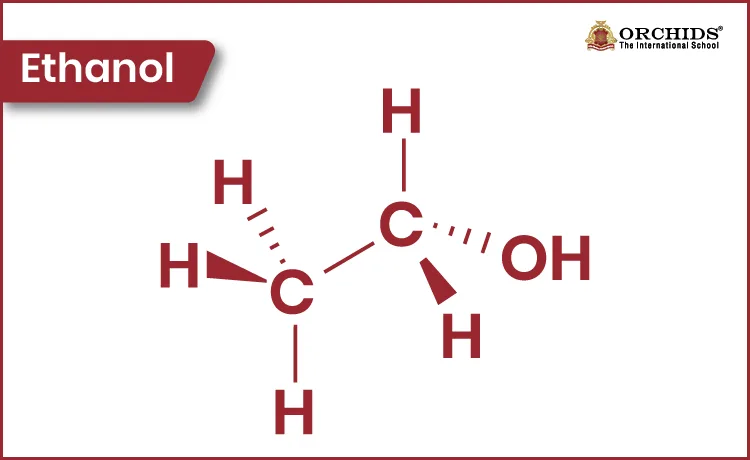
The structural formula shows that ethanol contains:
- Two carbon atoms
- Six hydrogen atoms
- One oxygen atom
- A hydroxyl group (-OH)
The hydroxyl group is responsible for the characteristic properties of alcohol structure.
The ethanol molecule consists of a two-carbon chain attached to a hydroxyl (-OH) group.
Structural Representation
CH₃ – CH₂ – OH
Components of Ethanol Structure
- Ethyl group (C₂H₅)
- Hydroxyl group (-OH)
The presence of the hydroxyl group makes ethanol soluble in water and capable of forming hydrogen bonds.
Preparation of Ethanol
Ethanol can be produced through both natural and industrial methods.
1. Fermentation of Sugars
This is the most common natural method.
In this process:
- Sugars from fruits, grains, or sugarcane are converted into ethanol by yeast.
- Carbon dioxide is released as a by-product.
Example
Glucose → Ethanol + Carbon Dioxide
2. Hydration of Ethene
Industrially, ethanol is produced by reacting ethene with water in the presence of a catalyst.
This method is widely used for large-scale ethanol production.
Have you heard about Denatured Alcohol?
To prevent misuse of industrial ethanol, toxic substances such as methanol are added to it.This process is called denaturation, and the resulting product is known as denatured alcohol.
Denatured alcohol is unsuitable for drinking but remains useful for industrial purposes.Ethanol is one of the most important organic compounds used in everyday life and industrial applications. From medicines and cosmetics to fuels and chemical manufacturing, its versatility makes it highly valuable.While ethanol has many beneficial applications, responsible handling and consumption are essential because excessive exposure can affect human health.
Physical and Chemical Properties of Ethanol
Ethanol possesses several important physical properties that make it useful in many applications.
|
Property |
Description |
|
Appearance |
Colourless liquid |
|
Odour |
Characteristic alcoholic smell |
|
Melting Point |
156 K (-117°C) |
|
Boiling Point |
351 K (78°C) |
|
Solubility |
Completely soluble in water |
|
Nature |
Volatile and flammable |
|
Taste |
Slightly sweet and burning |
One of the most important properties of ethanol is its ability to mix with water in any proportion.
Ethanol undergoes various chemical reactions because of the presence of the hydroxyl group.
1. Reaction with Sodium
When ethanol reacts with sodium metal, sodium ethoxide and hydrogen gas are formed.
Reaction
Observation
Hydrogen gas is released during the reaction.
2. Oxidation of Ethanol
Ethanol can be oxidised to form ethanal and further oxidised to ethanoic acid.
Oxidation Using PCC
Pyridinium Chlorochromate (PCC) converts ethanol into ethanal (acetaldehyde).
Reaction
This reaction is important in organic chemistry because PCC prevents further oxidation to carboxylic acids.
3. Dehydration of Ethanol
When ethanol is heated with concentrated sulphuric acid at about 443 K, it loses water and forms ethene.
Reaction
This process is known as dehydration because water is removed from the molecule.
Uses of Ethanol
Ethanol is widely used in daily life as well as in various industries because of its excellent solvent properties and versatility.
1. In Beverages and Medicines; Ethanol is the main alcohol present in alcoholic drinks and is also used in cough syrups, tonics, antiseptics, and tincture of iodine.
2. In Sanitisers and Cosmetic Products, It is commonly used in hand sanitisers, disinfectants, perfumes, lotions, deodorants, and other beauty products due to its antimicrobial and solvent properties.
3. In Fuel and Industrial Applications, Ethanol is blended with petrol to improve fuel efficiency and reduce emissions. It is also used as a solvent in paints, inks, varnishes, and chemical manufacturing.
4. In the Food Industry, It is used as a flavouring agent, preservative, and food additive in various food and beverage products.
Effects of Ethanol on Living Organisms
Although ethanol has many useful applications, excessive consumption can affect human health.
-
Short-Term Effects
Drinking large amounts of ethanol may cause drowsiness, poor coordination, slurred speech, impaired judgment, and slower reaction times. These effects can increase the risk of accidents and injuries.
-
Long-Term Effects
Regular and prolonged alcohol consumption may lead to serious health problems such as liver damage, heart disease, nervous system disorders, addiction, and memory-related issues. Maintaining moderation is important to avoid these long-term health risks.
Difference Between Ethanol and Methanol
Students often confuse ethanol with methanol, but they are very different.
|
Basis |
Ethanol |
Methanol |
|
Formula |
C₂H₅OH |
CH₃OH |
|
Toxicity |
Less toxic in small amounts |
Highly toxic |
|
Uses |
Beverages, fuel, medicines |
Industrial solvent, fuel |
|
Effect on Humans |
Intoxicating |
Can cause blindness or death |
Also Read: Ethane and Carbon Compounds
Till now we have learned that how Ethanol is a versatile organic compound that plays an important role in everyday life and various industries. From its use in medicines, sanitisers, fuels, and beverages to its significance in chemical manufacturing, ethanol has numerous practical applications.
Frequently Asked Questions on Ethanol
1. What is ethanol made of?
Ethanol is an organic compound made of carbon, hydrogen, and oxygen atoms. The Ethanol Formula is C₂H₅OH, representing a two-carbon alcohol commonly produced through fermentation.
2. What is 90% ethanol used for?
Ethanol at 90% concentration is widely used as a disinfectant, solvent, and laboratory reagent. Its high purity makes it useful for cleaning surfaces and preparing chemical solutions.
3. What is 100% ethanol used for?
Pure Ethanol (100%) is mainly used in laboratories, pharmaceuticals, and industrial applications. Since it contains almost no water, it is ideal for chemical synthesis and specialized research work.
4. What is 96% ethanol used for?
96% Ethanol is commonly used as a solvent in laboratories, cosmetics, and pharmaceutical manufacturing. It is also used in extraction processes where high-purity alcohol is required.
5. Why is only 70% ethanol used?
Although Ethanol is available in higher concentrations, 70% solutions are often preferred for disinfection. The presence of water helps ethanol penetrate microbial cells more effectively, improving its germ-killing action.
6. What is the density of ethanol?
The density of Ethanol is approximately 0.789 g/cm³ at 20°C. This property helps distinguish it from water and plays an important role in industrial and laboratory applications.
7. Is ethanol flammable?
Yes, Ethanol is highly flammable and can ignite easily when exposed to heat, sparks, or open flames. Proper storage and handling are essential to ensure safety.
8. What is the history of ethanol?
Ethanol has been known and used by humans for thousands of years, primarily through the fermentation of sugars. Today, it is widely used in fuels, beverages, medicines, and industrial processes.
9. How to make pure ethanol?
Pure Ethanol is typically obtained through fermentation followed by repeated distillation and dehydration processes. Advanced purification methods are used to remove water and achieve near-absolute purity.
10. What is ethanol?
If you're wondering what is ethanol, it is a colorless, volatile alcohol commonly used as a fuel, solvent, disinfectant, and ingredient in alcoholic beverages. It is one of the most important organic compounds used across industries.
Science isn't just a subject, it's the way of seeing the world. Curious how Orchids The International School teaches it that way? Talk to our admissions team.
Admissions Open for 2026-27
What type of concept pages would you prefer?
CBSE Schools In Popular Cities
- CBSE Schools in Bangalore
- CBSE Schools in Mumbai
- CBSE Schools in Pune
- CBSE Schools in Hyderabad
- CBSE Schools in Chennai
- CBSE Schools in Gurgaon
- CBSE Schools in Kolkata
- CBSE Schools in Indore
- CBSE Schools in Sonipat
- CBSE Schools in Delhi
- CBSE Schools in Rohtak
- CBSE Schools in Bhopal
- CBSE Schools in Aurangabad
- CBSE Schools in Jabalpur
- CBSE Schools in Jaipur
- CBSE Schools in Jodhpur
- CBSE Schools in Nagpur
- CBSE Schools in Ahmednagar
- CBSE School In Tumkur











Orchids The International School is one of India's leading chains of CBSE and ICSE schools, with 110+ schools across the country.