

Methods of Separation of Mixtures for a Solid-Solid Mixture :Grade 6
Have you ever noticed how stones are removed from rice or how farmers separate grains from husk? These everyday activities are examples of methods for separating mixtures. In our daily lives, many substances exist in mixed forms, and separating them is important for making them useful. Different methods of separation are used based on properties like size, weight, and magnetic nature of the components.
In this section, you will learn about simple and commonly used techniques such as handpicking, sieving, threshing, and winnowing. Understanding these methods will help students connect science with real-life situations and build a strong foundation in basic chemistry concepts.
Table of Contents
- What-is-the-Separation-of-a-Mixture
- Separation-Techniques-of-a-solid-solid-mixture
- Frequently Asked Questions on Separation of Mixtures for a Solid-Solid Mixture

What is the Separation of a Mixture
Methods that are used to separate the components of a mixture are known as methods of separation.
If in a mixture, the components are not chemically combined, they can be easily separated.
However, a single type of method cannot be used to separate all kinds of mixtures. The selection of the appropriate method of separation for a mixture depends on the characteristic properties of each component.
Separation Techniques of a solid-solid mixture
Handpicking
In this method, the component that is in lesser numbers is picked by hand and separated from the mixture. Undesirable substances such as pieces of stones, unwanted grains, insects and husk in rice, wheat and pulses can be separated by handpicking.
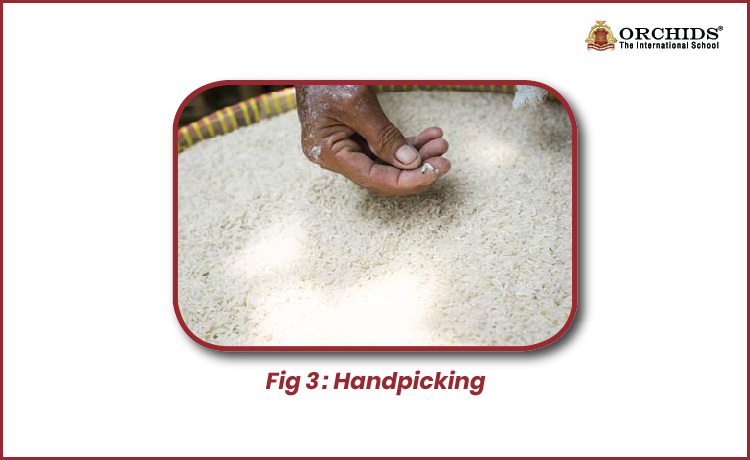
Handpicking is a time-consuming technique; it is not preferred if the quantity of the mixture to be separated is large.
This method can be used when:
• the shape, size or colour of the undesirable component is different from the desirable component.
• The quantity of the undesirable component is less.
• The quantity of the mixture is small.
Sieving
Sieving is a method of separating a mixture of various sized particles by passing them through a suitable sieve. A sieve is a mesh usually fitted into a frame. The mesh allows only particles of a specific size to pass through it. Sieves of different pore sizes are used based on the particle size of the components to be separated.
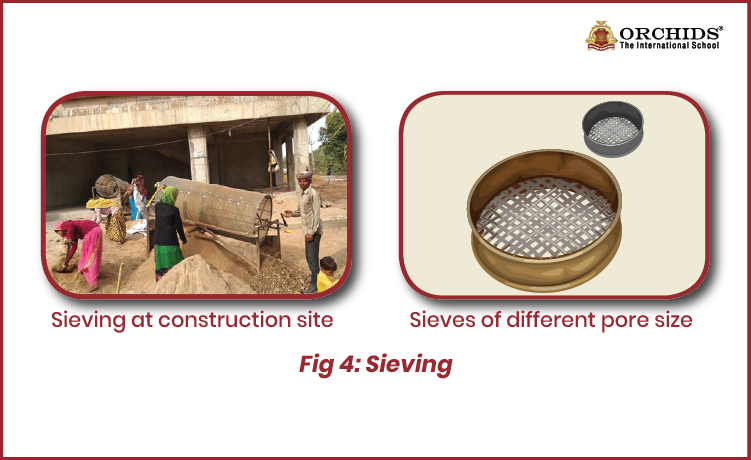
In this method, the smaller component passes through the sieve, and the bigger one remains on the sieve.
For example: Separation of gravel from the sand at a construction site, separation of wheat bran from the flour, etc.
Sieving is used in the following conditions only:
• There is a difference in the particle size of the components.
• The quantity of the mixture is too large.
• The size of the particles of the components is too small to pick up by hand.
Magnetic separation
The process of separation of a mixture using a magnetic force is known as magnetic separation.
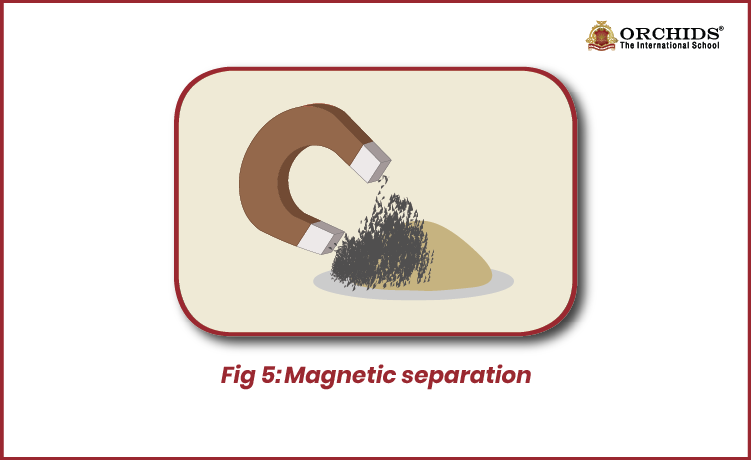
This method is useful to separate a mixture in which one of its components has a magnetic property. If a magnet is placed near the mixture, the component with the magnetic property will stick to the magnet and can be separated easily.
For example: Separation of a mixture of iron filings and sand.
Threshing
Once the crops are harvested, the grains need to be separated from the stalk. Threshing is used to separate the grains from the stalk. Threshing is the process of beating the crops to separate the grains from the stalk. Threshing can be done in the following ways:
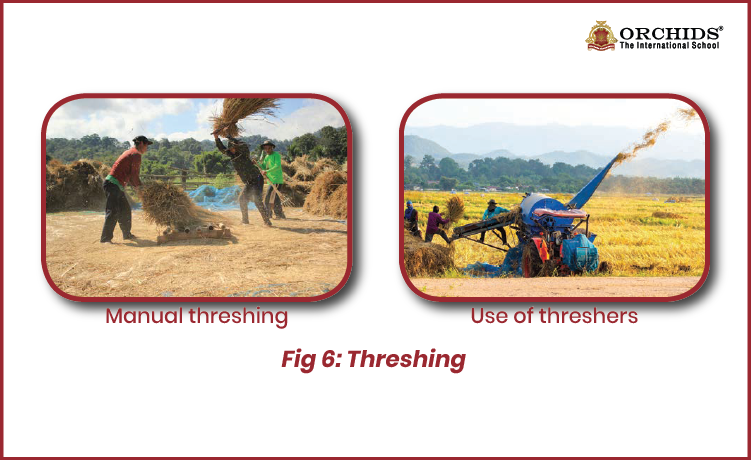
- In manual threshing, a pile of crops is held in the hands and beaten on a rock or a hard surface. This loosens the grains and separates them from the stalks.
• Threshing can also be done by crushing harvested stalks using bullocks and buffaloes.
• Machines used for threshing are called threshers. Machines are normally used when large quantities of grains are to be separated at a time.
Winnowing
The process of separating grains ( heavier components) from chaff ( lighter components) by the action of blowing wind is called winnowing.
This method of separation is based on the difference in the weights of the components to be separated.
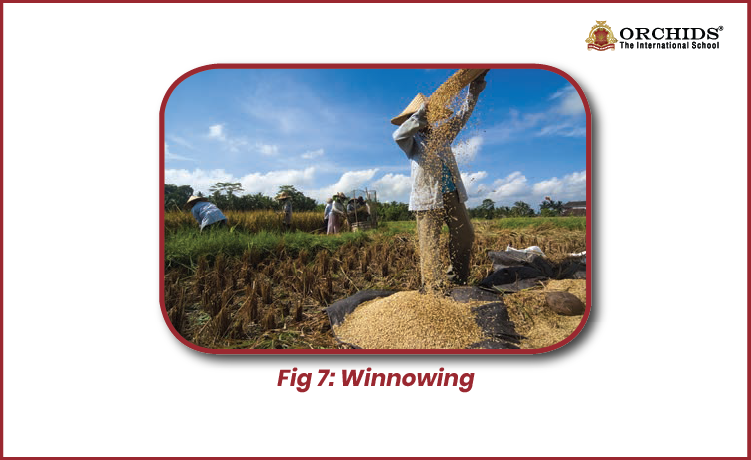
Winnowing is extensively used by the farmers to separate the husk from all type of grains that are covered by husk, such as rice, wheat, etc.
Methods of separation are essential in our daily lives as they help us separate useful substances from unwanted materials. Techniques like handpicking, sieving, magnetic separation, threshing, and winnowing are based on differences in size, weight, and physical properties. Understanding these methods helps students connect science with real-life activities such as cleaning grains or separating sand and stones. These concepts also form a strong base for learning advanced separation techniques in chemistry.
Frequently Asked Questions on Separation of Mixtures for a Solid-Solid Mixture
1. What are the methods of separation of mixtures?
They are techniques used to separate different components of a mixture based on their physical properties.
2. Why do we need different separation methods?
Different mixtures have different properties, so a single method cannot be used for all types of mixtures.
3. What is the handpicking method?
Handpicking is a simple method where unwanted substances are removed manually from a mixture.
4. What is sieving used for?
Sieving is used to separate particles of different sizes by passing them through a mesh or sieve.
5. What is winnowing?
Winnowing is a method used to separate lighter particles from heavier ones using wind or air.
Science isn't just a subject, it's the way of seeing the world. Curious how Orchids The International School teaches it that way? Talk to our admissions team.
Admissions Open for 2026-27
What type of concept pages would you prefer?
CBSE Schools In Popular Cities
- CBSE Schools in Bangalore
- CBSE Schools in Mumbai
- CBSE Schools in Pune
- CBSE Schools in Hyderabad
- CBSE Schools in Chennai
- CBSE Schools in Gurgaon
- CBSE Schools in Kolkata
- CBSE Schools in Indore
- CBSE Schools in Sonipat
- CBSE Schools in Delhi
- CBSE Schools in Rohtak
- CBSE Schools in Bhopal
- CBSE Schools in Aurangabad
- CBSE Schools in Jabalpur
- CBSE Schools in Jaipur
- CBSE Schools in Jodhpur
- CBSE Schools in Nagpur
- CBSE Schools in Ahmednagar
- CBSE School In Tumkur











Orchids The International School is one of India's leading chains of CBSE and ICSE schools, with 110+ schools across the country.