

Aluminium Oxide (Al₂O₃)
Aluminium oxide, or Al₂O₃, may appear as a common white powder. It occurs naturally and is utilised in industries everywhere, and this compound is heavily involved in things we take for granted daily, ranging from electronics to ceramics.
This article provides what aluminium oxide is, how it is structured, its physical and chemical properties, and its useful ways in modern life.
Table of Contents
- What is Aluminium Oxide (Al₂O₃)?
- Structure of Aluminium Oxide
- Properties of Aluminium Oxide
- Chemical Properties of Aluminium Oxide
- Applications of Aluminium Oxide
- Conclusion
- Frequently Asked Questions on Aluminium Oxide (Al₂O₃)

What is Aluminium Oxide (Al₂O₃)?
Aluminium oxide, commonly called alumina, is a naturally occurring white powder made up of aluminium and oxygen. You’ll find it in minerals like bauxite and corundum, and while it may seem ordinary, it plays a huge role in both nature and modern industry.
Whether it’s helping extract aluminium metal or adding durability to ceramics and electronics, aluminium oxide is a quiet workhorse in our everyday lives.
Structure of Aluminium Oxide
At the atomic level, aluminium oxide has a straightforward formula: Al₂O₃ two aluminium atoms per three oxygen atoms. But its structure is anything but simple.
The most solid state is alpha-alumina (α-Al₂O₃). In this state, the atoms are closely packed in a hexagonal close-packed arrangement, with each aluminium surrounded by six oxygen atoms.
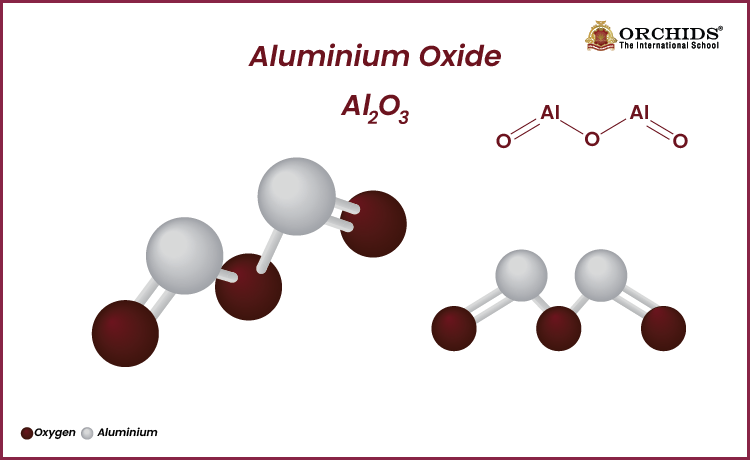
The close, symmetrical structure makes alumina very hard - and that's why it's used to make everything from grinding wheels to spacecraft components.
Properties of Aluminium Oxide
Aluminium oxide is cherished for its distinctive combination of physical and chemical characteristics, which make it applicable in dozens of industries. Here's a glimpse at what makes it so unique:
.webp "Aluminium Oxide")
- Appearance: White, fine, and powdery - nearly chalk-like
- Melting Point: Very high (more than 2000°C)
- Boiling Point: Close to 3000°C
- Hardness: Very resistant - it rates 9 on the Mohs scale (diamond is 10)
- Water Solubility: Not soluble in water
- Conductivity: Not very good at conducting electricity, but excellent at conducting heat
- Stability: Won't react with most substances easily
These characteristics suit alumina for use in high-pressure, high-temperature, or high-strength applications.
Chemical Properties of Aluminium Oxide
One of the interesting facts about aluminium oxide is that it's amphoteric, meaning that it can act like an acid or a base depending on what it's reacting to.
➔ Reacting with Acids
When combined with acids such as hydrochloric acid (HCl), alumina acts as a base and forms salts:
➔ Reaction with Bases
However, when reacting with strong bases like sodium hydroxide (NaOH), it is an acid and yields a compound named sodium aluminate:
➔ Reaction with Water
Interestingly, aluminium oxide is not very reactive with water. That's part of the reason it's so long-lasting; it doesn't rust or dissolve easily.
Applications of Aluminium Oxide
Aluminium oxide may not be on your daily radar, but it's probably making your world work - quietly and dependably. Here are just a few of its day-to-day and industrial applications:
- Refining Aluminium
Al₂O₃ is also a main component of the procedure employed to remove aluminium from bauxite. - Abrasives
Due to its hardness, aluminium oxide is utilised in sandpaper, cutting tools, and even dental drills. - Ceramics
From test tubes to tiles to artificial hip joints, alumina-based ceramics are remarkably durable and resistant to heat - ideal for harsh conditions. - Electronics
Due to its insulating nature, aluminium oxide is widely employed as a barrier material in electronic components and circuit boards. - Medical Devices
Alumina is not only chemically inert but also biocompatible, meaning that it does not react with the human body. - Catalysts
Sometimes it acts as a catalyst itself or stabilises the chemical reactions.
Conclusion
Aluminium oxide is more than a white powder; it's an ingredient that underpins many industries and technologies. From helping to manufacture aluminium to quietly enhancing the capabilities of electronics and ceramics, its impact is felt in everything from smartphones to space exploration.
Frequently Asked Questions on Aluminium Oxide (Al₂O₃)
1. What is Al₂O₃?
Al₂O₃, also called aluminium oxide, is a white, crystalline compound made of aluminium and oxygen. It's widely used in ceramics, polishing, and even as an insulator.
2. What is aluminium oxide Al₂O₃ used for?
Aluminium oxide is used in everything from toothpaste and sandpaper to electronics and medicine. Its hardness and resistance to heat make it incredibly versatile.
3. What is the importance of aluminium oxide?
Aluminium oxide is vital in making everything from scratch-resistant glass to electronic chips. It’s strong, heat-resistant, and incredibly useful in both industry and medicine.
4. Does aluminium oxide react with water?
No, aluminium oxide doesn’t react with water under normal conditions. It’s quite stable, which is why it’s used to protect aluminium surfaces from rusting.
5. What are some interesting facts about aluminium oxide?
Aluminium oxide is the same material that makes rubies and sapphires sparkle! It’s also used in toothpaste as a gentle abrasive for polishing teeth.
6. Is aluminium oxide flammable?
Not at all, aluminium oxide is non-flammable. In fact, its high melting point makes it perfect for heat-resistant applications like furnace linings.
Science isn't just a subject, it's the way of seeing the world. Curious how Orchids The International School teaches it that way? Talk to our admissions team.
Admissions Open for 2026-27
What type of concept pages would you prefer?
CBSE Schools In Popular Cities
- CBSE Schools in Bangalore
- CBSE Schools in Mumbai
- CBSE Schools in Pune
- CBSE Schools in Hyderabad
- CBSE Schools in Chennai
- CBSE Schools in Gurgaon
- CBSE Schools in Kolkata
- CBSE Schools in Indore
- CBSE Schools in Sonipat
- CBSE Schools in Delhi
- CBSE Schools in Rohtak
- CBSE Schools in Bhopal
- CBSE Schools in Aurangabad
- CBSE Schools in Jabalpur
- CBSE Schools in Jaipur
- CBSE Schools in Jodhpur
- CBSE Schools in Nagpur
- CBSE Schools in Ahmednagar
- CBSE School In Tumkur











Orchids The International School is one of India's leading chains of CBSE and ICSE schools, with 110+ schools across the country.