

What is Metal? Properties, Types and Examples Explained
Metals are an essential part of our everyday lives, right from the utensils in our kitchen to the vehicles we travel in. But what exactly makes metals so special, useful, and widely used? Metals are solid, shiny, and strong materials that are naturally found in the Earth’s crust. Interestingly, because of this, they are known for their ability to conduct heat and electricity, which is why they are used everywhere from cooking utensils to electric wires.
This article focuses on the metals in the simplest form, along with their types and properties, explained with our daily life examples.
Table of Contents
- What Are Metals
- Types of Metals
- Physical Properties of Metals
- Chemical Properties of Metals
- List of All Metals
- Uses of Metals
- Frequently Asked Questions on Metals

What Are Metals?
Metals are naturally occurring elements found deep within the Earth’s crust, usually in the form of ores. But how are they processed? The fact that these ores are mined and processed to extract pure metals.
The simplest metals are inorganic, meaning they are not formed from living organisms. They usually have a shiny appearance, are solid at room temperature (except mercury), and possess strong physical and chemical properties that make them useful in almost every industry.
But how does the Occurrence of Metals in nature happen?
Metals are found in two forms:
• Native State: Unreactive metals like gold and silver exist freely in nature.
• Combined State in which reactive metals like aluminium, iron, and sodium exist as compounds.
• Mineral Ores, like rocks containing high amounts of metal compounds, are called ores.
Let's have a closure on the key points about metals:
- Most metals are shiny or lustrous.
- Almost all are solid at room temperature.
- They are strong, durable, and good conductors of heat and electricity.
- Many metals occur mixed with other elements in ores, not in pure form.
Some common metals we use daily include:
- Iron is used for tools, machinery, and buildings
- Copper is used in wires, utensils, and electrical parts
- Gold and Silver in jewellery, coins, and electronic components
- Aluminium in cans, utensils, aeroplane parts
- Zinc in batteries, galvanising iron
- Magnesium in firecrackers, alloys
Some Special Cases:
- Sodium & Potassium are soft metals cut with a knife
- Mercury is the only liquid metal at room temperature
Also Learn: Non Metals
Types of Metals
Apart from the fact that how we see metals is not enough, these metals are classified into four more
- Some metals, like ferrous metals (iron, steel), are magnetic and used for building strong structures.
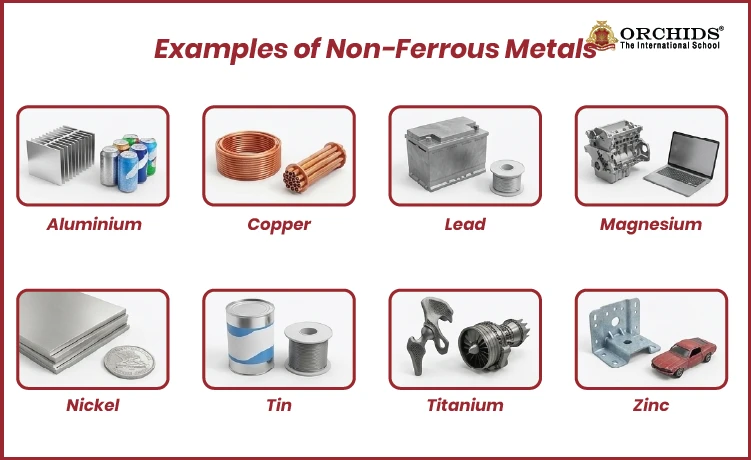
- Non-ferrous metals such as copper and aluminium resist rust and are lightweight, making them perfect for wiring or aircraft.
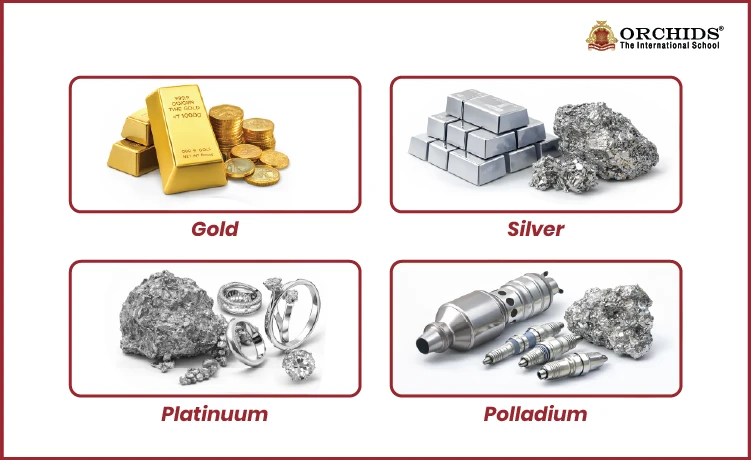
- Precious metals, gold, silver, and platinum are prized for beauty and rarity.
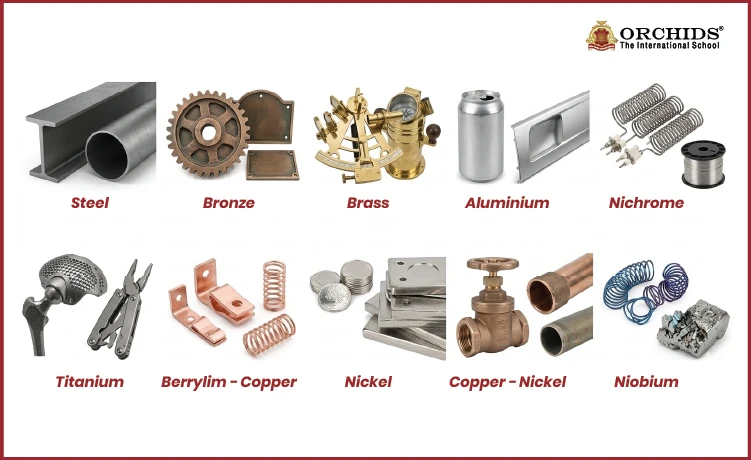
- Alloys, mixtures like bronze or stainless steel, combine strengths for specialised purposes.
Physical Properties of Metals
Metals show certain characteristic physical features that make them unique:
• Lustre that is metals have a shiny appearance when polished. This is why gold and silver are used in jewellery.
• Most metals are hard and cannot be broken easily. Iron and copper are classic examples.
(Exceptions: Sodium and potassium are soft enough to be cut with a knife.)
• It's the property of metals called malleability, in which Metals can be hammered into thin sheets without breaking.
Example: Aluminium foil.
• The property ductility, in which Metals can be stretched into thin wires.
Example: Copper and aluminium wires used in electrical circuits.
• The fact that Metals are excellent conductors of heat and electricity.
This is why cooking utensils and electrical cables are made of metals.
• Metals show High Melting and Boiling Points as they require a lot of heat energy to melt.
Example: Iron melts at around 1538°C.
• Most metals have high density, meaning they are heavy for their size.
Chemical Properties of Metals
• Reaction with Oxygen: Metals react with oxygen to form metal oxides.
Example:
Magnesium + Oxygen → Magnesium oxide
• Reaction with Water: Some metals react vigorously (like sodium), some slowly (like iron), and some not at all (like copper).
• Reaction with Acids: Metals react with acids to form salt and hydrogen gas.
Example:
Zn + HCl → ZnCl₂ + H₂↑
• Reaction with Bases: Certain metals react with strong bases (like NaOH) to form complex compounds.
• Reactivity Trend: Highly reactive metals react more quickly and vigorously compared to less reactive ones. This is explained by the Activity Series.
List of All Metals
| S.No | Atomic Number | Symbol | Metal Element |
| 1 | 3 | Li | Lithium |
| 2 | 4 | Be | Beryllium |
| 3 | 11 | Na | Sodium |
| 4 | 12 | Mg | Magnesium |
| 5 | 13 | Al | Aluminium |
| 6 | 19 | K | Potassium |
| 7 | 20 | Ca | Calcium |
| 8 | 21 | Sc | Scandium |
| 9 | 22 | Ti | Titanium |
| 10 | 23 | V | Vanadium |
| 11 | 24 | Cr | Chromium |
| 12 | 25 | Mn | Manganese |
| 13 | 26 | Fe | Iron |
| 14 | 27 | Co | Cobalt |
| 15 | 28 | Ni | Nickel |
| 16 | 29 | Cu | Copper |
| 17 | 30 | Zn | Zinc |
| 18 | 31 | Ga | Gallium |
| 19 | 37 | Rb | Rubidium |
| 20 | 38 | Sr | Strontium |
| 21 | 39 | Y | Yttrium |
| 22 | 40 | Zr | Zirconium |
| 23 | 41 | Nb | Niobium |
| 24 | 42 | Mo | Molybdenum |
| 25 | 43 | Tc | Technetium |
| 26 | 44 | Ru | Ruthenium |
| 27 | 45 | Rh | Rhodium |
| 28 | 46 | Pd | Palladium |
| 29 | 47 | Ag | Silver |
| 30 | 48 | Cd | Cadmium |
| 31 | 49 | In | Indium |
| 32 | 50 | Sn | Tin |
| 33 | 55 | Cs | Cesium |
| 34 | 56 | Ba | Barium |
| 35 | 57 | La | Lanthanum |
| 36 | 58 | Ce | Cerium |
| 37 | 59 | Pr | Praseodymium |
| 38 | 60 | Nd | Neodymium |
| 39 | 61 | Pm | Promethium |
| 40 | 62 | Sm | Samarium |
| 41 | 63 | Eu | Europium |
| 42 | 64 | Gd | Gadolinium |
| 43 | 65 | Tb | Terbium |
| 44 | 66 | Dy | Dysprosium |
| 45 | 67 | Ho | Holmium |
| 46 | 68 | Er | Erbium |
| 47 | 69 | Tm | Thulium |
| 48 | 70 | Yb | Ytterbium |
| 49 | 71 | Lu | Lutetium |
| 50 | 72 | Hf | Hafnium |
| 51 | 73 | Ta | Tantalum |
| 52 | 74 | W | Tungsten |
| 53 | 75 | Re | Rhenium |
| 54 | 76 | Os | Osmium |
| 55 | 77 | Ir | Iridium |
| 56 | 78 | Pt | Platinum |
| 57 | 79 | Au | Gold |
| 58 | 80 | Hg | Mercury |
| 59 | 81 | Tl | Thallium |
| 60 | 82 | Pb | Lead |
| 61 | 83 | Bi | Bismuth |
| 62 | 84 | Po | Polonium |
| 63 | 87 | Fr | Francium |
| 64 | 88 | Ra | Radium |
| 65 | 89 | Ac | Actinium |
| 66 | 90 | Th | Thorium |
| 67 | 91 | Pa | Protactinium |
| 68 | 92 | U | Uranium |
| 69 | 93 | Np | Neptunium |
| 70 | 94 | Pu | Plutonium |
| 71 | 95 | Am | Americium |
| 72 | 96 | Cm | Curium |
| 73 | 97 | Bk | Berkelium |
| 74 | 98 | Cf | Californium |
| 75 | 99 | Es | Einsteinium |
| 76 | 100 | Fm | Fermium |
| 77 | 101 | Md | Mendelevium |
| 78 | 102 | No | Nobelium |
| 79 | 103 | Lr | Lawrencium |
| 80 | 104 | Rf | Rutherfordium |
| 81 | 105 | Db | Dubnium |
| 82 | 106 | Sg | Seaborgium |
| 83 | 107 | Bh | Bohrium |
| 84 | 108 | Hs | Hassium |
| 85 | 109 | Mt | Meitnerium |
| 86 | 110 | Ds | Darmstadtium |
| 87 | 111 | Rg | Roentgenium |
| 88 | 112 | Cn | Copernicium |
| 89 | 113 | Nh | Nihonium |
| 90 | 114 | Fl | Flerovium |
| 91 | 115 | Mc | Moscovium |
| 92 | 116 | Lv | Livermorium |
Uses of Metals
Your competitor is missing this section; adding it makes your page more useful.
1. In Construction, Iron, steel, and aluminium are used in buildings, bridges, and railways.
2. In Transport Cars, aeroplanes, ships, and bicycles use metal parts.
3. In Electrical Appliances, Copper and aluminium wires conduct electricity.
4. In Jewellery, Gold, silver, and platinum are used for ornaments.
5. In Healthcare, titanium and stainless steel are used in surgical tools.
6. In the Kitchen, ironn, steel, and aluminium are used for cookware and utensils.
7. In technology, Metals like silicon (metalloid), gold, and copper are used in electronics.
We learned that metals are among the most valuable resources on Earth. Their unique physical and chemical properties make them essential across industries, from construction and transportation to electronics and healthcare. With this detailed and student-friendly guide, learning about metals becomes simple, engaging, and highly exam-ready.
Frequently Asked Questions on Metals
1. What are 10 facts about metals?
Metals are shiny, strong, and great conductors of heat and electricity, which makes them super useful in everyday life. These 10 facts about metals usually highlight their properties, uses, and how they behave in different conditions.
2. Who is the king of metals?
The king of metals is the one known for its unmatched shine, durability, and high value. This title is often given based on its status, rarity, and importance in history.
3. What are the 10 importances uses of metals?
The 10 importance of metals usually focus on how they support construction, transportation, technology, and daily tools. These points show why metals are essential for our modern world.
4. What is metal made of?
Metal is made of tightly packed atoms arranged in a crystal-like structure, which gives it strength and conductivity. Its composition depends on the element or alloy it belongs to.
5. What is the type of metal?
The type of metal is usually classified as ferrous or non-ferrous depending on whether it contains iron. These types help us understand how each metal is used in real-world applications.
6. What is the strongest metal?
The strongest metal is known for its exceptional toughness and ability to handle extreme pressure without breaking. This title depends on the type of strength being measured: hardness, tensile strength, or durability.
Science isn't just a subject, it's the way of seeing the world. Curious how Orchids The International School teaches it that way? Talk to our admissions team.
Admissions Open for 2026-27
What type of concept pages would you prefer?
CBSE Schools In Popular Cities
- CBSE Schools in Bangalore
- CBSE Schools in Mumbai
- CBSE Schools in Pune
- CBSE Schools in Hyderabad
- CBSE Schools in Chennai
- CBSE Schools in Gurgaon
- CBSE Schools in Kolkata
- CBSE Schools in Indore
- CBSE Schools in Sonipat
- CBSE Schools in Delhi
- CBSE Schools in Rohtak
- CBSE Schools in Bhopal
- CBSE Schools in Aurangabad
- CBSE Schools in Jabalpur
- CBSE Schools in Jaipur
- CBSE Schools in Jodhpur
- CBSE Schools in Nagpur
- CBSE Schools in Ahmednagar
- CBSE School In Tumkur











Orchids The International School is one of India's leading chains of CBSE and ICSE schools, with 130+ schools across the country.