

All About Rust Formula (Fe₂O₃·xH₂O)
Rusting is one of the most common chemical changes we observe in our everyday lives. It is a slow process where iron reacts with oxygen and moisture from the environment to form a reddish-brown flaky substance. This rust not only makes objects look worn out but also weakens the metal over time. It is a clear example of a chemical change.
The article provides clear insight into what rust formula, prevention and more in a neat, detailed manner.
Table of Contents
- What Causes Rusting?
- Why is Rusting Considered a Chemical Change?
- How Do We Prevent Rusting of Iron?
- Frequently Asked Questions on Rust

What Causes Rusting?
Have you ever wondered how the things around us, materials containing iron like suitcases, taps, pipes and more turn reddish brown? Rusting mainly occurs when iron is exposed to:
- Water (moisture in the air)
- Oxygen (from the atmosphere)
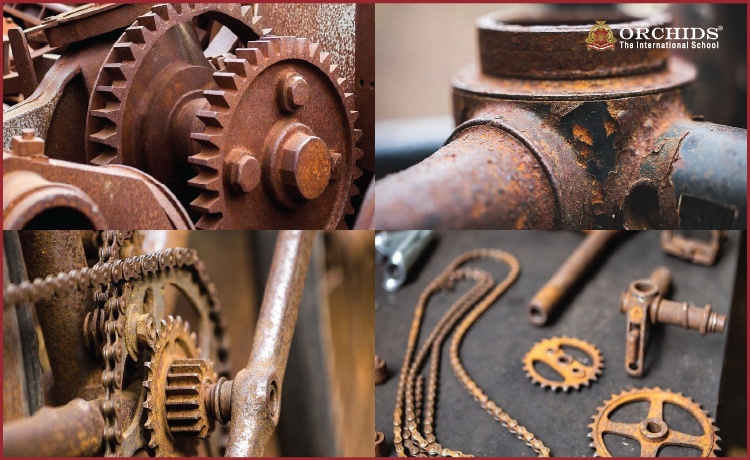
When both water and oxygen come into contact with the surface of iron, a chemical reaction takes place, leading to the formation of iron oxide.
The resultant reaction takes place like this :
4Fe + 3O₂ + 6H₂O → 4Fe(OH)₃
This compound eventually dehydrates to form Fe₂O₃·xH₂O, commonly known as rust, also known as the rusting of iron formula.
Why is Rusting Considered a Chemical Change?
Rusting is classified as a chemical change due to the following reasons:
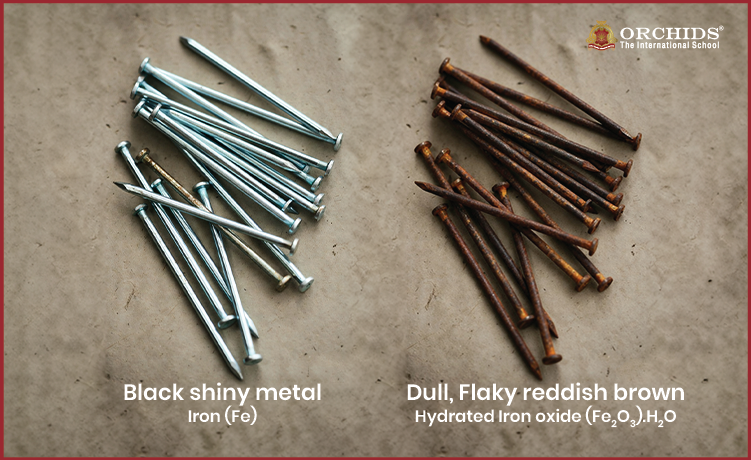
First, we need to understand how a chemical change is identified:
- A new substance (iron oxide) is formed.
- The change is irreversible under normal conditions.
- It alters the physical and chemical properties of the original metal.
- Energy is either absorbed or released during the process.
- Unlike physical changes, which are generally reversible, chemical changes result in the formation of one or more new substances.
Rusting fits all the characteristics of a chemical change.
How Do We Prevent Rusting of Iron?
Rusting can be highly damaging, especially to infrastructure, vehicles, and tools. Fortunately, there are several methods to prevent or slow down the process of rust formation:
1. Painting is a very useful technique. We have seen that coating iron surfaces with paint prevents air and moisture from coming into contact with the metal.
This method is commonly used for fences, gates, machinery, and household items.
2. Greasing or Oiling is a quick method to prevent rusting by applying grease or oil on iron surfaces, which forms a protective layer.
It is widely used in tools, bicycle chains, and machine parts to avoid exposure to water and air.
3. Galvanisation; the most followed technique. In this process, a thin layer of zinc is applied to iron or steel.
Interestingly, what happens is that Zinc acts as a protective shield and, even if scratched, continues to offer protection due to its sacrificial nature.
4. Electroplating; Iron can be coated with a layer of another non-reactive metal like chromium or nickel, through electrochemical methods. This enhances the appearance and also prevents rusting.
5. Alloying is another technique used in which mixing iron with other metals to form alloys (e.g., stainless steel) helps resist rust. Stainless steel, which contains chromium, forms a passive layer that prevents corrosion.
Till now, we have known that rusting of iron is more than just a surface problem; it leads to loss of strength and durability of metal objects. Being a chemical change, it alters the original properties of iron and leads to permanent damage if left unchecked. Preventing rust is essential in preserving the longevity and utility of iron products. By using methods like painting and more.
Frequently Asked Questions on Rust
1. Why is rusting significant?
Rusting is a natural reminder of the way metals behave when they come in contact with water and oxygen. Knowing this keeps our bridges, cars, and buildings from being damaged.
2. What are the significant factors for rusting?
Rusting requires iron, water, and oxygen to initiate it. Even a small drop of water can set the process in motion over time.
3. What leads to rusting?
Rusting results from the reaction of iron with oxygen in the presence of water to give reddish‑brown iron oxide.
4. Mention the methods for the Prevention of rusting?
Prevention of Rusting by painting, oiling, galvanising, or coating metals, excluding air and moisture.
5. Why do certain metals not rust?
Metals such as aluminium, stainless steel, and gold do not rust because they naturally develop protective layers or do not react with oxygen readily.
6. Why does salt water accelerate rusting?
Salt water accelerates rusting because salt is an electrolyte, allowing iron to lose electrons and corrode more quickly.
7. What is the chemical formula of rust?
Rust is mainly iron(III) oxide, which forms when iron reacts with oxygen and water. Its chemical formula is Fe₂O₃·xH₂O, showing it contains water molecules in its structure.
Science isn't just a subject, it's the way of seeing the world. Curious how Orchids The International School teaches it that way? Talk to our admissions team.
Admissions Open for 2026-27
What type of concept pages would you prefer?
CBSE Schools In Popular Cities
- CBSE Schools in Bangalore
- CBSE Schools in Mumbai
- CBSE Schools in Pune
- CBSE Schools in Hyderabad
- CBSE Schools in Chennai
- CBSE Schools in Gurgaon
- CBSE Schools in Kolkata
- CBSE Schools in Indore
- CBSE Schools in Sonipat
- CBSE Schools in Delhi
- CBSE Schools in Rohtak
- CBSE Schools in Bhopal
- CBSE Schools in Aurangabad
- CBSE Schools in Jabalpur
- CBSE Schools in Jaipur
- CBSE Schools in Jodhpur
- CBSE Schools in Nagpur
- CBSE Schools in Ahmednagar
- CBSE School In Tumkur











Orchids The International School is one of India's leading chains of CBSE and ICSE schools, with 110+ schools across the country.